


 1 Photo
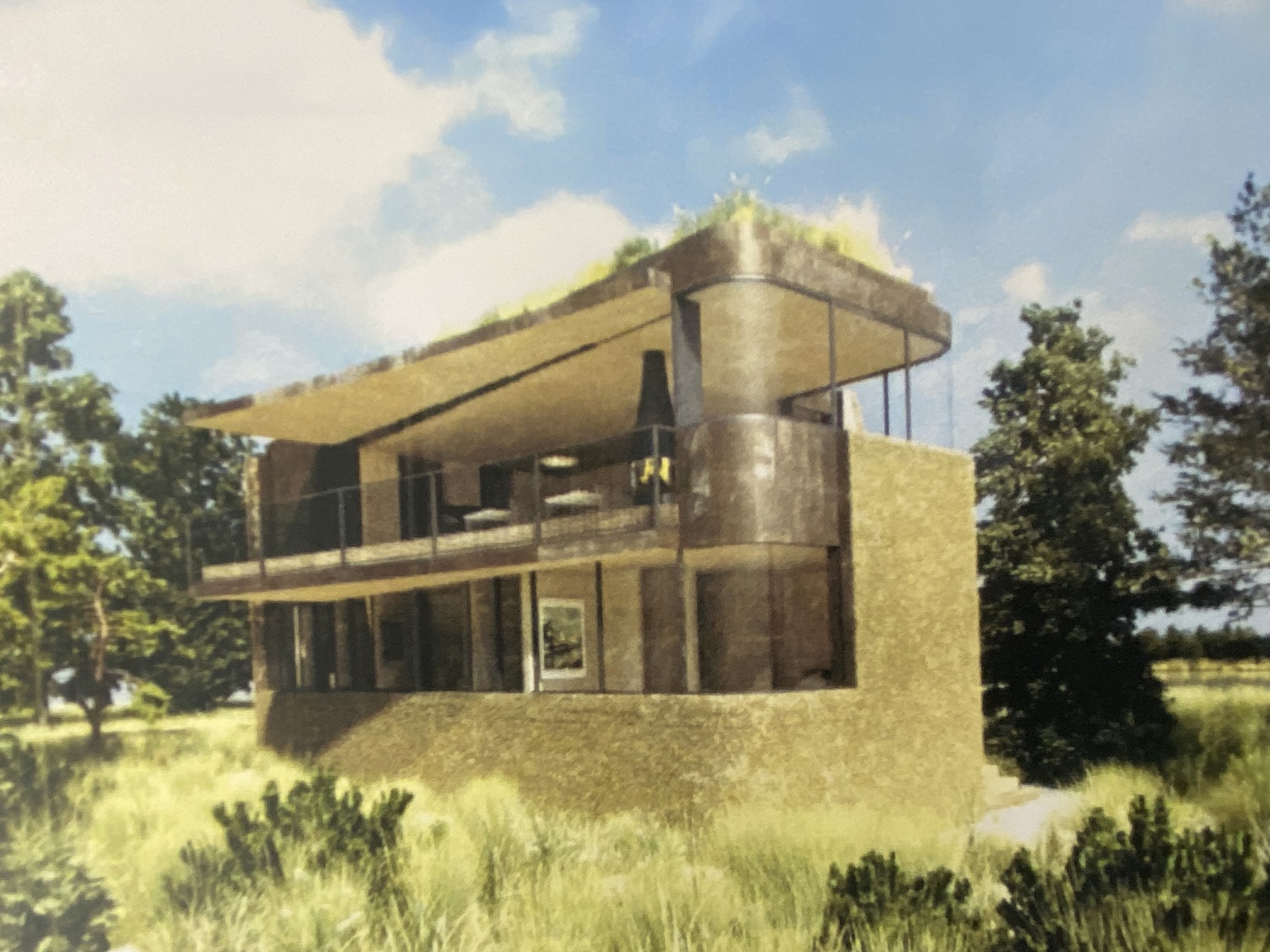
A rendering of the proposed house.
The Sag Harbor Village Harbor Committee made it official last week, formally granting a wetlands permit to Cheryl and Blair Effrons’ Pumpkin Partners LLC after more than two years of resistance.
The vote was 4-1 at the committee’s monthly meeting on November 7, with former board Chairman Will Sharp voting “no.”
The permit allows the Effrons to build a two-story house with 1,562 square feet of total habitable space, 800 on the first floor, at 22 Long Point Road in Sag Harbor, about 50 feet from wetlands — 25 feet closer than the village code’s minimum wetlands setback of 75 feet.
The house, which will feature a “green” vegetated roof and an I/A nitrogen-reducing septic system, will stand on a sandy 1-acre parcel between Ligonee Creek and Morris Cove that shrinks to about a half-acre of upland (24,000 square feet) at high tide. More than 15,000 square feet of the site will be conserved as a wetlands buffer. The Effrons, who have a large house on a separate parcel next door, have said they plan to use it as a guesthouse.
The house will have two bedrooms and two-and-a-half bathrooms, one less of each than proposed, according to a compromise pitched last month by recently appointed board Chair Herbert Sambol. Committee members who had vocally opposed the application from the beginning — Mary Ann Eddy, John Parker and Sharp, as chairman at the time — reluctantly said they that they would agree to deal because they had been advised they could not legally deny the application.
As Sambol noted in October, the panel’s legal and environmental advisors have told board members that the property is a legally “buildable lot” and that the wetlands code has provisions for granting applications when wetlands setbacks cannot be met if adequate mitigating measures are offered.
The parcel was created through a subdivision map of the Long Point Road peninsula filed with the county in 1979. Until last month, Parker, Eddy and Sharp had argued either that no house should be built on a lot so constrained by wetlands or that Pumpkin Partners should reduce its size to the bare minimum allowed by zoning, which Sharp has argued is 800 square feet on one floor.
After that informal consensus was reached in October, the committee’s environmental consultant, Brant A. Reiner of the firm Nelson Pope Voorhis, drafted a proposed decision for the board to consider at last week’s monthly meeting.
Explaining why he would vote “no,” Sharp said the applicant “has not convinced me they have the right to double” what he believes is the zoning code’s minimum house size of 800 square feet of habitable space on one floor.
In its written decision, the board appears to interpret the code’s 800-square-foot house minimum as applicable to “the ground floor” only, rather than an overall limit.
While Sharp has argued that the applicants should have reduced the size of the house to the minimum allowed by the zoning code, their attorney, Mary Jane Asato, and environmental counsel, Michael Schiano, have countered that it was already as small as “practicable,” the term used in the wetlands code for appropriate alternatives when setbacks cannot be met.
Before the vote last week, board member John Parker balked at language in the written decision indicating that the applicants had shown through “a series of scientific studies” that the project would not “adversely impact marine life.”
“You can’t convince me there’s no impact” on water quality, Parker said. He asked for language acknowledging that the applicants had made efforts to “reduce the impact” of the project. Reiner and the board’s legal counsel agreed to making the change, which was included as a condition of the decision, as was the filing of revised plans showing the required reduction in the number of bedrooms and bathrooms.


