


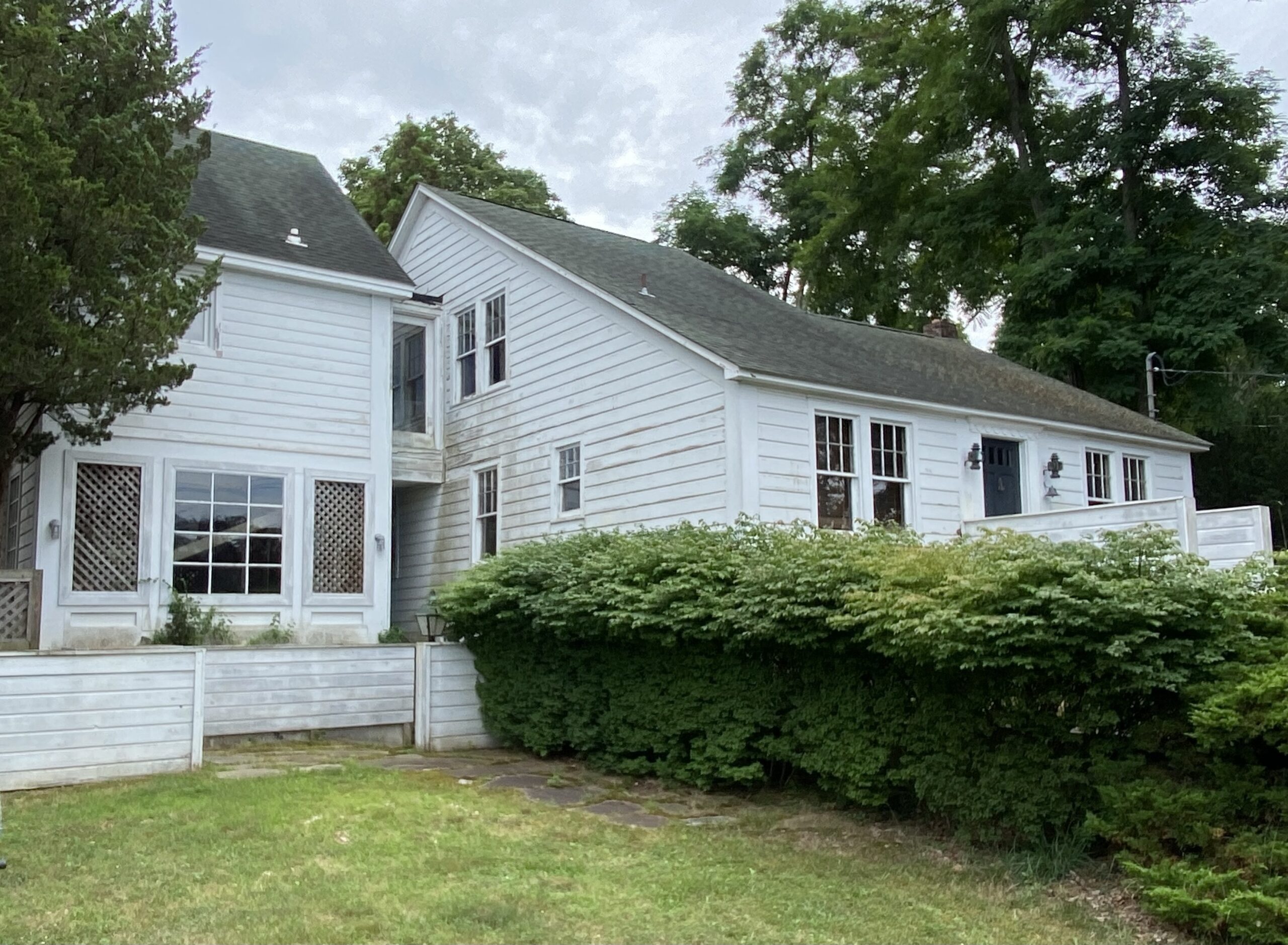
 1 Photo
The Sag Harbor Yacht Club is considering demolishing the house it owns across the street at 42 Bay Street to make way for a new clubhouse for its new affiliated organization, the Maycroft Club. PETER BOODY
The Sag Harbor Yacht Club now may demolish instead of restore an officially “historic” but shabby house it owns at 42 Bay Street and build a new structure to serve as headquarters for its spin-off organization, the Maycroft Club.
The club’s attorney and board member, Dennis Downes, told Sag Harbor’s Historic Preservation and Architectural Review Board during an informal discussion on July 28 that the house is in too poor condition to salvage. He listed a buckled first floor, a roof that has been leaking for years and beams in the basement that “do not meet code” among its deficiencies.
With architectural and site plans for a new structure yet to be finalized, he asked the board for “guidance” on the question of whether or not the club can bulldoze the building, which is listed in the Sag Harbor Historic District’s nominating inventory as a historic structure. The original section dates to 1930. An addition with no foundation and a barn-like rear studio were added in a 1980 expansion, Downes said.
“How does that go into the formula?” for including a building as a “contributing structure” in the historic district, Downes asked. “All the others are from the 1800s. I couldn’t find why it was included as a historic house.”
“A house only needs to be 50 years to be contributing,” commented board Chairman Steve Williams.
After an inspection of the property last year, the board’s historic consultant, Zachary Studenroth, reported that “little remains unaltered of the original structure,” which compromised its integrity as an historic building.
Board member Bethany Deyermond noted the club initially had not planned for a demolition.
Then “we found out how bad the building was,” Downes responded.
No board member raised any alarm bells at the prospect. “We’re anxious to get going,” Downes said, and added that he would file an application with full plans for the project at a future meeting. He said the club was “not opposed to keeping the old section” of the house. “One architect recommends demolishing it. One recommended working around it,” Downes added.
The Maycroft Club is a social club that will seek to “preserve the maritime history of Sag Harbor” and will display “a lot of artifacts” now in storage across Bay Street at the Sag Harbor Yacht Club, Downes said.
In another case on July 28, the board took little time coming to a decision to approve the demolition of an existing house — not historic, and not in the historic district, but for many years the home of former village trustee and ambulance volunteer Ed Gregory — at 62 Joels Lane and the construction of a new 3,600-square-foot residence there.
The board also quickly granted Romany Kramoris permission to install two new “egress” windows on the south side of the building containing her gallery on the first floor at 41 Main Street to legalize an upstairs apartment.
The board deferred making a quick “emergency” decision in the case of 18 Hampton Street to allow asphalt shingles rather than the cedar shingles usually required for new roofs on 19th-century historic structures. The owner is claiming financial hardship. The board, three of whose members appeared to oppose the request, agreed to ask for a sample shingle before making a decision.
It was announced at the meeting that controversial plans for three new houses on vacant parcels on Marsden Street, within the Sag Harbor Historic District, had been withdrawn after having appeared for more than a year on biweekly meeting agendas only to be tabled each time at the applicant’s request.
Sag Harbor builder Pat Trunzo’s plan to develop the properties, which his family has owned for half a century and subdivided in the 1980s, has faced stiff resistance from neighbors and board members since it was first aired in 2019.
The withdrawal doesn’t mean the project is dead. Trunzo said in a voicemail message that he had no choice but to withdraw the three pending projects because the village does not allow unlimited postponements while his architect works to revise the plans. It is a challenge to keep the floor plans intact while reducing the size of each house “somewhat,” he said, adding. “We’ll be back.”
The critics have said the proposed houses, at 6,000 square feet of floor area, are too massive for the neighborhood. Trunzo has countered that they are appropriate to the size of their three-quarter-acre lots and conform to all zoning requirements.
The last time the project was aired before the board, in late 2021, then Chairwoman Jeanne Kane told Trunzo he needed to rethink the project so the development would not seem like “a neighborhood that has just been plopped down” into the community.
Also at the July 28 meeting, the HPARB:
• Approved the renovation and expansion of the house at 110 Division Street and addition of an in-ground pool.
• Granted permission to remove a potentially dangerous tree at 22 Howard Street.
• Informally discussed plans to demolish all the structures at 100 Glover Street, with no indication of opposition.


