


 8 Photos
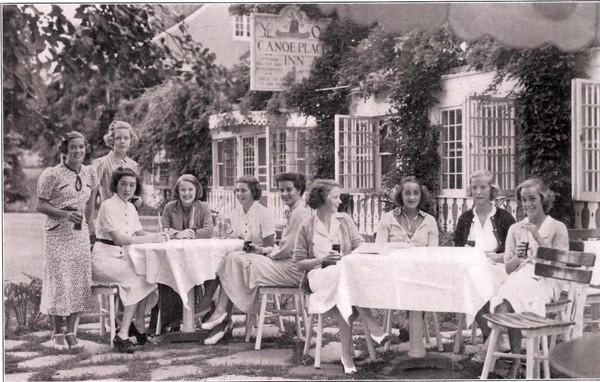
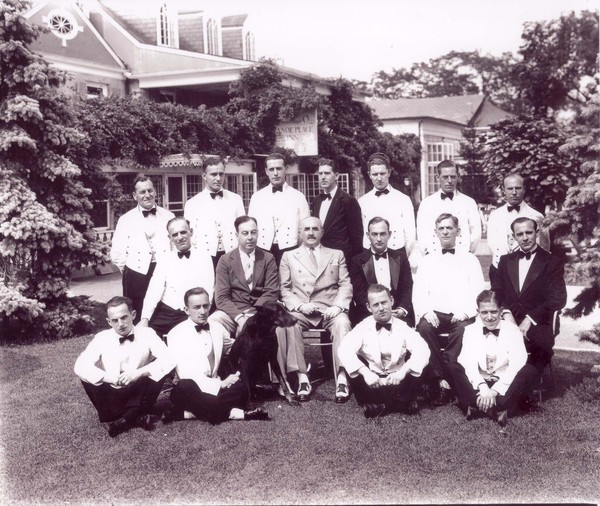


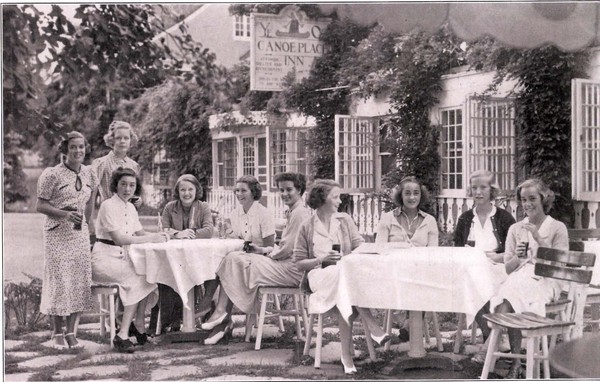
HAMPTON BAYS—If developers follow through on threats to demolish the Canoe Place Inn, they would be tearing down a structure with a rich and colorful history, despite the fact that the Montauk Highway building has never earned the distinction of being an official historic landmark.
The original Canoe Place Inn, which burned to the ground on July 5, 1921, predated the Revolutionary War, and both that building and its four-story replacement, constructed in 1922, were visited by scores of famous guests spending time in the Hamptons. And, according to some locals, ghostly apparitions still often appear from behind the inn’s weathered windows, just as they have done over the past three-plus centuries.
According to Brenda Berntson, president of the Hampton Bays Historical and Preservation Society, the current Canoe Place Inn, even at 88 years old, could very well be the “oldest hostelry” on Long Island, as well as the most historic structure in Hampton Bays and, possibly, all of Southampton Town. Her organization’s records show that the original building was constructed sometime between 1635 and 1640, and redesigned circa 1750. It was later used as a headquarters for British army officers during the Revolutionary War, which began in 1775.
The land the inn stands on was bought by Jeremiah Culver, the son of one of the earliest settlers of Hampton Bays, in 1739, according to the Historical Society’s records. Mr. Culver lived in a house on the property until after the Revolutionary War, which ended in 1783. The property was called the “Canoe Place” because it was a popular location for Native Americans to launch their canoes and access Shinnecock Bay. The area was also a popular spot for stagecoach drivers and Pony Express riders, according to records.
In 1902, the Canoe Place Inn was owned by the Buchmuller family, owners of the Waldorf Astoria in Manhattan. According to the Historical Society, Ernest Buchmuller decided how much a person would pay to stay at the inn based on the model of car that they drove.
The inn was under the ownership of Julius Keller in 1917 when it became a popular destination for celebrities, such as actresses Helen Hayes and Lucille Ball, and politicians including former President Franklin Delano Roosevelt. At that time, the inn also boasted its own Long Island Rail Road train stop so guests traveling from the west could walk to the building. Canoe Place Inn was also a popular destination during Prohibition from 1920 to 1933, as its shelves were steadily stocked by bootleggers, according to Historical Society records.
On July 5, 1921, the original Canoe Place Inn burned to the ground and the source of the fire was traced back to the kitchen, according to Ms. Berntson. A New York Times article from the day after the fire stated that two employees—Florence Whittington, a maid, and Richard Heineman, a cashier—died in the blaze and three guests, as well as a maid, jumped out of windows to escape their deaths. According an article in Connecticut’s Naugatuck Daily News, dated July 5, 1921: “The bodies were found in the ruins. Ms. Whittington appeared at a third floor window but onlookers were powerless to save her. The fire caused $50,000 loss.”
The room where Ms. Whittington met her demise is one at the center of speculation regarding a ghostly light and figure that supposedly haunts the building to this day. Hampton Bays Historical Society Trustee Joe Giaquinto, a paranormal investigator who lives in the hamlet, said that while he has never seen spirits there himself, he is familiar with the building’s reputation for paranormal activity.
“I don’t have any specific personal knowledge of the spirits of the Canoe Place Inn,” Mr. Giaquinto said. “I have heard that it’s haunted, I would love an opportunity to investigate. “[I’ve heard of] strange things going on—slamming doors, apparitions.”
A year after the fire, the inn was rebuilt as it appears today, on the foundation of the original structure, according to Ms. Berntson. Still, some believe that the spirit of Ms. Whittington continues to haunt the inn; according to folklore, strange light is often seen coming from windows on the now vacant second and third floors, including near the window where she was standing during the last minutes of her life.
The rebuilt inn opened its doors sometime in 1922 and, since then, has hosted a variety of entertainers including Duke Ellington, Jefferson Starship, Jon Bon Jovi, Billy Joel and The Ramones, according to the society.
For many longtime Hampton Bays residents, the Canoe Place Inn was a place to attend school proms, weddings and reunions. For Ms. Berntson, a former Girl Scout, the structure still holds special significance. “My fellow Scouts and I were awed to be able to use the ballroom for our event,” she said. “Memories, to me, are why the Canoe Place Inn matters.”
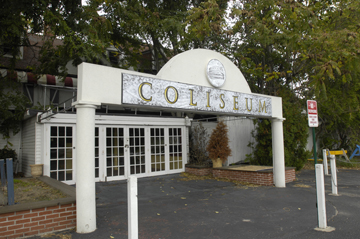
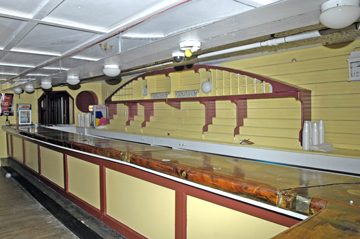
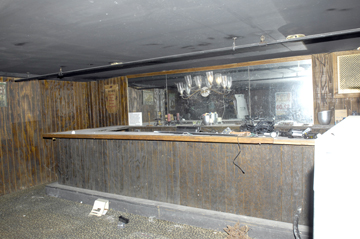
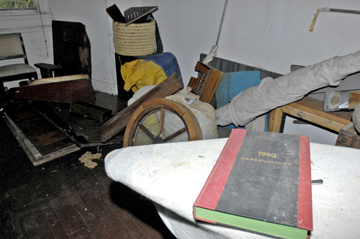
The inn is a relic and, recently, one that is showing its age. A recent walk-through of the building, whose first floor has served as a nightclub, revealed abandoned rooms, mattresses ripped apart by raccoons and a crumbling interior, including a collapsing floor. Dirty clothes, broken suitcases and human feces—left behind by squatters who often seek shelter inside the inn’s 28 guest rooms—were strewn about the building’s second and third floors, which lack electricity. The inn’s old suite are the only rooms that occupy the fourth floor. Also, vines have made their way through windows, doors sag off their hinges and decades-old dust fills the air, making it hard to breathe.
Yet, despite of its current condition, Ms. Berntson and other hamlet residents agree that the Canoe Place Inn is worth saving, and many are still urging Southampton Town officials to work with its owners, developers Gregg and Mitchell Rechler, to come up with a plan that not only saves the building, but also guarantees its refurbishing.
As part of their latest offer to the town, the Rechlers have offered to preserve the inn and renovate both its interior and exterior so it can operate as a catering hall, in exchange for being allowed to build 40 luxury condominiums on the eastern side of Shinnecock Canal, on land that they already own and now features a pair of restaurants. But in order to build, the developers would need the town to change the zoning of that land to planned development district, or PDD, and the town, to date, has not announced whether or not it would be open to doing that.
The Rechlers, who own the Melville development firm R Squared LLC, filed their demolition permit application with the town last month after negotiations hit an apparent stalemate. And just last week, the Southampton Town Landmarks and Historic Districts Board voted to oppose the proposed demolition of the inn, calling it an “architectural and historic heritage resource.”
The landmarks board, which lacks the authority to stop the demolition, agreed to send a letter to the Town Planning Board asking that it deny the permit application and request that the property be subjected to an adaptive reuse analysis. If approved, that analysis would require the Rechlers to study ways the building could be preserved but adapted for a different use. And last Thursday, November 18, the Planning Board referred the demolition permit application back to the Southampton Town Board, whose members will ultimately decide whether or not the Canoe Place Inn will have a date with the wrecking ball.
“If the inn is destroyed, we shall lose more than just an old building, but a centuries-old link to our past that cannot be reforged,” Ms. Berntson said.


 Laura Cooper on Nov 23, 2010