


 1 Photo
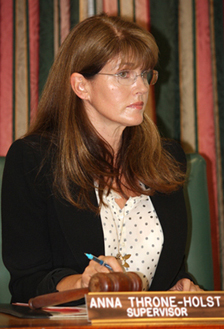
Months of mounting criticism over a controversial planning tool, the planned development district, culminated Tuesday in Southampton Town Supervisor Anna Throne-Holst’s call for a moratorium on all such projects until the legislation governing them is more clearly spelled out—or until the Town Board opts to eliminate the option completely.
“I would like to suggest that as a Town Board we put forward a moratorium on PDDs as we consider this law and other work that’s being done, as well as a consideration of whether we want to abolish the PDD process altogether,” Ms. Throne-Holst said at a public hearing at Southampton Town Hall on Tuesday. The hearing focused on proposed legislation relating to PDDs, special zoning designations created by the Town Board that allow developers to surpass standard restrictions in exchange for providing some community benefit. The new measure seeks to clarify exactly what “community benefit” means in the PDD law.
A moratorium would halt several ongoing PDD projects that have been the focus of recent debate, including a plan by developer Robert Morrow to create a shopping and residential complex in the hamlet of Tuckahoe on 12 acres of land along County Road 39. It would also leave hanging the status of negotiations between town officials and Gregg and Mitchell Rechler, developers who have promised to preserve the historic Canoe Place Inn in Hampton Bays in exchange for constructing 40 condominiums on the east side of the Shinnecock Canal.
After Ms. Throne-Holst suggested the moratorium, Town Councilman Chris Nuzzi questioned the feasibility and necessity of that move, noting that all actions on proposed PDD projects are “discretionary,” and the Town Board can simply choose on its own to drop consideration of a project. “From a practical perspective, I just don’t see how that would work,” he said of a moratorium.
No action was taken Tuesday on the supervisor’s proposals. The Town Board voted to adjourn the hearing on Ms. Graboski’s PDD legislation till October 12, when it will resume.
Several residents lined up to speak at the hearing, which focused on legislation sponsored by Town Councilwoman Nancy Graboski to consider a proposal to more clearly define the term “community benefits” in the town’s law on PDDs. Those benefits more clearly defined in the town’s legislation would include open space, affordable housing, parks, elder care, day care, and other “physical, social or cultural amenities, or cash in lieu thereof, of benefit to the residents of the community.”
Some residents raised questions about the “cash in lieu of” benefit. Francis Genovese read a letter into the record written by Water Mill resident Marlene Haresign, who noted that allowing developers to give cash to the town raises issues.
“Future town officials who are trying to plug holes in a town budget may be seduced by the millions of dollars that a developer may offer ... Cash payments to the Town Board should not be part of the discussion,” read the letter from Ms. Haresign.
The legislation addresses that concern, Ms. Graboski pointed out, by placing any money received in a “dedicated fund” that can be withdrawn only by a Town Board resolution.
Many residents who spoke at the hearing said that while the town was heading in the right direction in more clearly defining community benefits, more still needs to be done.
Southampton lawyer John Bennett, who has been critical of the Tuckahoe PDD application, stood up at the podium to criticize the Town Board’s efforts to identify community benefits, noting that not enough is being done to quantify the benefits. “What we’re doing here tonight really isn’t doing anything at all, to be blunt,” he said.
But that was before Ms. Throne-Holst called for a moratorium on all PDDs. On Wednesday morning, Mr. Bennett said he was pleasantly surprised by Ms. Throne-Holst’s suggestion. “I think the Town Board is actually starting to listen now to the fact that the public doesn’t like these PDDs, in particular the commercial ones,” he said.
After the meeting, Ms. Throne-Holst said that she’d like more time to explore Ms. Graboski’s efforts to define community benefits, and her own planning reform advisory group’s work in identifying, hamlet by hamlet, what is and isn’t a community benefit. For example, in Hampton Bays, she said, the community has spoken loudly against more affordable housing units, while in Sag Harbor, the community has actually asked for more affordable housing. Other measures she said she’d like to see materialize include requiring developers of such projects to hold pre-submission conferences, where they would present their plans at a public work session before any action is taken on them. Ms. Throne-Holst initiated that measure last year for significant applications that come before the Planning Board.
A Town Board resolution to suspend Southampton Town Police Officer Herbert Loper without pay is expected to be on the agenda for a special Town Board meeting on Friday, October 1.
Ms. Throne-Holst declined to discuss the nature of the charges surrounding Mr. Loper on Tuesday.
Southampton Town Patrolmen’s Benevolence Association President Patrick Aube said the charges were not criminal in nature and related to violating department policy—in particular, “how a call was handled and how the paperwork was accomplished.” He declined to offer more details.
Mr. Aube spoke on the resolution on Tuesday night, asking the Town Board to include a time period within the suspension period not to exceed 30 days. Currently, the resolution would suspend the officer indefinitely.
Town Board members held off on voting on the resolution Tuesday due to the language in it. It stated that the officer was served disciplinary charges although it was not clear whether he was actually served them at the time of the resolution’s discussion. Officer Loper was expected to be served that same evening, but as of Wednesday morning, Mr. Aube said he had not been.


 Rohma Abbas on Sep 29, 2010