


 1 Photo
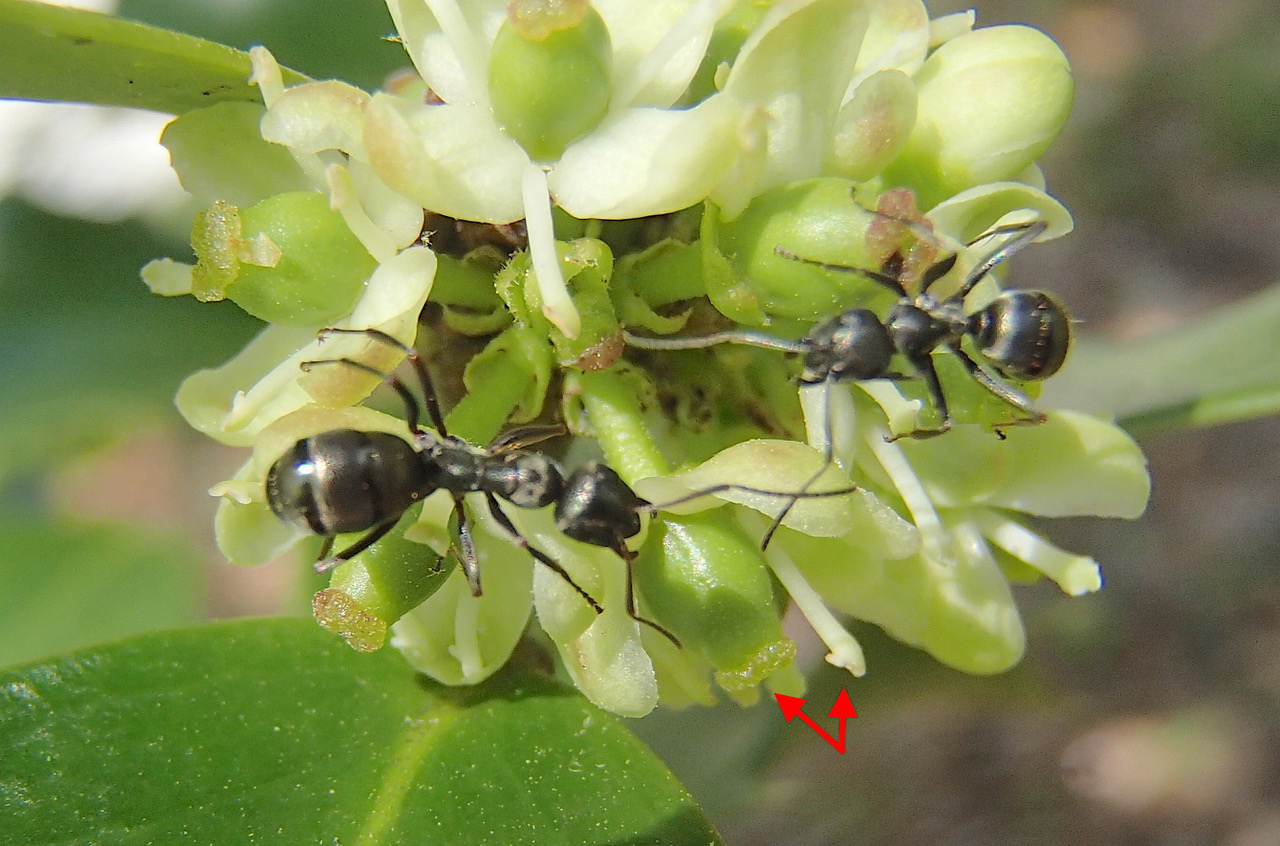
The female flowers of the American Holly were crawling with ants that were feasting on the nectar, but providing no benefit to the holly in terms of pollination. MIKE BOTINNI
This week’s warm, sunny weather fast-tracked leaf-out and blooming for many plants that seemed to be in limbo, or very slow-motion growth, during April’s cool temperatures. Even the very-late-to-leaf-out tupelos are now sprouting leaves.
Among the blooming flowers are those of our dominant forest trees: the oaks and hickories, and American beech. These are all wind-pollinated flowers: The pollen-bearing male flowers of the oaks and hickories form conspicuous drooping pennants, while beech pollen is shed by spherical flowers measuring approximately ½ inch in diameter.
Since the work of pollinating is done by the wind and not insects, there is no need to develop showy flowers. Most people do not recognize the pollen-bearing sacs nor the less conspicuous female flowers that need to receive pollen to eventually develop their respective seeds: hickory nuts, acorns and beech nuts. Collectively known as “mast,” all are important sources of food for many species of birds and mammals, and critical for some to bulk up for the winter.
Yet we all notice the yellow pollen collecting on our cars and home windows at this time of year — and, of course, those with pollen allergies notice more than the yellow stains.
One of our most inconspicuous and easily overlooked flowers that is blooming this week is that of the American holly. The four white petals form a tiny flower that measures a mere ¼ inch in diameter, basically the same diameter as their striking red berries.
Both the female and male flowers look quite similar in terms of the petals. Males have four short filaments tipped with yellow, pollen-bearing structures called anthers. The whole arrangement is called the stamens. Females have a green bulbous structure centered on the four petals that receives the pollen and, once pollinated, will eventually form the classic red berry.
Unlike the oaks, hickories and beeches, which are monoecious, meaning a single specimen has both male and female flowers, the American holly does not have both male and female flowers on the same plants, so there needs to be at least one of each in the general area in order for the female plants to get pollinated. That situation is called dioecious.
The use of the prefix “mono,” meaning “one,” for the plants that have both sexes on the same tree may seem confusing. Way back in my college botany course, monoecious was described as “under one house,” for two sexes cohabitating, and I thought of dioecious as a “house divided,” as in separate. Still, I often confuse the terms.
How close do the male and female plants need to be in order to get pollinated? I’m not sure. However, I have three mature female hollies and no mature males on my small third-of-an-acre property, and none on my adjacent neighbors’ properties. The closest male holly has to be several hundred feet away.
And how does the holly’s pollen get transported? Despite its tiny size, the holly’s flower does attract insects — and this week the flowers were buzzing with bees. According to some of my references, American holly nectar gets transformed into quite delicious honey. The female flowers also were crawling with ants that were feasting on the nectar but providing no benefit to the holly in terms of pollination.
Or do they? While sorting through my photos, I noticed that the flowers on my American hollies have both the green female “stigma-style-ovary” structure and the male stamens. So I may have a hybrid that self-pollinates, and the ants may be pollinating as they move over the clusters of flowers. I’ll have to look into this further.
While surveying Poxabogue Pond for sign of otters on Sunday, I noticed a half dozen osprey noisily circling around the northwest corner of the small, shallow pond. I did not notice any nests in the area.
Two were carrying fish in their talons, and I wondered if I was watching a competition for mates. It seems a little late for matchmaking, as mid-May is the midpoint in the egg-laying season here. I also wondered why they were congregated here when the nearby bays are teeming with schools of herring known as menhaden,or bunker.
While checking an otter site near Indian Island County Park in Riverhead, I watched (and filmed) a small school of bunker working the tidal portion of Terry Creek at low tide. You could clearly see how they moved slowly through the upper surface of the water column with their large mouths and gill slits wide open as they filtered tiny particles of plankton from the water with their unusual network of gill rakers (not visible) that act as a sieve to catch the food before it exits the gill slits.
You can watch a video of this at: https://www.facebook.com/mike.bottini.9/videos/10217755538101272/
Fellow ocean lifeguard Andrew Wilson reported on a trip some 50 miles off Montauk last Saturday. Among the interesting sea life sightings was a humpback whale with her several-month-old calf.
Northwest Atlantic population humpbacks head south to the Caribbean for the winter, where they mate and give birth to young between January and April. Gestation is nearly a year, and our female humpback population, unlike that documented in Hawaii, gives birth to calves once every two or three years.
The calves are 15 feet long at birth and grow at the rate of up to 1.5 feet per month on their mother’s super rich and fatty milk. They will nurse for an entire year, at which time they will have reached 25 to 28 feet in length.
If that’s not amazing enough, Mom does not feed while in the warm, shallow Caribbean waters giving birth and nursing, nor during her annual migration, a round-trip distance of 4,000 miles from Long Island to calving grounds off the Dominican Republic.
What magnificent and incredible animals!


 Staff Writer on May 19, 2020