


 1 Photo
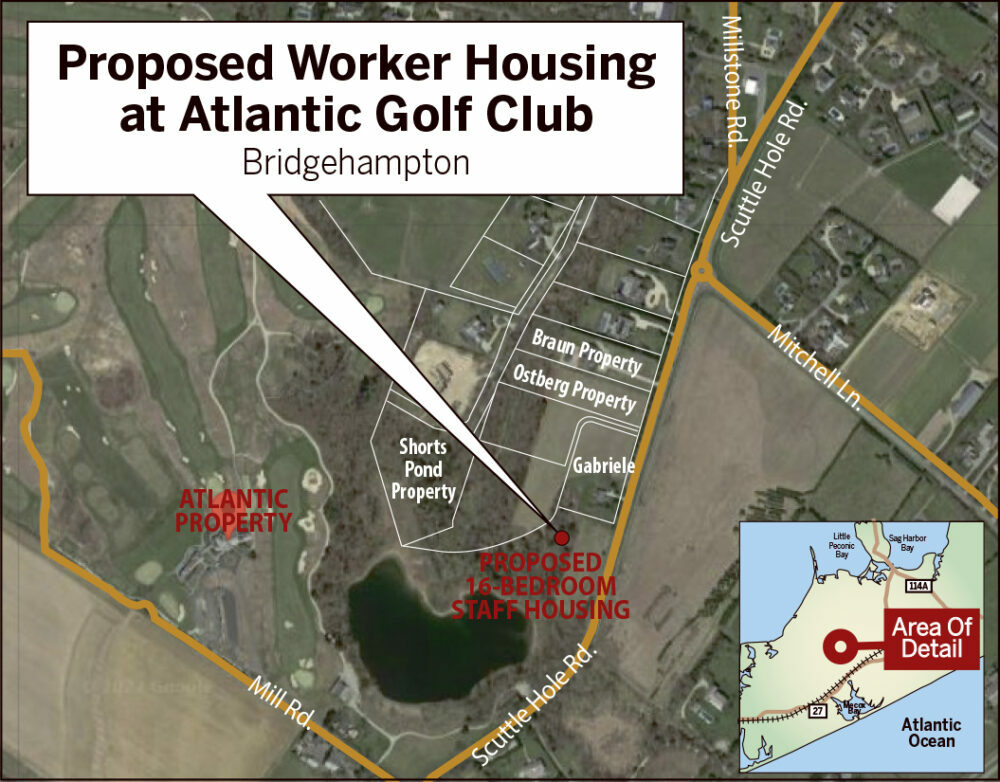
Proposed staff housing at Atlantic Golf Club was a focal point of last month's hearing on crafting zoning to allow staff housing at golf courses in Southampton Town.
Members of the Southampton Town Board voted Tuesday, March 14, to ratify an addition to the town’s zoning code regulating staff housing on golf courses.
Speaking to the “crisis in the community” regarding staff housing for businesses, Southampton Town Supervisor Jay Schneiderman said he believes the measure “has a lot of merit.” It does a good job protecting neighbors of golf clubs and gives the Planning Board “a lot of discretion,” the supervisor asserted.
The vote was unanimous.
One section, that exempts clubs that have received town planning approvals, was stricken following a February 14 public hearing. “This forces everyone to go in front of the Planning Board,” Schneiderman said.
The change affects the Atlantic Golf Club, which received approval to construct a 6,500-square-foot building for staff on its Scuttle Hole Road property in Bridgehampton over a year ago. At the hearing on the measure, most of those who commented referenced Atlantic’s plan.
The proposal is the subject of a lawsuit by neighbors. Speaking of the change removing the exemption last week, the neighbors’ attorney, Brian Matthews, called the amendment “spot zoning in spirit.”
“This clearly came out about Atlantic,” he said, describing the amendment as “designed to shoehorn Atlantic’s wildly inappropriate structure into this small pondside corner on their 200-acre property.” He sees the grandfathering provision in the original law as an effort to “back-door” the Planning Board’s approval of the project.
Matthews contends that the approval isn’t valid because, in a subsequent determination by the Zoning Board of Appeals, board members overturned the building inspector’s determination that staff housing was a legal accessory use on a golf course. Atlantic then sued, seeking to overturn the ZBA decision.
During the February hearing, the club’s president, Dennis Suskind, emphasized that the site chosen for the structure was the only viable one. Responding to the change in the proposed law this week, he said, “I’m happy they fixed the legislation. I would have been happier if they followed the Planning Board’s approval of our application.”
The club will continue to work toward establishing the housing, Suskind said. “We’ll just be reapplying as soon as we can … We’ll just do what we have to do because this is the right thing to do for the community and the golf club.”
Most golf courses in Southampton Town have preexisting housing for staff, some of it dating back to the 1970s. However, the town zoning code doesn’t speak to it or provide a pathway to garner approval for new housing. The code amendment was crafted to address the omission.
It adds “living quarters for golf course employees” as a special exception use to the zoning code and lays out a number of special standards. The housing must be located on the same property as an 18-hole course and built a set distance from neighboring properties, meeting the setbacks of whichever zone it’s in.
The housing must be in a detached building, but housing could be in another structure designated for another use as long as the height of the building does not exceed 32 feet.
No more than 50 employees, with no more than 25 per building, may be housed. If a course already has housing, the number of occupants in the existing abode will count toward the overall maximum of 50. The maximum permitted size of any new living quarters for golf course staff can’t exceed 7,000 square feet of total floor area, with a total of 14,000 square feet aggregate if more than one new building is proposed.
With the affordable housing crisis making it difficult to recruit and keep employees, the amendment, said Schneiderman, “helps these places stay in business.”


