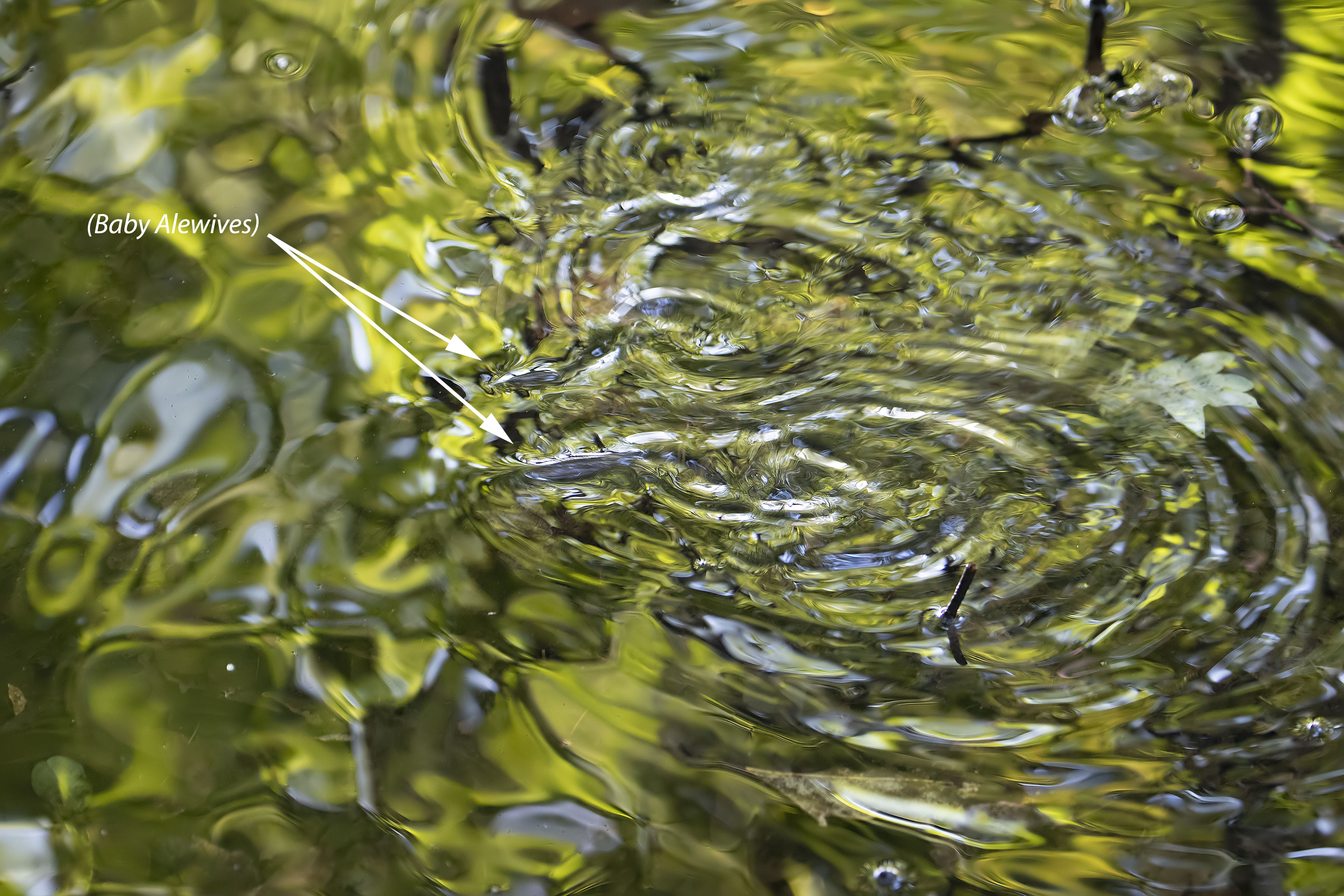
The East End’s only anadromous fish migration has begun, right on time, with this month’s full and new moon tides.
Under the cover of darkness, hundreds of thousands of alewives — a species of herring that, like salmon and striped bass, spend most of their lives in saltwater but swim up freshwater streams to spawn — have been pouring into the few trickles of freshwater that empty into the Peconics and their harbors, batting their way upstream toward the freshwaters of places like Wildwood Lake and Big Fresh Pond.
The alewife “run” into Big Fresh is generally considered the most robust in the region, with the numbers of fish that make their way to the pond estimated to be somewhere around 100,000 each year — though comprehensive surveys have not been conducted in several years.
Last year, the Southampton Town Highway Department completed an extensive overhaul of the culvert under the southern end of Noyac Road, where the alewives headed for Big Fresh Pond make their first leap from the tidal waters into the shallow stream of water flowing toward the bay from the pond.
In dry years, the stream can be barely a trickle and the old culvert, known most commonly as the Alewife Drain (usually pronounced more like “L-Y Drain”), was an obstacle course of concrete and debris that often slowed or even blocked the alewives’ upstream rush. For decades, humans harvested the fish by the thousands at the culvert, using headlamps and dip nets to scoop them up as they approached. When the humans moved on, the raccoons and herons moved in to take their share.
The new culvert — the replacement of which was done specifically with the alewives in mind — provides a seamless transition from the saltwater to the start of the stream bed and a flat, and comparatively deep channel for them to follow into the upland stream.
But just a few hundred yards into their journey they again run into an obstacle course — where the stream again has to go under a busy roadway.
On Monday afternoon, amid a particularly heavy period of rain showers, water poured off the roadway, forming a miniature waterfall that gushed into a tunnel in the creek embankment scoured by past rainfalls, before dribbling into the stream a few feet away as a brown, silty discharge quickly caught up in the current of crystal clear water from Big Fresh and carried downstream toward North Sea Harbor.
Standing in the stream near where the tainted water emptied into the stream stood Peter Topping, the Peconic Baykeeper, pointing to the shredded heads of hundreds of alewives on the bank — victims of the nightly raccoon feast.
The certainly polluted runoff flowing into the stream bothers Topping, as his organization’s main mission is fighting to improve water quality and ecological health of the Peconic Estuary, but it poses little concern for the alewives themselves. What is killing them — literally — is the concrete culvert, which can be impossible to traverse in dry years and poses a fatal bottleneck even when the stream is running strong, as it is this week.
The alewives will stack up at the start of the downstream side of the culvert, unable to make the leap up over the lip of concrete that can stand several inches above the stream water at times.
“These fish are not like salmon that can leap — where there is a 2-foot culvert, they can’t get over that,” Topping says. “This is what you call a perched culvert, so there’s a lip, and you can see hundreds of [alewives] bottled up at the choke point.”
When they hit a roadblock like that they are easy pickings for raccoons, egrets, herons — and the occasional human poacher (harvesting alewives from the creek was banned by the town a decade ago).
“The town did a great job with the Noyac Road culvert, it was a fantastic project,” Topping, who grew up nearby, said. “The first time I checked it out I saw alewives just cruising right through it, better than I’d ever seen in my life.”
Fixing the runoff into the stream is a critical issue, Topping says, and fixing the culvert so that it is more friendly to the alewives making the push to Big Fresh Pond should be an obvious pairing. The culvert is owned by Suffolk County, because North Sea Road is a county highway. The county dedicated $500,000 toward the construction of a $1 million fish passage on Little Peconic River in 2022 specifically to help restore the alewife run into Wildwood Lake.
Topping says he’s been pressing the county for five years to do something about the runoff flowing directly from the road into the stream and into North Sea Harbor. The county, he says, has said that it will address the runoff when it undertakes a planned repaving of all of North Sea Road, which also come with extensive new drainage systems. The project is still being designed and the county has not offered a timeline for when it will be done.
But the point source of pollution going directly into a stream should be something that could be addressed more urgently in the meantime, the Baykeeper says.
“They are aware of it, they have just been dragging their feet,” Topping said. “The are aware of the stormwater runoff. They have a plan to address it when they do the road, but you don’t need to do a whole road to fix this.
He pointed to the steady stream of brown water flowing into the creek. “I submitted a complaint about this five years ago and absolutely nothing has been done.”
County Legislator Ann Welker said that the county Department of Public Works is drafting the engineering plans for the road project, but she also was unable to put a time frame on when the work would begin.
She said the county also ordered a study of the culvert and the stream last year, specific to the alewife run, and that its official diagnosis was that the culvert wasn’t causing such extensive blockages of the steam to justify the expense of replacing it. Her office is exploring other ways to pay to replace or modify the culvert to make it easier for the tiny fish to navigate, Welker said.
“We don’t want to delay the road project since it is in the design and engineering phase at this point, so we’re looking into other funding resources for the possibility of a new culvert,” she said.
In the meantime, after a second rainy spring, the alewives are making their way through the obstacle course and in to Big Fresh Pond. Topping will lead two annual spring alewife walks this coming Saturday, March 29, and on Friday, April 4, leading participants along the path that the fish swim, in reverse, staring from Elliston Park on the shores of the pond, then up to where the creek passes beneath North Sea Road and Noyac Road — littered with the carnage of the previous night’s massacre.
“It’s part of the ecosystem,” Topping said.