


 1 Photo
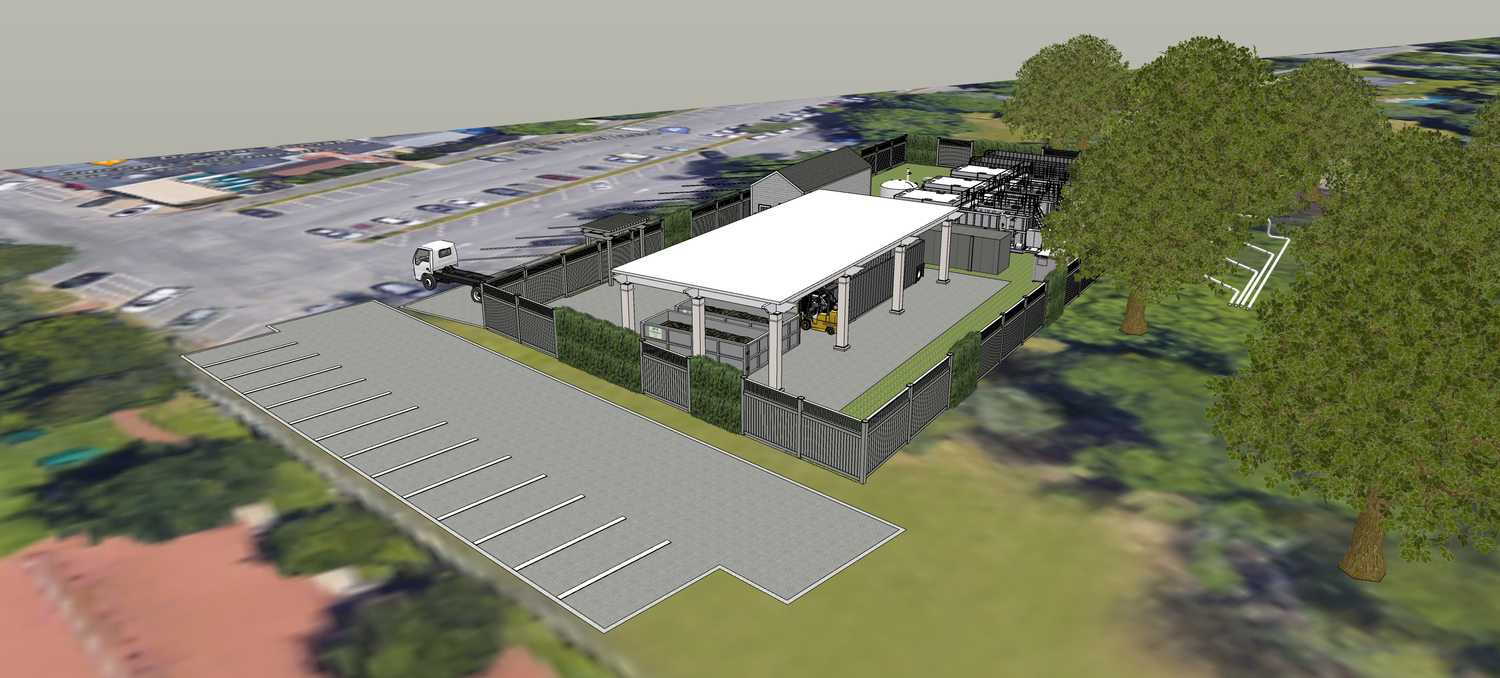
A rendering of the three algae harvesters at Doscher Park. COURTESY SOUTHAMPTON VILLAGE
At its April 10 meeting, the Southampton Village Board tabled a resolution to execute the full contract with a Florida-based company hired to build three algae skimmers that will be installed at Doscher Park near Lake Agawam.
AECOM was contracted to build the system to filter 3 million gallons of lake water every day, removing algae and nutrients that lead to harmful algae blooms, before returning the water to the lake. The $10 million project is fully funded by a combination of federal EPA grants and money from the Southampton Town Community Preservation Fund for water quality improvement projects.
Mayor Bill Manger explained the reason for tabling the resolution, saying that while the project is fully funded, the grants are such that the village has to lay the money out first and then be reimbursed, and there is still discussion to be had about the best way to go about that.
“Some people I had spoken to earlier in the day said that there might be other sources of funding aside from the clean water fund and fund balance for capital projects, and that maybe we should look at other options like a bond or other types of financing,” he said earlier this week.
Manger added that tabling the resolution will not halt the progress on construction of the skimmers. He said that, in discussion with representatives from AECOM, the company could begin the work on the algae skimmers as long as it had an advance of $300,000, which was needed to begin essential electrical work on the skimmers, a first part of the process. The village was able to provide that funding right away.
Manger added that in addition to needing a bit more time to find the best way to proceed with laying out the money for the project, the board also tabled the resolution because it needed to wait until the end of a 30-day public comment period that was a part of the State Department of Environmental Conservation permit approval process. The DEC tentatively approved the permit — pending the 30-day comment period — on March 21. That approval represented the final hurdle in what has been a years-long process to have the skimmers installed.
The harvesters should be up and running by the early fall, barring any other delays. They will operate nine months out of the year, shutting down during the colder months.
The harvesters will not be there permanently, but the time frame for how long they will need to operate depends on their efficacy in cleaning the lake and is expected to take anywhere from three to five years, and possibly longer.
While they are expected to be effective, based on their use in other parts of the country, the harvesters will have their work cut out for them until the village can get a sewer district up and running — which will greatly decrease the volume of polluting substances entering the lake. The village is still searching for a suitable location for a sewage treatment plant.
News and Notes
• The board once again tabled a resolution on adopting a proposed law to amend the village’s tree code to require permits for tree removal in a required setback. The village is proposing changing the definition of what constitutes a “private tree” as any tree that measures 12 inches in diameter, an increase of 2 inches from the previous measurement proposed in the code. For American holly and cedar trees, that number is 10 inches.
There have been several updates to the proposal, and a lot of back-and-forth from residents about the law. With more fine-tuning proposed and discussed at the most recent meeting, the board decided to table the resolution once more.
• Deputy Mayor Len Zinnanti provided an update on an April 4 meeting of the village’s traffic committee, sharing that the funding in the fiscal budget for two seasonal police officers — one of whom will remain on staff as a full-time officer once the summer season is over — will allow Police Chief Suzanne Hurteau to keep up the level of enforcement and issuance of traffic tickets for motorists who do not follow turn restrictions and adhere to the speed limit during the busy rush hour, in the western portion of the village in the neighborhoods between Hill Street and County Road 39.
He said the committee also reviewed several of the mitigation proposals recently presented by engineering firm VHB earlier this year.
• The board passed another resolution at the meeting that can sometimes cause confusion among residents. The board passed a resolution authorizing a tax levy in excess of the limit for the fiscal year starting on June 1, 2025. The move is essentially a precautionary measure, taken as a matter of course every year. The village does not plan to pierce the tax cap this year.
A village can exceed the cap if its board of trustees passes legislation authorizing itself to do so — and villages often pass that legislation as a precautionary measure — but in deference to taxpayers, they typically comply with the cap when the final budget is approved, and the measure is later rescinded.


 Cailin Riley on Apr 16, 2025