


 2 Photos

Kerry Washington in "Night Catches Us." COURTESY MAGNOLIA PICTURES Photo by Anneke Schoneveld
Plans for a 7-Eleven convenience store in Amagansett were slated to be discussed anew at a meeting of the East Hampton Town Zoning Board of Appeals on Tuesday evening, July 28.
The convenience store chain signed a lease for the building with owner Richard Principi earlier this year.
The zoning board was scheduled to hear an appeal on Tuesday night of a 2014 building inspector’s ruling. The ruling had declared that the plans for a round-the-clock convenience store would have to go through a detailed review by the Planning Board, and receive a special permit, even though physical changes to the property would only be in the interior of an existing former restaurant.
The town issued a building permit in January 2014 for the renovation plans for 521 Montauk Highway, adjacent to the IGA shopping center. At the time, officials noted the relatively minor physical changes being made and the less strenuous use of the property, environmentally speaking, in switching from a restaurant to a convenience store. Shortly thereafter, renovation work began, including demolition of the building’s facade.
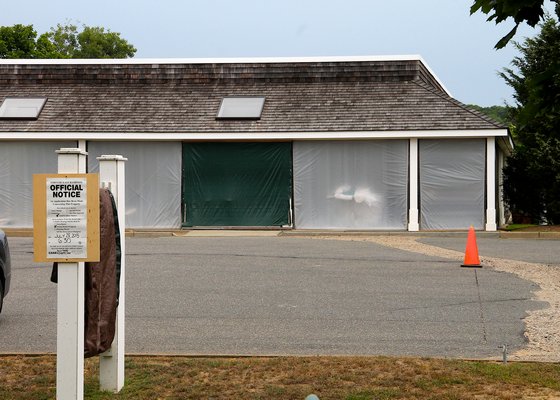
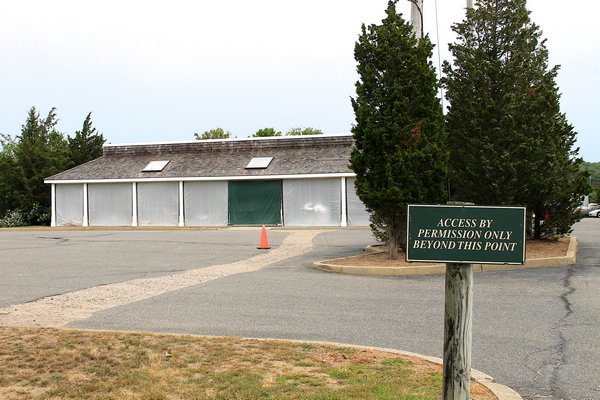
But a month later, former town Chief Building Inspector Thomas Prieato rescinded the permit, saying that it was issued in error because the proposed change of use meant that the new plans had to be reviewed by the Town Planning Board. Construction work halted, leaving the front of the building draped in black plastic weatherproofing for the 16 months since then.
Several months after Mr. Prieato’s order, the Town Board adopted a new law requiring that so-called “formula” businesses that are part of a chain be required to receive a special permit from the Planning Board to operate in the central business zone, which includes the proposed 7-Eleven property.
The law defines formula businesses as one of 15 or more other businesses in the U.S. that are franchised under a trademark, use a common supplier for at least 50 percent of their merchandise, or share common physical appearances, from building facade to the uniforms worn by employees. The law says that formula stores may exist in central business districts but must conform to the visual character of the surrounding area, or be altered substantially in appearance from other formula stores of their kind in areas where historic features are present.
Attorneys for 7-Eleven, Mr. Principi and a New York corporation also listed on the lease inked this year argued in their appeal briefs that the initial building permit should be reinstated as originally granted because the town had previously declared that new site plan review was not needed on the property unless there was new construction.
“The town had interpreted, time and again, that no further site plan approval would be required for any complete improvements on the property which conform to the originally approved site plan,” the brief filed by the Amato Law Group reads. “The proposed work does not fall into any of the delineated situations requiring site plan approval.”
Several facets of the project would likely require that a new site plan approval, and possibly the special permit, be issued by the Planning Board. Clearing and regrading of a portion of the property that was done in 2010, without site plan approval, would typically trigger a need for new review, regardless of the new use of the property.
Residents of Amagansett decried the proposal when it was first floated in 2014. They worried about traffic impacts along Montauk Highway and about the effect the store might have on other local markets and delis.


 on Jul 24, 2015