


 1 Photo
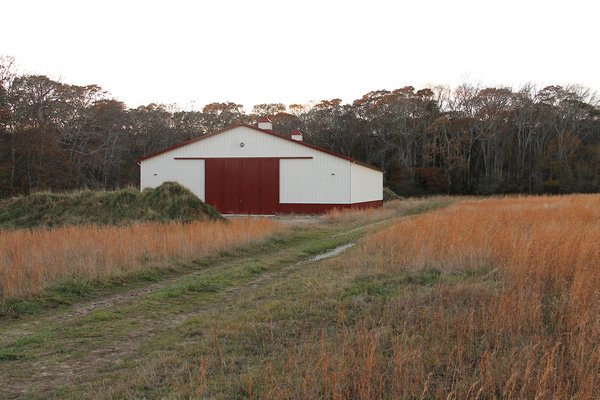
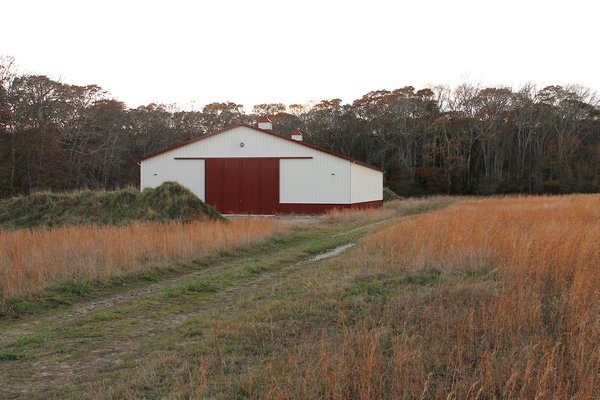
Farming industry advocates have joined a legal battle over the right of farmers to construct agricultural buildings on protected farmlands. This barn in Amagansett, which was constructed by the Peconic Land Trust, has been the subject of a lawsuit that sites a judge's ruling last year that says such structures cannot be built on land that has its development rights purchased by the county. Kyril Bromley
A state appellate court on Wednesday overturned a lower court ruling and upheld Suffolk County’s right to allow the construction of farm-related buildings on land preserved by the county for agricultural use.
A decision by State Supreme Court Justice Thomas F. Whelan in December 2016 had invalidated laws county legislators enacted in 2010 and 2013 to update its farmland preservation program to allow certain structures to be built on preserved land, including farm stands, processing facilities and buildings used for agricultural tourism and special events.
That decision came in response to a lawsuit filed against the County Legislature by the Long Island Pine Barrens Society, which successfully argued that the farmland preservation program was created by referendum and could only be revised by referendum.
On appeal, the Appellate Division voted 3-1 to overturn the lower court decision. The majority of the four-judge panel concluded that the various structures on and uses of preserved farmland—they range from horse boarding and equine operations and farm stands to greenhouses, crop mazes, “U-pick” operations and alternative energy systems—“all constitute or are sufficiently related to agricultural production.”
The laws amending the county’s farmland preservation program, which was created in 1974, did not require a public referendum, the appellate judges concluded, reversing Justice Whelan’s earlier decision.
One appellate judge disagreed with the majority. Justice Linda Christopher maintained that allowing processing facilities, farm stands and special events, on land where the development rights had been purchased by the county and retired, “constituted a waste of public funds,” because they are not directly related to agricultural production.
The decision could be appealed by the plaintiffs, the Long Island Pine Barrens Society, to the State Court of Appeals.
The lawsuit had divided groups that typically are united in the cause of land preservation. Among the groups supporting the appeal of the December 2016 decision were the Southampton-based Peconic Land Trust, the Long Island Farm Bureau and Cornell Cooperative Extension of Suffolk County.
“The Appellate Court’s decision is a win-win that protects Suffolk County’s agriculture, environment, locally grown food, and our unique quality of life,” Peconic Land Trust President John v.H. Halsey said in an email on Thursday. “Agriculture is constantly changing and it is self-evident that farmers need structures to farm. This decision validates that the purpose of the county’s landmark Farmland Preservation Program is farming and recognizes that the needs of agriculture change over time. The decision also affirms that farmers had always retained the right to have agricultural structures and improvements on their property through a permitting process. As such, no public referendum is required—the county did not give back rights to farmers, but rather permitted them to do what is necessary to farm.”
The groups had maintained that the earlier ruling threatened farmland preservation efforts throughout the region, in two ways. They said the county’s revisions were real-world attempts to support agriculture as an industry, rather than merely focusing on the preservation of the land itself from development. They said various buildings and uses are part of the infrastructure necessary for any reasonable definition of “farming,” and without them the businesses would struggle to keep preserved land in active cultivation.
“Farm is a verb,” County Legislator Bridget Fleming had said last year, regarding the 2016 court decision. “You have to be able to run a business of farming to run a farm. In order to run a farm, you need to be able to store your vehicles, you need to irrigate, you need to protect crops. This decision, it would appear, seems to disallow reasonable agricultural practices. I think the folks who brought this suit are afraid of abuses—but there really isn’t much evidence of that.”
But they also said they worry that Justice Whelan’s ruling changed the very nature of what could be done with preserved land years after the deals were struck—which could void contracts signed by not just the county but the East End towns to purchase development rights on targeted land.
Richard Amper, the executive director of the Long Island Pine Barrens Society, had said the plaintiffs’ concern was less about the uses and more about the way the county set up the process to allow them. He said laws like the county’s farmland program were created by referendum, and the public also should have the final say, via ballot, on revisions to that program.
In a written statement on Thursday, Mr. Amper expressed disappointment and said his organization will appeal to the State Court of Appeals.
“First, this unusual split-decision by the court ignores the Appellate Division’s previous ruling that any law created by referenda can only be altered by a subsequent vote of the public,” Mr. Amper said. “Second, it’s clear that [county] government’s action in support of the agriculture lobby constituted a violation of the Public Trust Doctrine. And, third, if the appeals court concluded that farmers could do anything that constitutes farming under New York State’s Agriculture and Markets Law, then what did the public get when they bought the development rights from the farmers?”
The Suffolk County Farmland Program was the first program in the nation to use public money to purchase the legal rights to residential development from farmers, allowing landowners to take advantage of some of the value inherent in their acreage, without having to give up farming and sell the land entirely.
The program has preserved more than 10,000 acres of farmland and been emulated in dozens of other states, as well as in the five East End towns, with the help of revenues from the Community Preservation Fund’s 2-percent tax on real estate transactions.
“The court confirmed that agricultural production can continue on preserved farmland, including the construction of barns, fences, irrigation and other improvements that are essential to farming,” said attorney Lisa Kombrink of the Riverhead law firm Twomey, Latham, Shea, Kelley, Dubin & Quartararo, which represented the county in the case. Ms. Kombrink was the lead on the case, which was argued in a Brooklyn courtroom in December 2017.
She added, “The decision also recognizes the authority of the Suffolk County Farmland Committee to review permits for structures, farm stands and special events.”
In the majority decision, the appellate judges noted that the county’s Farmland Committee “continues to perform its gatekeeping function” in reviewing permit applications for farm stands and other structures, special events, and other facilities on preserved land, using discretion on a case-by-case basis while protecting the public trust. Any individual decision, they noted, is subject to be challenged in court.


 Joseph Shaw, Executive Editor on Mar 15, 2018