


 1 Photo
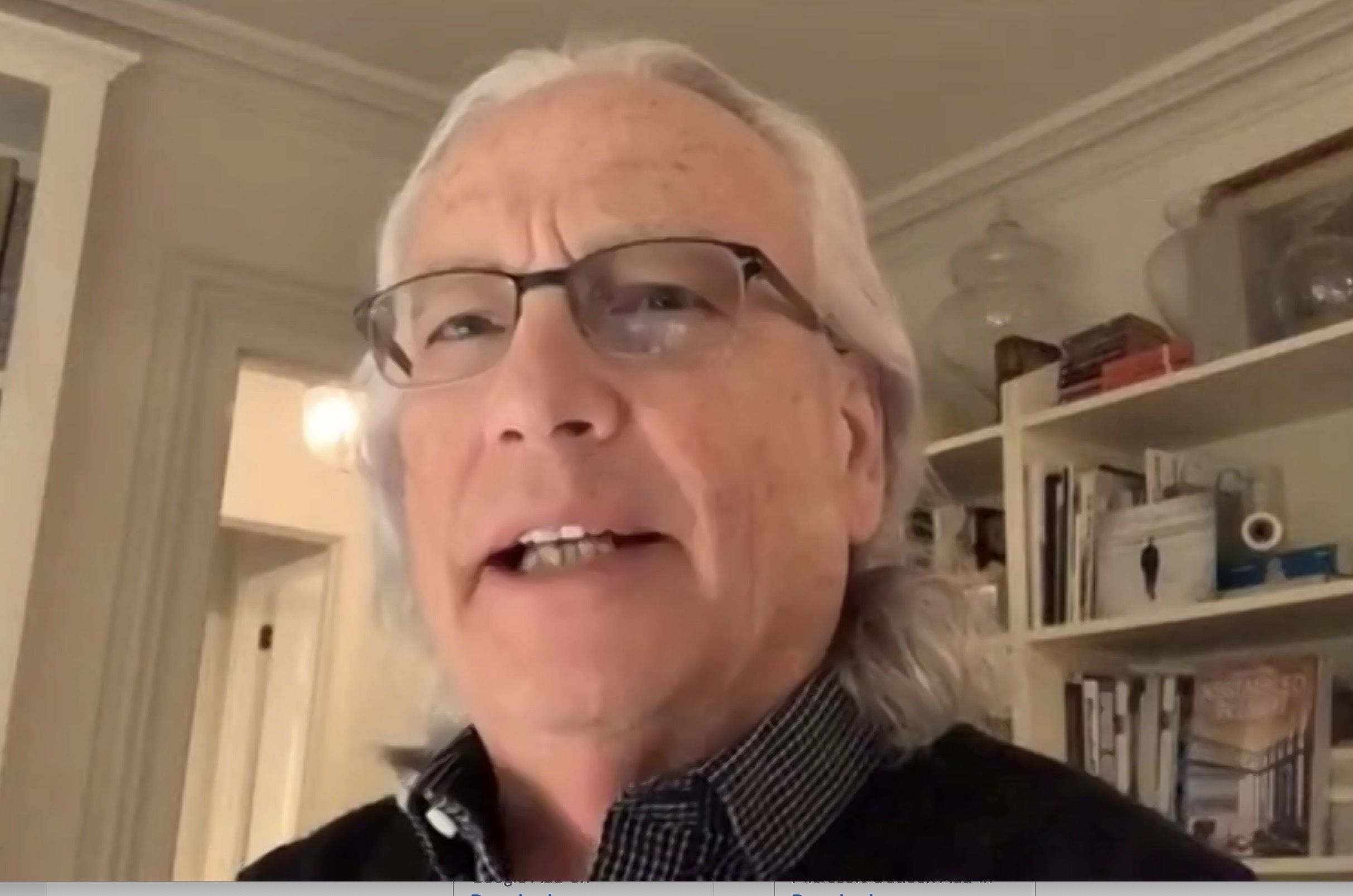
Architect Christopher Coy speaking at the January 13 Soon session of the Sag Harbor HPARB about the windows at 207 Main Street.
The wrangling over the pros and cons of putting in new windows at the circa 1790 house at 207 Main Street in Sag Harbor went on for another hour at the latest Zoom meeting of the Historic Preservation and Architectural Review Board (HPARB) last week and, in the end, it seemed to have headed back to where it had started.
The panel’s chairperson, Jeanne Kane, hinted the board might be willing to allow the homeowner to install custom-made thermopane replicas of its existing, drafty 2-over-2 windows that were installed during a 19th-century remodeling. Meanwhile, the board gave its conditional approval for other elements of architect Christopher Coy’s renovation plan.
They include removing aluminum siding to decide if the clapboarding underneath should be restored or replaced; installing a dormer below the roofline on the rear roof; adding French doors and a new back door; and rebuilding what’s been long known as the Art Shop on the Jefferson Street edge of the property, which the contractor mistakenly and illegally tore down in late December.
Coy told the board, “I never gave any directions” to the contractor “to take down the shed.” But the week after Christmas, “The next thing I know [Building Inspector] Chris Talbot was calling” him about the unauthorized demolition.
Coy said the crooked, unheated 20th-century shed, where a previous owner sold art supplies, will be rebuilt and “straightened up” in the same dimensions using its original wood, which he said the contractor had stacked and protected from the weather.
As for the thorny topic of replacing antique windows in a historic house, the HPARB — which in the past has required original windows to be preserved — appeared willing for the first time to at least consider allowing what Coy has been asking for since early December: a go-ahead to replace the drafty Victorian-era 2-over-2 sashes with double-paned custom-made replicas.
But first, the panel wants to see a sample up close and also it wants to visit a house in the area — anywhere from East Hampton to Southampton — that has them installed to gauge their appearance from the street, Kane said. The key question is whether or not they will look too obviously new. The panel also will require that “some” of the old windows “be preserved” in the house, as required by Department of the Interior rules for national historic districts, Kane said.
The board’s position has seemed to evolve as Coy has insisted adamantly all along that the old windows are “shot” and can’t be restored and that interior storms are an unacceptable requirement. When the case was first heard at the board’s December 9 Zoom meeting, Coy got the impression that the board opposed replicas because they were not consistent with Historic District guidelines that call for preservation as the preferred option and HPARB precedent upholding that approach.
He also got the impression, nevertheless, that the board would be amenable to 6-over-6 replicas as a more appropriate alternative than replicated 2-over-2s. That path seemed to open after previous owner Dennis Downes, who attended the December 9 session, told the board he had found an old, possibly original window in the cellar.
The board’s historic architectural consultant, Zachary Studenroth, responding to Downes’s initial statement that he had found an old 12-over-12 sash, saying at the board’s December 9 meeting that 12-over-12 replicas would be an appropriate style for a late 18th-century Federal house and might be the basis for a compromise allowing for new windows.
It was only later in the Zoom session, during a hearing on another case, that Downes advised the board it was a 6-over-6 that he had found.
When Coy appeared at the next session on December 23 with an elevation showing how 6-over-6 replicas would look in the house. Studenroth flatly rejected that option, saying that 6-over-6 windows were common when Greek Revival became the dominant style in the 19th century and were not appropriate for 207 Main Street, which had Italianate details added during a Victorian remodeling.
At last week’s January 13 session, Coy went back to defending the original plan for 2-over-2 replicas. He asked if the board had visited 264 Main Street to see a recent example of a house where historic windows had been replaced with replicas; Kane told him that she and other board members had, but there were storm windows obscuring the new windows so “we don’t have a good sense of what it will look like.”
The key issue for the board, Studenroth said, is “not so much getting the configuration of the panes right; it’s what the appearance will be from the street … Do they look new?” If so, “the aesthetic is off.”
“We have to do something” to replace the existing 2-over-2s,” Coy added after having said he was “on the same page” with the board about striving to preserve historic aspects of the house, such as the clapboards under its aluminum siding. But it was time to make “a commonsense decision” about the windows, he argued.
“I’m not asking you to break precedent at all,” he said. “I’ve seen other projects where insulated windows have been permitted, as long as they were correct historically.” He repeated his past argument that the existing ones are “too deteriorated to repair.”
Studenroth told Coy he had “never said” that he opposed 2-over-2 windows because they were part the Victorian-era “total overhaul” of the house. “It’s an earlier house updated in the Victorian period and the 2-over-2s are very much a part of that.”
Kane said the board had to decide whether to require Coy to keep the existing windows, “maybe with storms inside,” or to consider modern replicas. “But we don’t know what these windows are going to look like” because the maker has no sample to show the board. “Truly we need a sample, not a drawing,” she told Coy.


