


 4 Photos
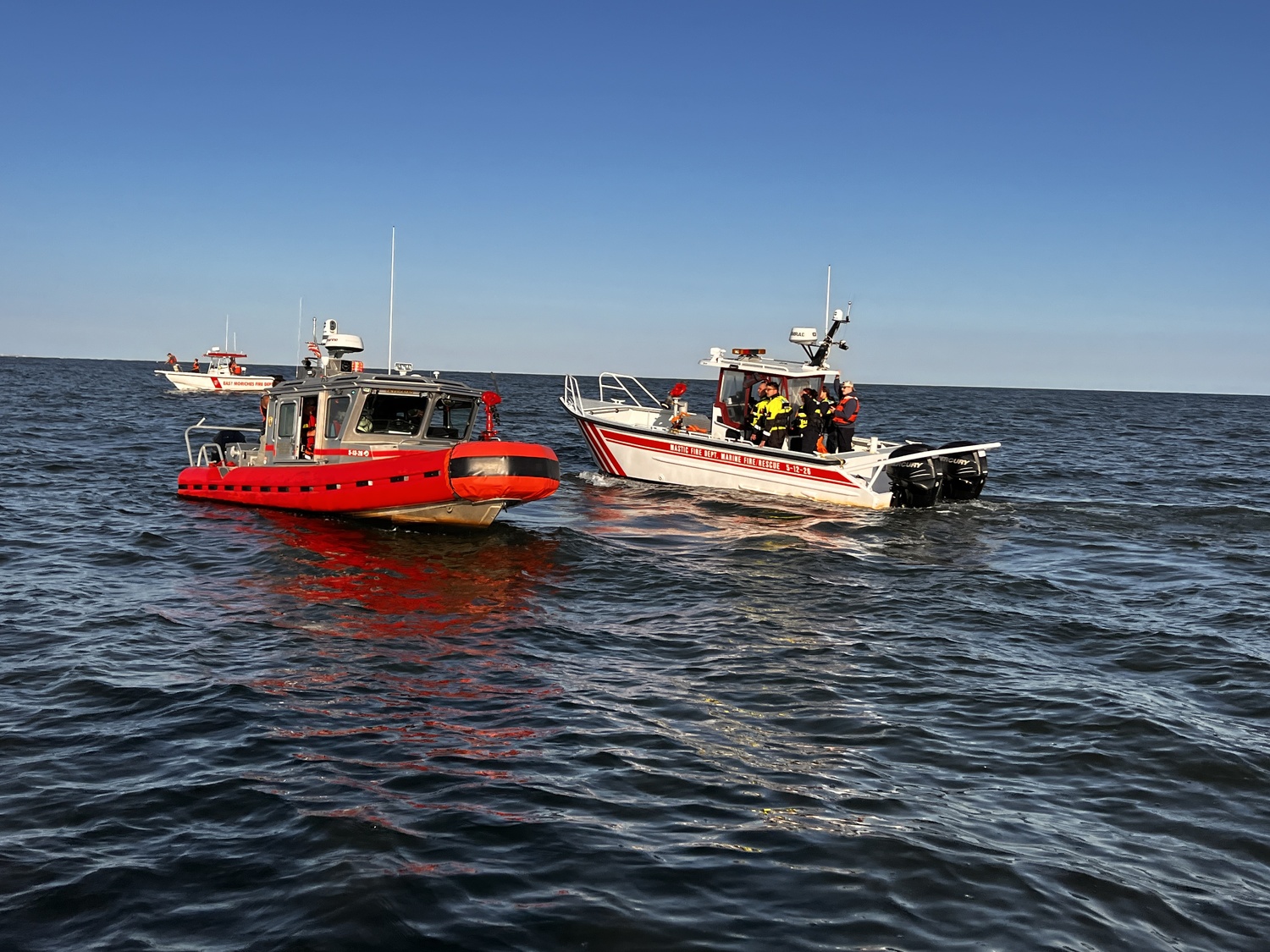
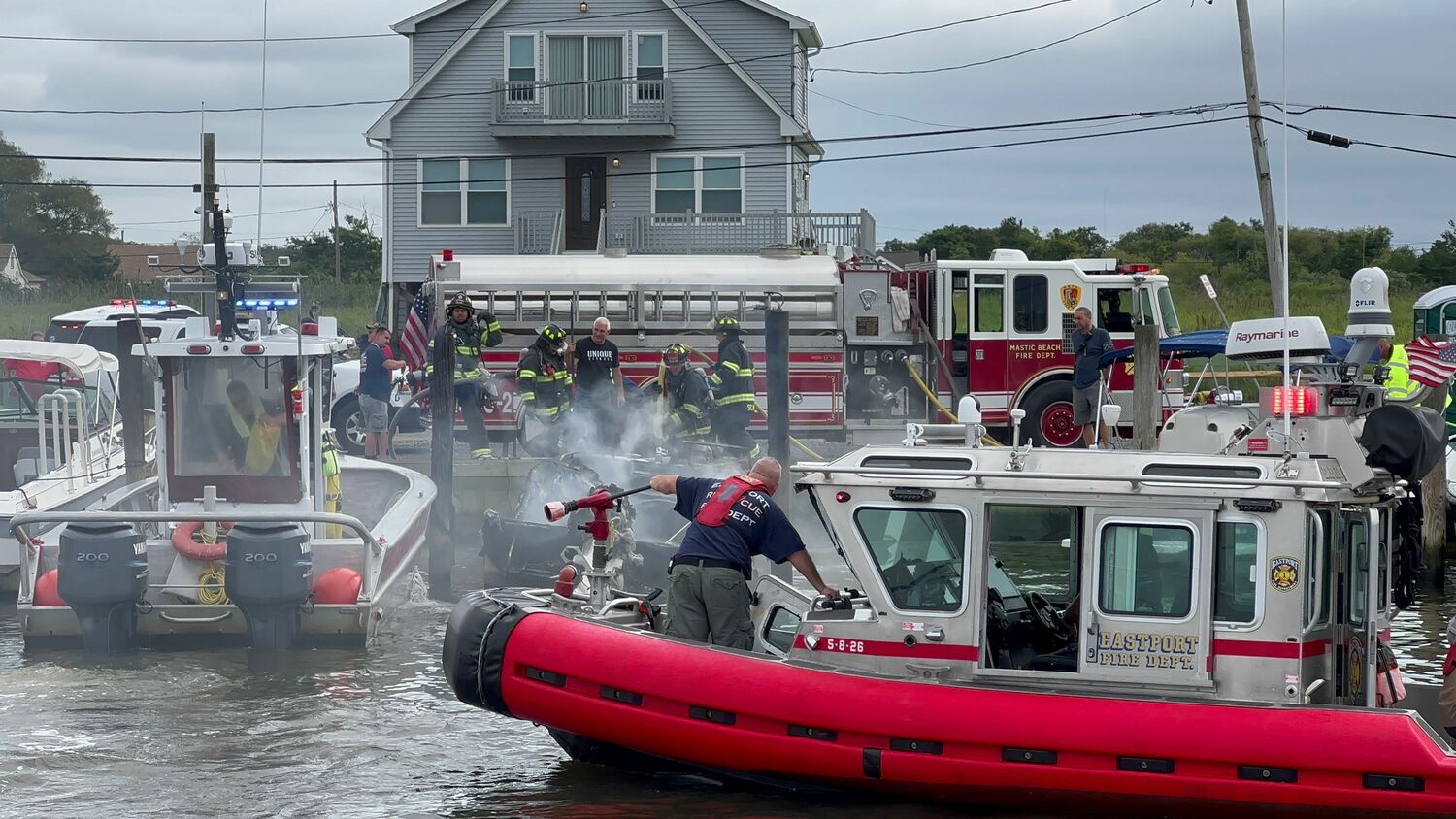
Six local fire departments formed a coordinated marine rescue team to respond to emergencies on and around Moriches Bay to fill the gap left by the loss of US Coast Guard crews in the bay due to staffing shortages.
Six local fire departments formed a coordinated marine rescue team to respond to emergencies on and around Moriches Bay to fill the gap left by the loss of US Coast Guard crews in the bay due to staffing shortages.
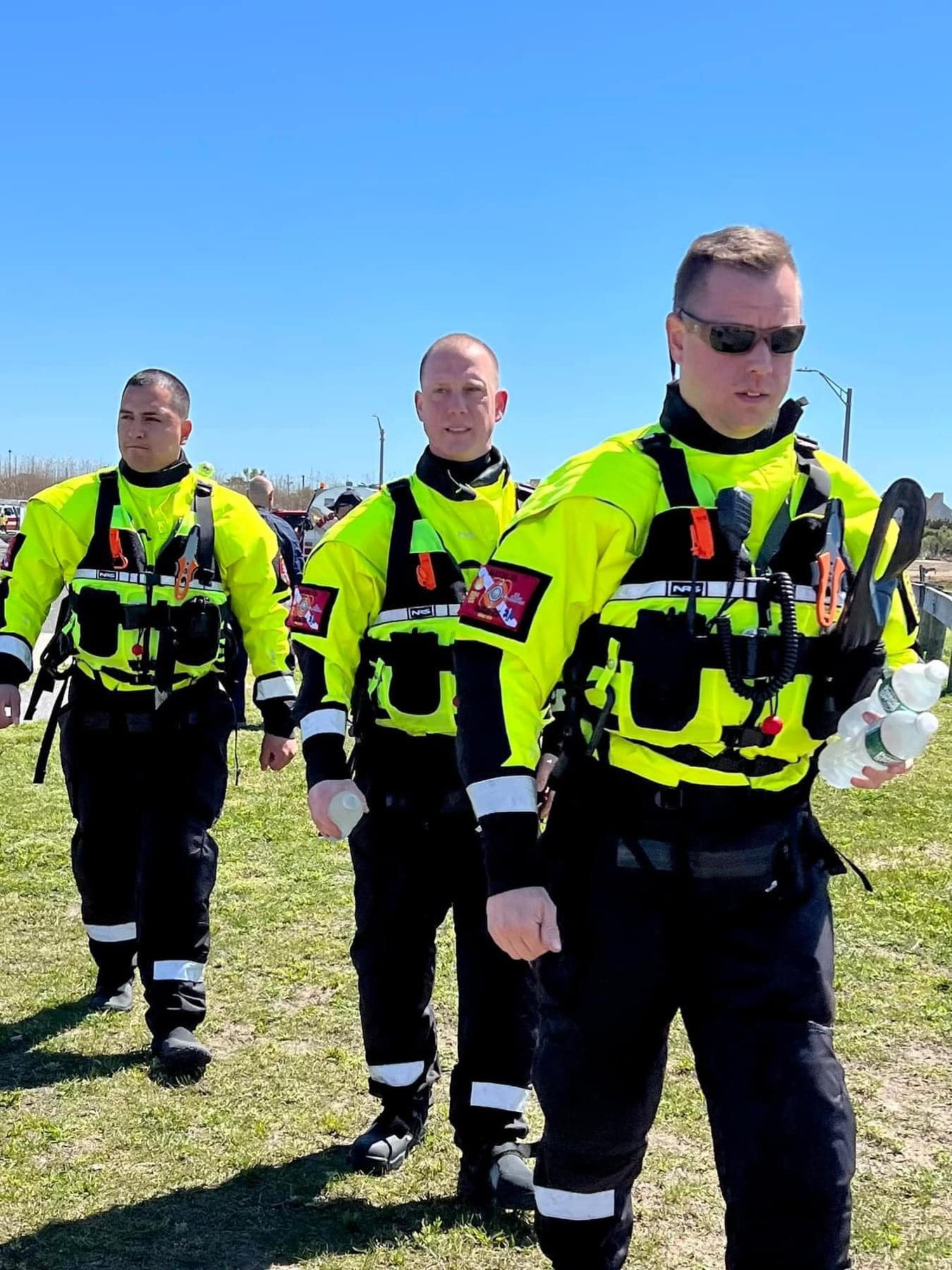
Marine Incident Response Team rescue swimmers Jonathan Parraga, Ian Arthur and Jason Lasek, who are members of the Mastic Fire Department.
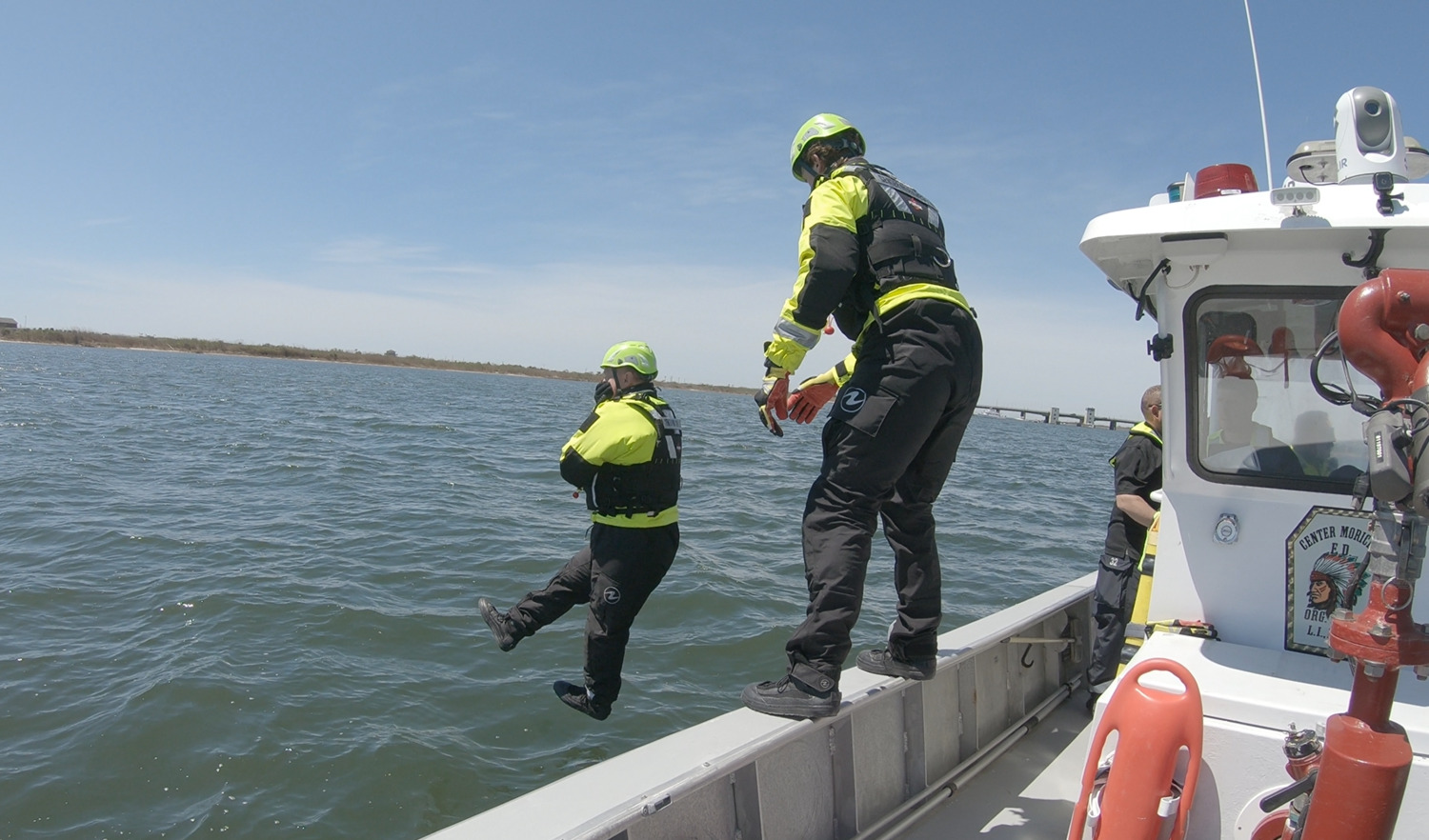
The Marine Incident Response Team rescue swimmers train on marine rescue tactics with the US Coast Guard.
News that a kayaker had been overturned and sucked out Moriches Inlet into frigid ocean waters last month shocked many in the local boating community.
The surprise was not just at the seemingly foolhardy venture of kayaking, especially near the inlet, in wintertime, but, for many, was also at the revelation that the U.S. Coast Guard station that sits on the bay’s northern shoreline, just a mile and a half from the inlet, is not manned with emergency response crews or vessels in the off-season anymore.
The East Moriches Coast Guard station is now officially manned by a single USCG rescue vessel and crew only on weekends during the summer months, deploying one of the boats otherwise assigned to the Coast Guard station in Shinnecock Bay, known as Station Shinnecock.
The rest of the time, the East Moriches station is purely an administrative office.
To fill the gap in marine rescue emergencies, six local fire departments have formed a joint response team that trains with the Coast Guard and drills twice a week on water rescues and searches and a wide variety of scenarios. With a half-dozen vessels and more than three dozen volunteers, the Marine Incident Response Team, or MIRT, responded to 21 emergency calls in 2023, capped off by the overturned kayaker. It was one of their boats that reached the hypothermic man first.
“Our whole team responded to that incident — Eastport’s boat was in the water at the time, so they headed there directly. Center Moriches and Mastic launched their Zodiacs and Mastic Beach sent their Jet Skis,” said Bill Renzetti, the response coordinator for the MIRT, which is made up entirely of volunteers from the Westhampton Beach, Eastport, East Moriches, Center Moriches, Mastic and Mastic Beach fire departments. “Without the East Moriches Coast Guard boat, they are responding from Shinnecock, so when time is of the essence, we are able to get our assets on the water quicker. That’s why we put this team together.”
The removal of the rescue deployment from East Moriches is part of a service-wide struggle with staffing levels within the Coast Guard that has plagued the service in recent years and is the second trimming of Coast Guard crews on the South Fork this winter. In December, the Coast Guard announced that it would be removing the cutter assignment from Montauk Harbor as personnel shortages have forced it to reduce the cutter fleet. The cutter that has been stationed there in recent years, the 87-foot Marine Protector-class patrol boat Bonito, will be mothballed on dry land.
Coast Guard brass have blamed the shortages on recruiting and retention difficulties, especially since the 2020 pandemic. Currently, the Coast Guard is more than 10 percent below its target personnel level, forcing a consolidation of services.
“We just don’t have the amount of personnel that we used to,” a Coast Guard spokesman, Ensign Hunter Medley, said last week. “We are trying to fix the recruiting and retention crisis so we can keep our small stations manned and staffed with trained crew members.”
The search and rescue response abilities of the service as a whole have not been diminished by the restructuring of deployments, Medley said, since each sector is still covered by response vessels: Moriches by the Station Shinnecock crews and long-range seas off Montauk by a cutter based in New London, Connecticut.
“We are still responding to all search and rescue calls from anywhere in the [region] from Station Shinnecock with maximum effort,” said Bosun Greg Lewis, the commanding officer at Station Shinnecock.
“At Shinnecock, I have 26 active duty personnel, 19 reservists who work one weekend a month, two 47-foot motor lifeboats and two 29-foot inshore response boats,” Lewis, a 26-year Coast Guard veteran, said. “If you think about the history of the Coast Guard, we have come a long way from when we had these little stations all over because you had to be close to where something might happen. We’re able to respond much faster now.”
Lewis said that one of the boats from Shinnecock did respond to the overturned kayaker and arrived on scene just a few minutes behind the MIRT boat. It takes his boats about 35 minutes to reach Moriches Inlet from the Shinnecock station, by motoring through western Shinnecock Bay and the Quogue Canal. The crews conduct regular surveys of boat traffic in the summertime and can speed through long no-wake zones in an emergency.
This winter is the first that the Coast Guard has not had a rescue boat and crew at Station East Moriches at least some of the time, Lewis said. Starting last winter, the service had begun testing the part-time staffing, keeping its boat there on the weekends only in the off-season. That staffing assignment was continued through the summer and then the decision was made to keep the crew at Station Shinnecock through this winter.
Station East Moriches is a large complex with multiple buildings and storage facilities. In 1996, it was the main staging area for the TWA Flight 800 recovery operations, and where most of the wreckage and the bodies of victims were brought to shore before being transported to a hangar in Calverton where the aircraft was reconstructed to aid in the investigation of the cause of the crash. The facility is a sector field office, home to about 30 Coast Guard administrative staff who handle health services, billing, marine safety and boat maintenance technicians.
But it has been years since the Coast Guard maintained a full rescue detail there. For most of the last two decades it has been staffed by a single rescue boat and crew who were officially part of the Station Shinnecock deployment.
Moriches Inlet is not technically a “navigable” inlet by Coast Guard standards — largely because it is not dredged — and has no commercial fishing fleet like Shinnecock and Montauk do, and while summer boat traffic is heavy, there are relatively few larger vessels that roam far out to sea.
But it does have a large recreational fleet – including two multi-passenger party boats – and is a very dangerous inlet, because it is not dredged, and the sand bar across the mouth of the inlet can create very hazardous conditions even on relatively calm days.
And that is why the local fire departments whose districts fringe the bay saw the need for a maritime emergency response team, even before the Coast Guard had completely withdrawn its rescue crews from the bay.
“In 2021, the Coast Guard was having difficulty with personnel numbers as far as being able to staff the station here 24/7, so we got together as local fire departments and said we have to be ready to respond,” Renzetti said. “We all have always had a presence on the water, we had our boats, but we knew we needed to start coordinating and be prepared to respond to everything if the Coast Guard wasn’t going to be able to get there.”
The MIRT is dispatched by Suffolk County Emergency Services and responds to any maritime emergency between the Beach Lane Bridge in Westhampton Beach and Smith Point Bridge in Mastic Beach, and out into the ocean east and west of the inlet. The team responds to calls 24 hours a day.
The volunteers include individuals trained as “swiftwater” and “flood water” and “surface water” rescue swimmers — meaning they are prepared to leap from a vessel into the water to assist a distressed person — as well as ice rescue technicians, and certified scuba divers.
The unit’s fleet of vessels includes two SAFE Boats – which are actually former Coast Guard vessels – and four other center consoles, each equipped with thermal imaging equipment for navigating in the dark, and high-definition side-scan sonars and full compliments of medical equipment and firefighting hoses, personal watercraft and even a hovercraft for ice rescues. Renzetti said the unit has been in search of grant funding to help it purchase new equipment like night-vision goggles that would help its volunteers in emergency situations.
“Training is the key to our team’s success,” Renzetti, a former chief of the Center Moriches Fire Department, said. The crews train twice week throughout the summer and do cold-water training several times during the winter.
The six departments maintain their own vessels, but the group trains together and responds to each call as a coordinated unit, deploying the most needed or appropriate resources in coordination.
The team trains with the Coast Guard often, and Renzetti said MIRT and the Station Shinnecock crews have a great relationship and conduct an annual joint training exercise — along with volunteers from all of the other East End fire department marine units — each spring off Shinnecock Inlet.
“Mastic Beach has divers, Center Moriches and Mastic have water rescue swimmers, we have the SAFE Boats and [personal watercraft], so we all work together,” Renzetti said. “It’s a real team response. We are water-based communities and we have to be ready for anything that comes up.”


 Michael Wright on Mar 12, 2024