



 7 Photos
Adrienne Esposito, executive director of Citizens Campaign for the Environment, speaks at Tuesday's Town Board meeting. DANA SHAW
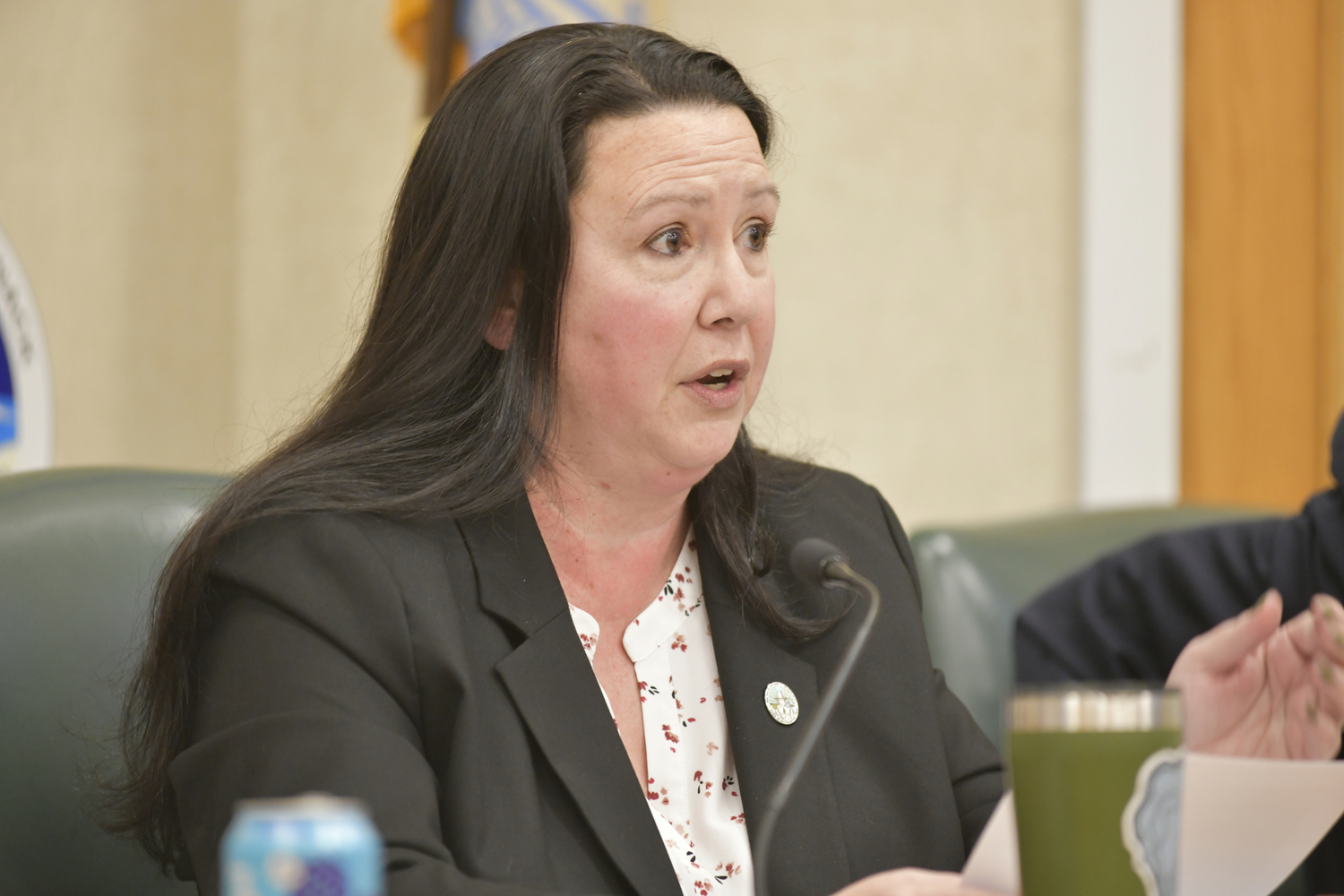
Southampton Town Councilwoman Cyndi McNamara at Tuesday's meeting. DANA SHAW

Architect Chris Coy speaks at the sand mine hearing at Tuesday's Southampton Town Board meeting.

Bob DeLuca, president and CEO of Group for the East End, speaks at Tuesday's Town Board meeting.
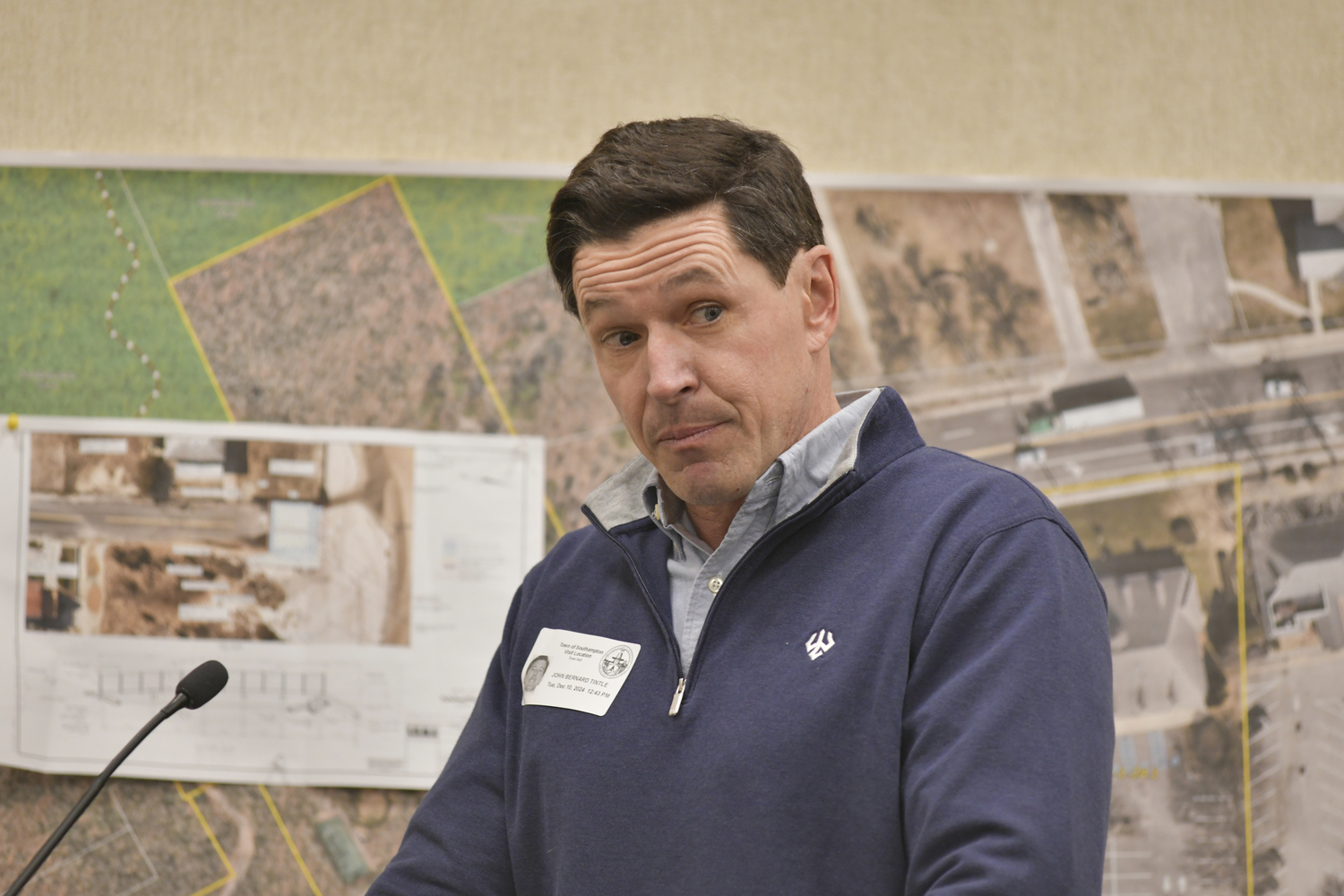
John Tintle, owner of Sand Land in Noyac, speaks at Tuesday's meeting. DANA SHAW
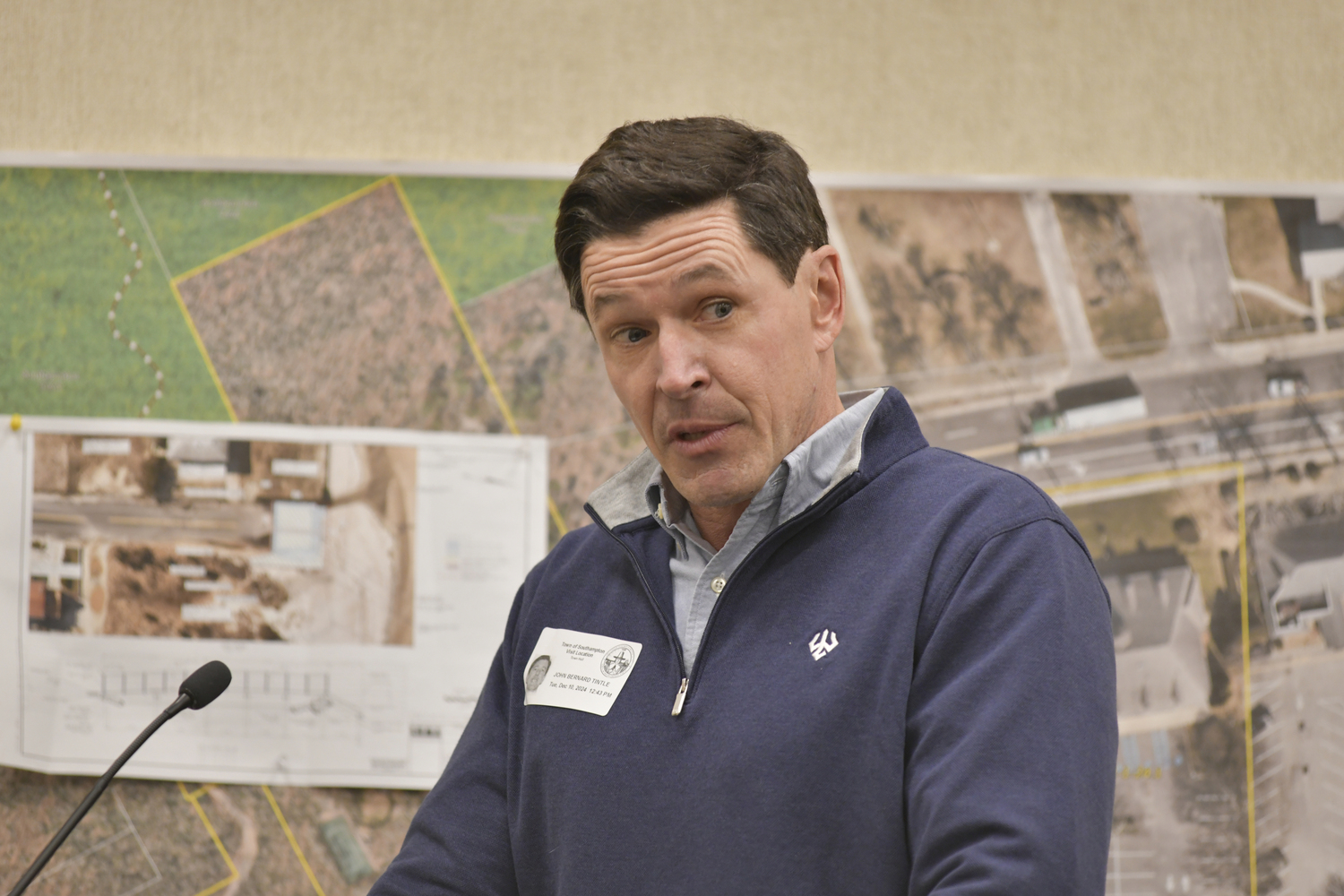
John Tintle, owner of Sand Land in Noyac, speaks at Tuesday's meeting. DANA SHAW

Southampton Town Supervisor Maria Moore at Tuesday's Town Board meeting. DANA SHAW
The battle lines were clearly drawn as the Southampton Town Board on Tuesday opened a hearing on a proposal that would force the closure of sand mines in the town over the next seven years.
Residents and environmentalists spoke unanimously in favor of the proposal, which would use a zoning tool called amortization to force mines that are in residential zones or special groundwater protection areas to shut down in the near future. Those who represented mining and construction interests were unanimously opposed.
The board’s meeting room was packed, with an overflow crowd forced to watch the proceedings on video screens in the ground-floor auditorium. While it appeared that more opponents of the legislation filled the room, the majority of speakers were in favor of it.
The audience was orderly, but a brief altercation between two men on opposite sides of the issue outside the meeting room brought police to the second-floor hallway.
Under the proposed legislation, those mines that have extracted all of the sand allowed by their mining permits would be forced to close within a year, and those that still have sand left to mine would be allowed to petition the Zoning Board of Appeals for an extension of up to seven years to exhaust their sand allotments. A total of seven mines, most inactive, would be targeted by the legislation.
After listening to testimony, which included a lengthy statement in opposition from Councilwoman Cyndi McNamara, the sole Republican on the board, at the start of the hearing, the board tabled the matter until January 28, as town planners begin to coordinate the environmental review of the proposed law under the guidelines of the State Environmental Quality Review Act.
McNamara presented a thick folder containing copies of emails — some of which, she said, contained confidential information intended for board members only — that had been sent from Councilman Bill Pell, the sponsor of the legislation, to Supervisor Maria Moore’s husband, Thomas Moore.
“I am left to question, as should you, why the supervisor’s husband was so heavily involved in this matter, as none of you elected him to represent you,” she said.
Moore dismissed the complaint. “Another councilperson happens to be friends with my husband, who is a lawyer, and he likes to get his input as well,” she said. “I don’t see anything wrong with that.”
Water Quality and the Economy
McNamara also accused Pell and Moore of hypocrisy, noting that the legislation cites groundwater protection as its key goal, while at an October work session to discuss the proposal, Pell said some mine operators would be happy to process vegetative waste, a use that has been linked to groundwater contamination.
At that same meeting, “when I asked why the town hadn’t collected data on the drinking water, the supervisor stated, ‘We are not basing this on the water — it is about the use,’” McNamara said.
McNamara also charged that town staff members who had sought to guide the legislation through the process had been bypassed in a rush to get it passed.
Kevin Brown, an attorney from Syracuse, who appeared on behalf of Huntington Redi Mix Concrete in Westhampton, said Southampton was not alone in trying to eliminate mines. Towns across Long Island have adopted, as “the issue du jour,” the elimination of sand and gravel mines, he said. Where there were once 73 mines scattered across Long Island two decades ago, only 21 remain, he said.
Brown said Long Island’s sand and gravel, the byproduct of its formation by glacial debris, was of high quality. He called on the town to recognize the importance of balancing the needs of contractors for material, with environmental protection.
“The premise of this law is that sand and gravel mining presents a threat to groundwater,” he said. “There is no credible study that supports that allegation. Not one.”
John Tintle, the owner of Sand Land and East Coast Mines, who has charged that the law targets his business, also dismissed claims that mines pollute the groundwater. “The stated purpose of this law is based on a falsehood,” he said. “The law is proposed to protect the groundwater, while no known threat exists.”
Far from seeking to eliminate mines, the town’s Comprehensive Plan “recognizes the preexisting right to mine,” he said.
Tintle said that since Sand Land closed last year, the cost of gravel has risen 40 percent, and it was becoming more and more difficult to meet the local need for material.
He urged the board to remember the winter of 1992-93, when Dune Road in Hampton Bays was breeched by a storm surge. “East Coast Mines was open around the clock for a week while every truck that could haul sand was marshaled to stop the breach and save Dune Road,” he said.
Tintle, who has charged that the town is trying to ban mines to win the favor of Robert Rubin, the owner of The Bridge golf club, which is next door to Sand Land, concluded, “This law should be voted down, and Robert Rubin’s influence over this board needs to come to an end for the good of this community and the integrity of this board.”
A Decision 50 Years in the Making
But Bob DeLuca, the president of the environmental organization the Group for the East End, argued that the board was doing the right thing.
Towns, he said, are required by the state to adopt zoning codes that comply with their Comprehensive Plan, and “it’s a central tenet of zoning that nonconforming uses come into conformity over time.” He said mining had been prohibited in residential zones for 50 years and, in a reference to Sand Land, said some mines had engaged in “industrial operations,” such as composting and processing construction debris.
“Such practices by their very nature increase the risk for groundwater contamination,” he said, adding that Suffolk County had documented contamination in Southampton. With the State Department of Environmental Conservation being unwilling to intervene, he said it was up to the town to close mines and order the land to be reclaimed.
Ron Paulson, who ran testing programs for the county, including at Sand Land, agreed. He said the groundwater was “under siege,” not only from mining operations but from pesticides, forever chemicals and sea level rise. He said groundwater protection areas were established to protect that resource, and it was time to take the designation seriously.
“You can’t truck in water or pipe it in,” he said. “You can truck in any damned building material you want.”
Adrienne Esposito, the executive director of Citizens Campaign for the Environment, also spoke in favor of the legislation. She criticized the DEC for failing to do its job.
“They are doing a fine job acting as a business partner with sand mines, but not as a regulator for sand mines,” she said, adding that left it to the town to take on the responsibility.
Esposito said state environmental law had established special groundwater protection areas and the only one in Southampton was in the area where the Sand Lane mine is located. She said the county health department had to go to court in 2017 to get the okay to sink test wells at Sand Land and said those tests found high levels of manganese and other polluting chemicals — a charge that Tintle in his own testimony disputed.
A Burden on Business?
Louis Grasso of Huntington Redi Mix said his company had already invested more than $15 million “under the premise we would be able to complete our project under the fullest extent, not just under the current DEC permit” but upon modifications of that permit. He said it was difficult for companies like his to plan for the future when it doesn’t know what kind of threat is going to confront it next.
Grasso said the DEC is already overseeing mines with “a staggering” level of regulation.
“They are not letting us miners do anything that is unacceptable to the environment,” he said. “The situation is very much under control, and it simply does not need further oversight from the municipality.”
He called for the town to work in partnership with mines and the DEC and said that sand is the second most used resource next to water.
“The Town of Southampton, along with all of Long Island, may be facing a sand crisis that they don’t even know is fast approaching,” he said. “This law is only going to bring that upon us even faster.”
Don Mahoney of Southampton said the law was an attack on the town’s working class. “From a business standpoint, this is just another nail in the coffin of local, hardworking members of this community,” he said. “Your actions are literally taking individuals’ careers away and very directly impacting the fiscal livelihood of their families.”
He said that segment of the community represented youth coaches, fire department and emergency services volunteers, and others who give back to the community.
He said the board needed to go back to the drawing board and warned that, if approved, the legislation would increase costs for both local businesses and the town itself. He cited Highway Superintendent Charles McArdle, who said at a recent board meeting that the law would put the squeeze on his budget by raising the cost of raw materials.
Concerns for Aquifer
Andrea Klausner of Water Mill objected to “opponents of this law categorizing this decision as a binary choice between our economy and our environment.” In fact, she continued, “the health of our local economy depends upon the health of our air and water.”
Klausner said the town outlawed mines in residential areas 50 years ago with the idea that they would be phased out. “Yet here we are, 50 years later, and the remaining mines still have not ceased operation, and some have attempted to expand,” she said.
She said the amortization law was “a fair solution that balances the environmental concern with the economic interest of the mining community.”
Klausner also took issue with ads in The Express News Group papers taken out by Tintle criticizing Democrats for accepting campaign donations from Rubin. She said McNamara had accepted a donation from Tintle. “Does this make Ms. McNamara’s opposition to the law suspect?” she asked. “No more so than does a campaign donation from Mr. Rubin.”
John Kirrane, whose family moved to Noyac in 1961, said he had witnessed firsthand the environmental destruction caused over the decades by Sand Land and the threat it caused to the groundwater.
“How would anybody have the audacity to do what has been done to the site?” he said, adding that he used to ride his bicycle past the mine when he was a boy and had seen the changes over the years.
“I’m not sure how anyone could look at Sand Land and possibly have a conflict with this proposed legislation,” he said, pausing to thank Pell and Moore “for having the courage to go up against these voices.”
Kirrane took issue with those who say the economic cost of the legislation would be too high. “I would counter with the impact of no legislation would be much more devastating,” he said. “There would be no return from destroying our aquifer.”


 Stephen J. Kotz on Dec 11, 2024