


 1 Photo
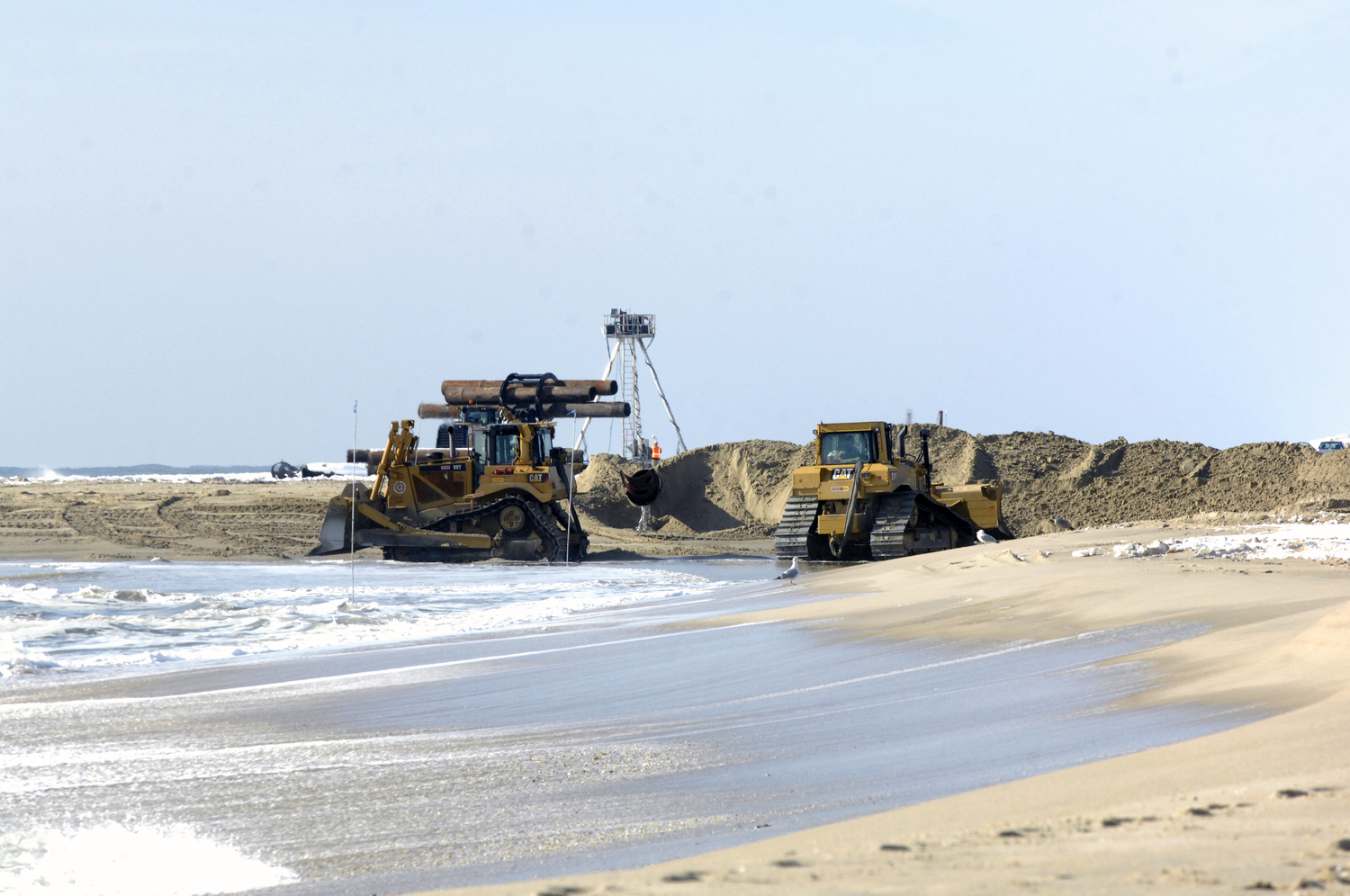
Two massive beach nourishment projects will take place on the South Fork this winter, one in Bridgehampton and Sagaponack and the other in West Hampton Dunes. DANA SHAW
An ocean-going dredging crew will begin work on the broadening of six miles of ocean beaches in Sagaponack, Bridgehampton and Water Mill on December 1 — a $22 million, privately funded project that homeowners hope will steel their shoreline against storms for a decade.
And early next year a second dredging crew will begin similar work on the beaches in West Hampton Dunes, work that is part of the Fire Island to Montauk Point Reformulation, or FIMP, that is funded with federal Superstorm Sandy storm resiliency money.
The Sagaponack project will pump 1.2 million cubic yards of sand — 120,000 dump trucks worth — onto the shoreline between Townline Road in Sagaponack and Fowlers Lane in Southampton Village.
It’s the second time that the 130-odd oceanfront homeowners who formed two erosion control taxing districts in the wake of Sandy will buck up to bolster their beaches. Southampton Town bonds for the funding to pay the dredging crews then taxes the homeowners according to linear feet of ocean front and assessment values. Individual homeowners pay between $10,000 and more than $200,000 a year for the largest properties.
The total cost of the project will be about $22.5 million and will take two to three months to complete, depending on weather conditions.
The sand will be pulled from “borrow” sites about a mile offshore and pumped ashore by the dredging vessel owned by Great Lakes Dredge & Dock, where it will be spread out by bulldozers. The work will continue around the clock when weather allows.
The West Hampton Dunes project is part of a multi-project package being managed by the U.S. Army Corps of Engineers so the exact start date is not known yet.
The federal project will also be vastly more expensive despite being much smaller than the Sagaponack-Bridgehampton work. According to Aram Terchunian, who coordinated the planning of the projects on behalf of both the Sagaponack and Bridgehampton homeowners and West Hampton Dunes Village, said that the federal project will cost some $44 million.
The higher cost is driven in part by the much more extensive preplanning and surveying that the private project did ahead of the project — saving the dredging company from having to deal with unforeseen conditions at the dredging site, Terchunian said, and also in part by the fact that the sand to be used to broaden the beaches must be pulled from farther away.
The West Hampton Dunes shoreline was originally rebuilt in 1994, after the ocean breached the barrier island during a series of severe winter storms. Homeowners sued, blaming the erosion on jetties constructed in Westhampton Beach, and won a court order to the Army Corps that the beaches be restored and maintained for 30 years.
The original reconstruction, however, required 4.5 million cubic yards of sand that was pulled from directly offshore of the barrier island — leaving a 20-foot deep basin in the ocean floor that fishermen have said remains a dead zone. Since then, the crews have had to range farther to get sand for the regular nourishments in the village, which have been done about every four years.
“In Sagaponack we made it easy — we spent money on the surveys of the borrow areas and we get it back 10 times because we gave [the company] the highest level of predictability,” he said. “In Westhampton, the borrow site is off Quogue, so they had to use a hopper dredge last time. The borrow site from the first time, back in the 1990s, still hasn’t recovered. That was 4.5 million cubic yards, so they’re having to spread out the borrow sites.”


 Michael Wright on Oct 25, 2024