


 5 Photos

Bill Oberkehr of NYSERDA speaks about battery energy storage systems at Tuesday's Southampton Town Board meeting. DANA SHAW
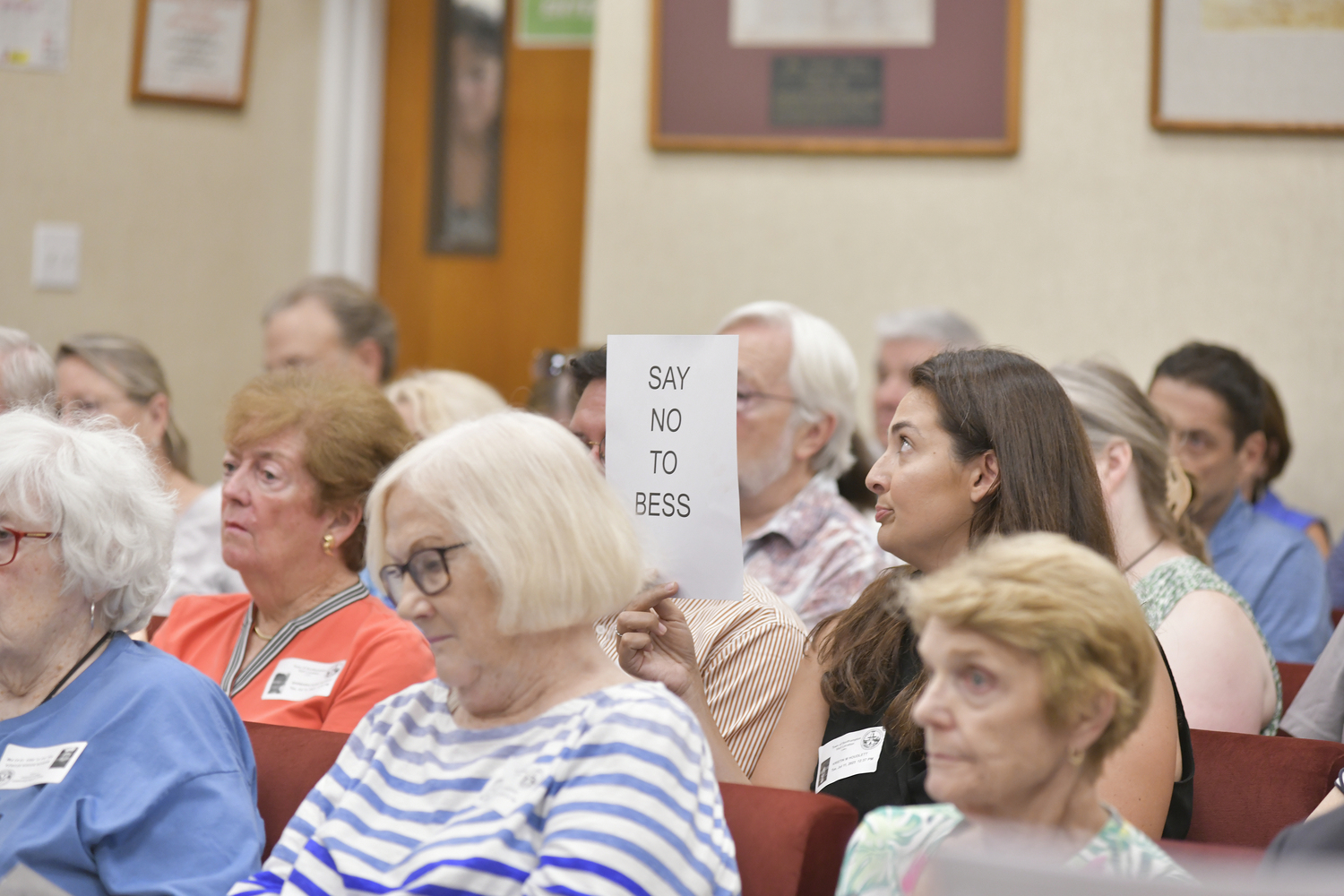
Visitors to the Southampton Town Board meeting on Tuesday express their opinion of battery energy storage systems. DANA SHAW

Bill Muir speaks about battery energy storage systems at Tuesday's Southampton Town Board meeting. DANA SHAW

Rome Arnold speaks about battery energy storage systems at Tuesday's Southampton Town Board meeting. DANA SHAW
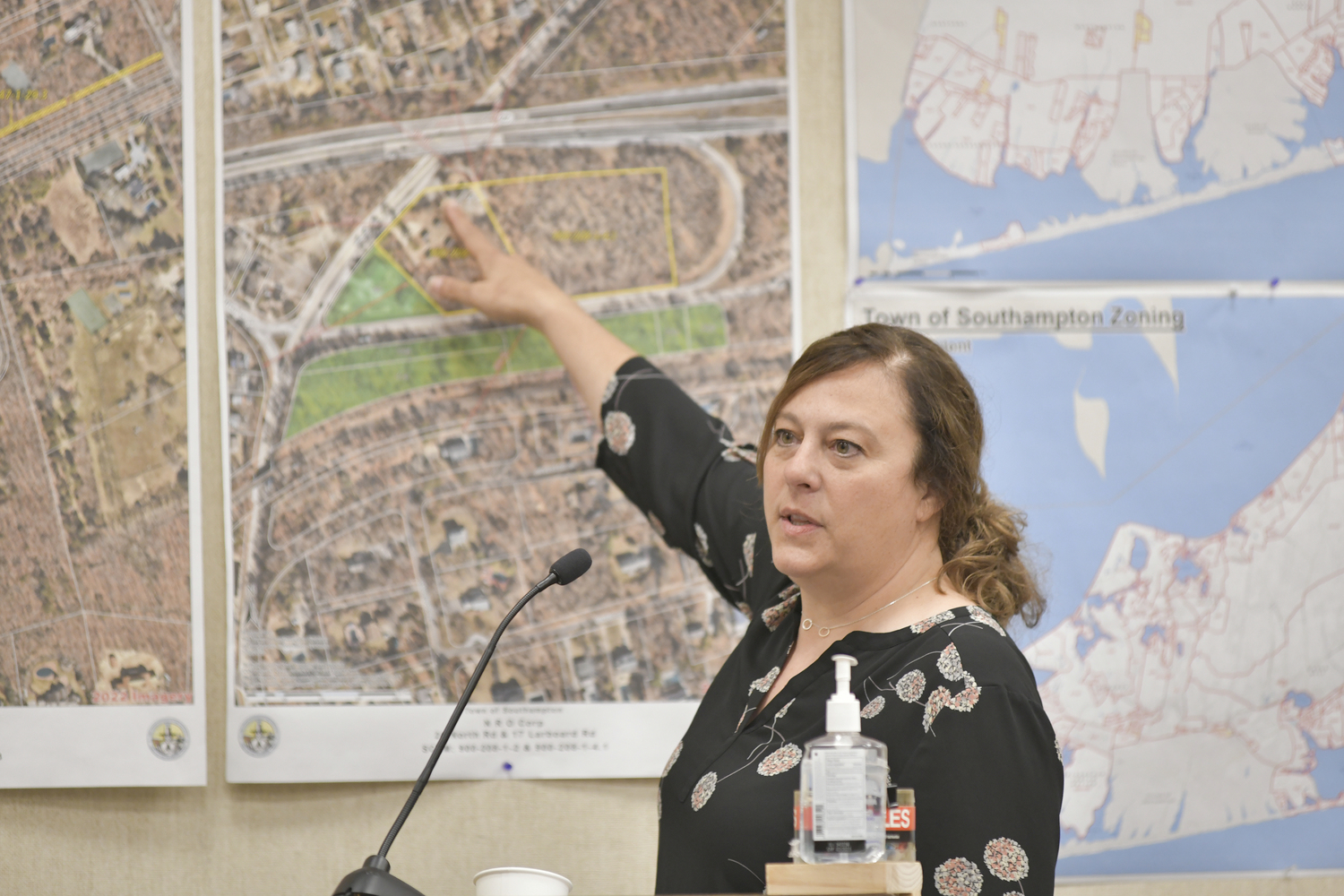
Southampton Town Planning and Development Administrator Janice Scherer talks about the general area where a proposed battery energy storage system will be located in Hampton Bays. DANA SHAW
For over four hours on Tuesday, members of the Southampton Town Board heard comments from more than 30 speakers during a public hearing on a proposed moratorium on the construction of new battery energy storage systems.
And, while the subject of the July 11 hearing was supposed to be BESS applications townwide, most speakers focused on the ardently opposed Canal Southampton Battery Storage proposal in Hampton Bays.
As put forth by town officials, the three-month moratorium would halt review of any new BESS applications — but Canal Southampton would be excluded from the pause because review of the application is already in process. Excluding applications already under review is a common practice when municipalities enact moratoriums.
However, Town Supervisor Jay Schneiderman and the moratorium sponsor, Councilwoman Cyndi McNamara, both reported that they had crafted alternative legislation that, if adopted, would enact a six-month moratorium that would include Canal Southampton.
Located off North Road in Hampton Bays, the Canal Southampton plan seeks approval from the Planning Board to build 30 battery enclosures, each with 24 battery modules, on a 4.9-acre property. Speakers offered a laundry list of justifications for their opposition.
Key among concerns was the potential for a disastrous fire. With the facility located just south of Sunrise Highway, near the exit ramps, as well as near the Long Island Rail Road, speakers wondered how people would escape the area in the event of a large fire.
It was mentioned that, in other BESS fires, a half-mile evacuation radius implemented would encompass closure of both Sunrise Highway and Old Montauk Highway. In the event of a disaster, said Hampton Bays resident Josh Poulakis, “nothing’s going to move.”
“What happens when this thing catches fire?” he asked, impassioned. “We’re all f----d! Done!”
It wasn’t just escaping a conflagration that speakers mentioned.
Donna Kreymborg, chairwoman of the board of directors of Southampton Volunteer Ambulance, spoke of the danger to emergency service personnel, who’d have to respond — if they could get there. In other events, firefighters had to wear hazmat suits to protect against toxic gases. Volunteers don’t generally carry that gear with them and could be exposed, she said.
Additionally, Kreymborg reported that, so far, local volunteers have not undergone training to prepare for a BESS fire. There’s been no training, no talks, “no anything,” to prepare the people who will be called upon to respond to a fire, she said
Nick Petrakis of the consulting firm Energy Safety Response Group attempted to assuage concern. He said New York has the most stringent and all-encompassing fire code in the country. Asked if he thought the site for the Hampton Bays proposal was safe, he said that, yes, as long as the strict code is adhered to, it would be safe.
Petrakis’s assertions triggered an outcry from the audience that packed the Town Hall auditorium and spilled into the adjacent conference room. Striking his gavel against the dais, Schneiderman called for calm.
“This guy’s not working for the developer,” the supervisor said, trying to quell the crowd. Petrakis allowed that he is a safety consultant for the group proposing the Hampton Bays BESS, prompting another outcry.
“You should have disclosed that,” McNamara said.
And who, exactly, is the developer? Hampton Bays activist Gayle Lombardi said she researched the LLC listed on the applicant’s petition to the New York State Public Service Commission and learned that the company, owned in England, is in turn owned by a global investment firm with annual revenue valued at $231 billion.
“This isn’t about green energy,” she said. “This is about green bucks.”
Lombardi pointed derisively to a portion of the filing that stated that the public has been engaged in all aspects of the project.
The absence of community outreach, both for the canal plan and the BESS code adopted in 2020, was a repeated theme. Patricia Kelly Stiles pointed to a Suffolk County Planning Commission review that noted the Canal Southampton is located in a Potential Environmental Justice Area, or PEJA.
“Projects that are situated in a PEJA should receive heightened awareness for resident knowledge and understanding of changes in their community,” the report states.
Patricia McKee made note of the town’s own code that lists “avoidance areas” as those that are environmentally, culturally, and recreationally valuable. “Our community meets all three criteria,” she said.
Highlighting the potential environmental impact of the Canal proposal, speakers mentioned its proximity to the Shinnecock Canal and Meschutt Beach, both downgrade of the North Road site. Earlier this spring, the Hampton Bays Civic Association urged the Planning Board to rescind its determination under the State Environmental Quality Review Act, in which the planners decided the plan did not have the potential for adverse environmental impacts.
But, after making the SEQRA determination, they asked for the moratorium because they felt they needed to learn more about BESS technology.
On Tuesday, Schneiderman said he believed the SEQRA determination might be reversed. If so, he said, the applicant would have to embark on a new, protracted environmental review process that would take months, significantly longer than a three-month moratorium would be, if adopted.
Some speakers did address comments to the official purpose of the hearing — a townwide moratorium that would offer time to revise town BESS regulations. But first, Town Planning and Development Administrator Janice Scherer defended the code adopted in 2020.
“At no time ever here did anyone create a land use code to put anyone in peril,” she said.
Schneiderman underscored that when the code was brought to the town, in furtherance of state sustainability goals, officials were led to believe it was a benign use.
Speakers acknowledge support of the green energy strategy but oppose the notion of siting BESS in residential areas, rather than industrial areas.
McNamara, who was not on the Town Board when the BESS code was adopted, spoke of an email in the hearing record from an email from the owner of a consulting firm that assists with implementing alternative energy projects.
“I understand that the town is looking to make this BESS code work, but there is no need to utilize residential zoning parcels, no matter what the size,” she said. “I truly hope this board understands the scope of these projects. That they have fully considered the ramifications of siting such and they strike the allowance of any and all in residential zones. There are plenty of other means to make BESS storage work — this is not it.”
Brigid Maher noted opponents have been painted as NIMBYs, for “not in my back yard.” She said opponents feel the facilities don’t belong in residential areas — “Not in anyone’s backyard,” she emphasized. Audience members jeered and shouted when Scherer opined that the canal site is “not near anything.”
And while Scherer, along with Bill Oberkehr from the State Energy Research and Development Authority, spoke of months of discussion that led up to the adoption of the code, opponents pointed out that the discussions took place during the pandemic, when, said James Dubrowsky, people were focused on trying to stay alive.
Bob DeLuca, president of the Group for the East End, spoke in support of the moratorium. The hearing on the town’s proposed BESS code was held in December 2019, and, he said, “Nobody came.” The public needs a voice in the decision making, he said, offering that three months is a “very ambitious” time frame to work on revising the code.
The moratorium was not without opponents. Members of the town’s Sustainability Committee spoke out against the pause. They favor more education about the technology.
A petition that gathered 3,000 signatures in opposition to the Canal plan is “loaded with opinions and statements that have no basis in fact,” Helen Roussel said.
“Since there has been no public education on battery energy storage systems, I find it hard to fault my fellow residents for filling the void from what they read on social media, or petitions that lack any foundation in fact,” said Dieter von Lehsten,co-chair of the Sustainable Southampton Green Advisory Committee.
So, what’s next? Board members voted to close the hearing to public comment but leave the record open for comments from the Planning Board and the Suffolk County Planning Commission. Discussion of the moratorium is on the agenda for the Planning Board’s July 13 meeting. The commission doesn’t meet again until August.
If the commission votes against the moratorium, the Town Board could overrule their determination, but must do so with a “supermajority” vote of four of the five members. Recently, the Southold Town Board voted unanimously to override commission findings on its year-long moratorium adopted last spring.
A six-month moratorium that captures the Canal proposal would be subject to a new public hearing, new legislation. While allowing a three-month moratorium on only new applications “is not enough,” Schneiderman said he and McNamara would have to collaborate on a six month pause. Legal advice would be sought in executive session, since capturing an application in process could prompt a lawsuit. The Town Board will discuss a six month pause during its July 13 work session, with a hearing on the longer moratorium possibly on tap for August 8.
At the outset of the hearing, McNamara offered a statement describing her reasons for pushing for the moratorium:
“I asked for a moratorium so that we can learn more about these systems and adjust our code accordingly. While I understand that New York has set some very ambitious goals regarding energy storage, the health and safety of our residents must come before an arbitrarily set timeline. We can support those goals, but we need to make sure that these facilities are sited and operated correctly and to do that we must amend our code. …
“I believe that taking a pause and amending our code with community and impartial, professional and expert input will lead to far less push-back for future projects — but we can’t fix the plane while we are flying it.”


