


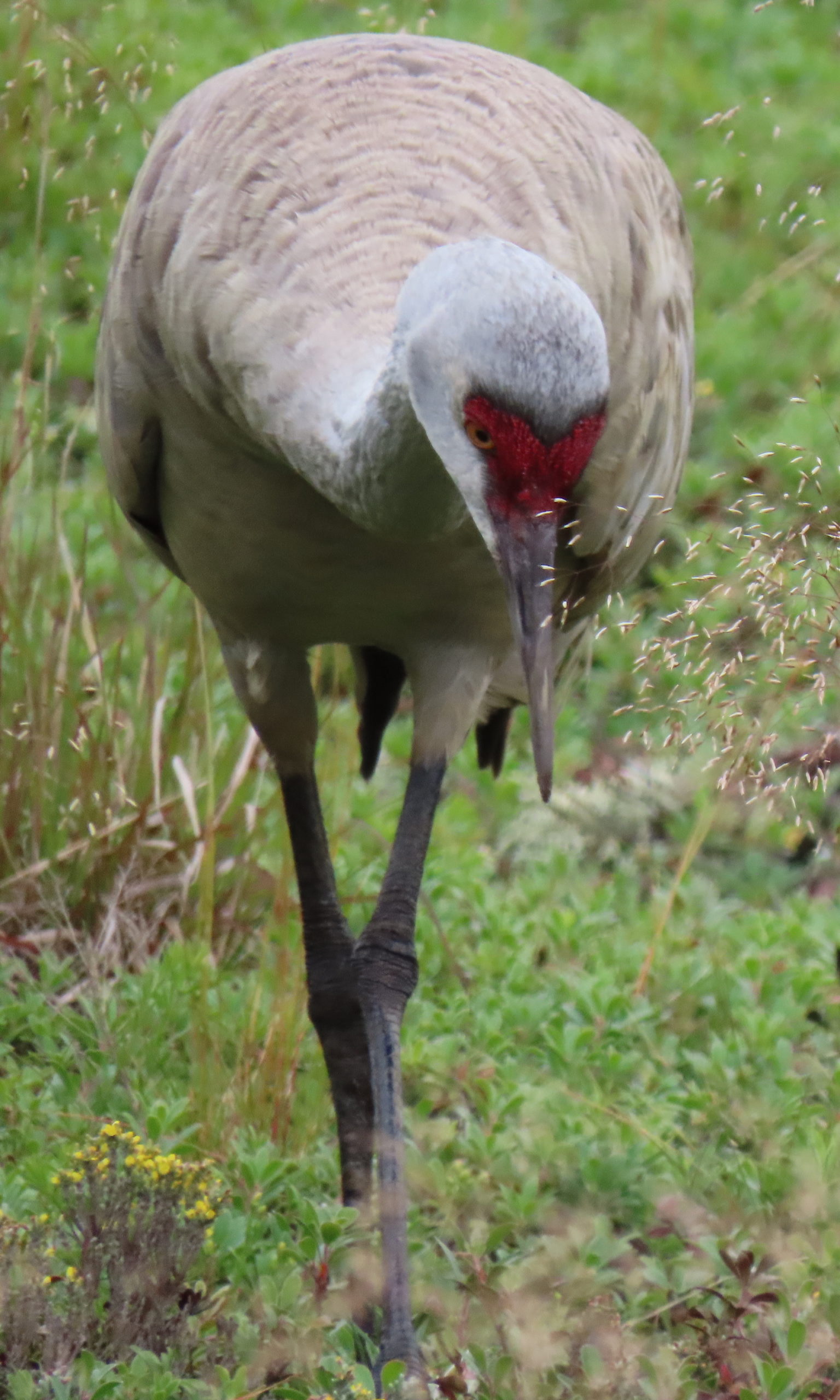
 1 Photo
A rare visitor to Long Island, this sandhill crane spent June in Napeague State Park foraging on bearberry fruit.
As with the past several years, tops among the interesting and exciting wildlife sightings this past year was the summer-long marine mammal show at our ocean beaches. But 2019 brought that up a notch with an estimated 20 humpback whales seen foraging off Maidstone Club and Main Beach early one August morning, and the largest pod of dolphins I’ve ever seen moving eastward later in the day!
The recovery of a type of herring called “bunker” or “Atlantic menhaden” here since their collapse in the mid-1960s has been a factor in not only attracting marine mammals, but has greatly increased the productivity of nesting ospreys and the recently established bald eagles in the region. The size and extent of the bunker schools off our ocean beaches was astounding this past summer.
Normally seen as dark patches at the ocean surface, this August the bunker schools stretched east to west along the shore as far as you can see, even with the aid of binoculars! And when a bird, even any one of our gull species, flew overhead, the bird’s shadow caused the tightly packed bunker to flee to one side or the other of the shadow, creating a wave of whitewater that moved along the surface of the ocean beneath the bird like a zipper parting the water for several hundred yards. Quite a sight!
In terms of interesting sightings, a close second for me was the new and successful bald eagle nest in Accabonac Harbor. Eagle nests are normally located in very large, live tree and hidden from view below the tree’s canopy. The Accabonac nest was located atop an osprey pole, and provided an excellent opportunity to observe the pair of adults, their two hatchlings, and their interactions with the local osprey. Both hatchlings successfully fledged.
Motorists driving along Cranberry Hole Road in June were treated to a close view of a sandhill crane feeding among the open, low growing, dune heath plants. This imposing bird, a very rare visitor to Long Island, stands 4 feet tall and appeared to be feeding on ripening bearberry fruits and stayed in the area for most of the month.
Many people mentioned the large numbers of dragonflies in the area from May through July. Up to two dozen of several species worked the small sunlit area of my backyard, catching insects on the wing. In mid-June, the ocean beach’s wrack line was covered with thousands of dead dragonflies, possibly caught in a storm and driven offshore to perish, that were identified as great blue skimmers.
Were the big numbers of adult dragonflies the result of high groundwater levels, full vernal ponds, and low mortality of dragonflies during their aquatic larval stage? I’m not sure. But the flooded vernal ponds, prime breeding grounds for many amphibians, boded well for the survival of our larval salamanders (tiger, spotted, marbled, four-toed and blue-spotted), frogs (wood, spring peeper, gray treefrog) and toads (Fowlers and spadefoot). As to the latter, I did not receive any reports of spadefoot vocalizations at potential breeding ponds from colleagues, yet several reported finding many recently metamorphosed young over the course of the summer.
State Department of Environmental Conservation biologists Samantha Hoff and Casey Pendergast reported on their research on Northern long-eared bats here on Eastern Long Island. With the help of volunteers, they’ve documented these very endangered bats overwintering in residential crawl spaces where temperatures rarely drop below 40 degrees.
And, they are not hibernating for the entire winter. On warm nights, they are emerging to feed. The question is: What nocturnal insects are available for them to feed on in winter?
Consider attending the March 20-21 Long Island Natural History Conference at Brookhaven National Lab to learn about this interesting project, and many other research and conservation projects on Long Island involving Atlantic menhaden, diamondback terrapins, white sharks, bay scallops, oysters, alewives, right whales, Eastern box turtles and the red fox. Subscribe to the conference email list at longislandnature.us8.list-manage.com/subscribe?u=4c814617da8381de223fadc93&id=e82115d392.
Closer to home, consider joining Jamaica Bay Guardian Don Riepe and myself for the Montauk Natural History Weekend (January 10-12) at the Montauk Manor. We’ll be heading out to the field to observe seals and winter waterfowl, and visit the winter scenery of some beautiful nature preserves. Info at littoralsociety.org/montauk-winter-weekend.html.


 Mike Bottini on Dec 17, 2019