


 3 Photos
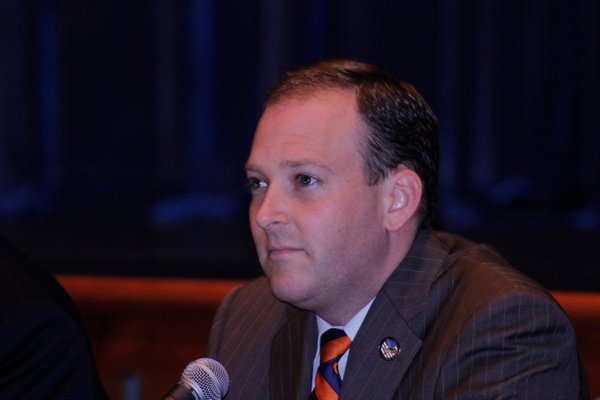
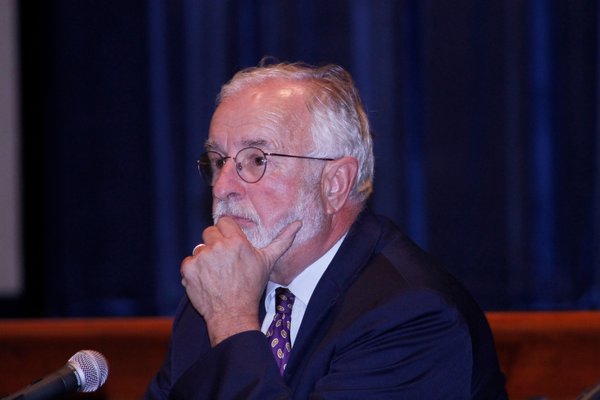
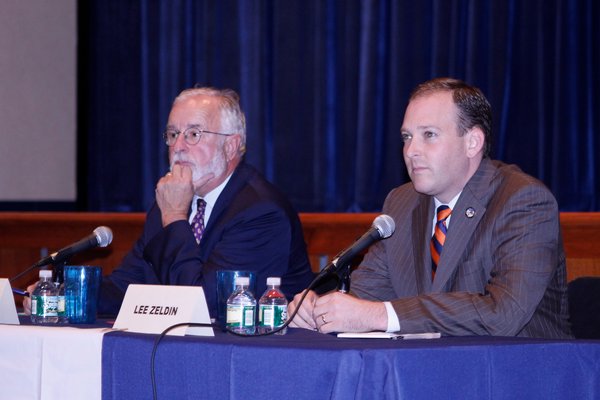
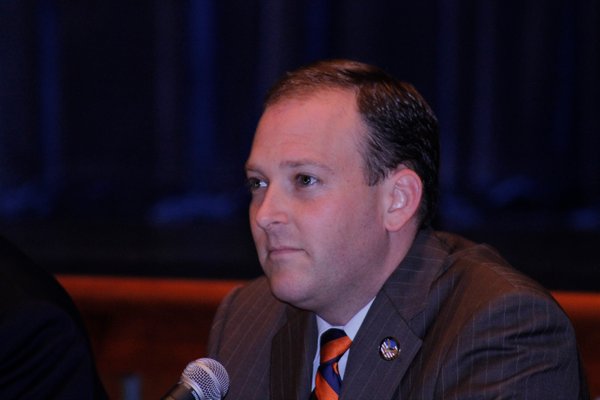
Congressman Tim Bishop, left, and State Senator Lee Zeldin during a debate at Westhampton Beach High School. KYLE CAMPBELL
In a rare moment of agreement, both candidates running to represent eastern Long Island in Congress criticized the president’s handling of the Ebola virus outbreak in the United States, and called for a travel ban to and from western Africa during a debate last week at the Westhampton Beach High School.
Incumbent U.S. Representative Tim Bishop, a Democrat from Southampton, called on Congress to cut its recess short in order to address the crisis regarding the virus, while his challenger, Shirley Republican and State Senator Lee Zeldin, said President Barack Obama has shown poor leadership on the issue.
“The president and his administration’s handling of this entire crisis has been terrible,” Mr. Zeldin told the estimated 100 people in attendance. “I think we need to ramp up and have the maximum screening procedures at our airports.”
Several audience members at the debate, which was organized by the League of Women Voters of the Hamptons, cosponsored by The Press News Group and held last Thursday night, October 16, questioned what the candidates thought of the way the virus had been handled thus far and should be handled moving forward.
Mr. Bishop added that the country could not afford to wait until after next month’s election to deal with the issue, which has resulted in one death on American soil, as well as other reported cases.
“I know we’re in election season, but certain members of the Senate and House are asking that the Senate and House be brought back into session to deal with this,” Mr. Bishop said. “I would support that, because it’s a very important issue that we can’t let sit until November 12.”
Outside of the few minutes of cordial agreement that the candidates shared on the Ebola issue at about the midway point of the debate, the two men contested each other on standard talking points—such as the Affordable Care Act, Common Core and immigration—as well as ideological stances on issues like minimum wage, abortion, the national debt and efforts to combat the extremist group known as the Islamic State in Iraq and Syria, or ISIS.
The debate hit a fever pitch when the candidates were asked about their views on how to fix Social Security and keep it solvent. Brought up frequently during debates between these two candidates, the topic is a vexing one for Mr. Zeldin, who has faced a barrage of attacks stating that he would privatize the system, citing a statement he made to Newsday in 2008 when he ran against Mr. Bishop for the first time. At the time, Mr. Zeldin said he’d support privatizing some Social Security contributions from people under 40.
Mr. Zeldin adamantly denies that he’s in favor of privatizing Social Security, saying that he “would never vote for any piece of legislation that would take one dime away from anyone who’s a senior or anyone who’s close to retirement.” However, Mr. Zeldin, who is 34, said he was open to the idea of increasing the minimum age to collect Social Security for members of his generation.
“You try to have a substantive discussion when you’re with your opponent, you’re in forums and they say, ‘What are you gonna do about decades from now?’” Mr. Zeldin said.
He added that he is open to the idea of members of his generation and those 10 years younger than him waiting another 12 to 15 months before they are eligible to start collecting Social Security. “I can deal with that,” he said. “But scaring seniors with regards to specifics is greatly unfortunate.”
In his response, Mr. Bishop did not provide a strategy for keeping the system solvent, but rather explained why privatization would be harmful to the Social Security trust fund. If some people, in this case those individuals under 40, take the money they would normally contribute to Social Security and put it into a private retirement fund, that leaves less money for the current recipients, Mr. Bishop explained.
“I would simply say that my opponent obviously doesn’t understand how the trust fund works,” he said. “It’s that simple: You take money out of the trust fund, the people who are relying on it will get less.”
The two also sparred when discussing the national debt, with Mr. Bishop saying there needs to a substantive debate about where to limit spending, while Mr. Zeldin said there should be a hard debt ceiling that gets enforced rather than constantly being bumped up, as has been the case in recent years.
Mr. Zeldin also criticized Mr. Bishop for not providing specific sources for cuts and instead only listing what budget items could not be touched.
In other topics, the candidates largely followed party lines in relation to gay marriage, abortion, raising the minimum wage and voter identification laws.


 Kyle Campbell on Oct 17, 2014