


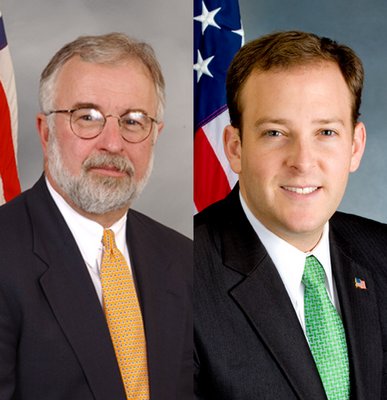
 2 Photos
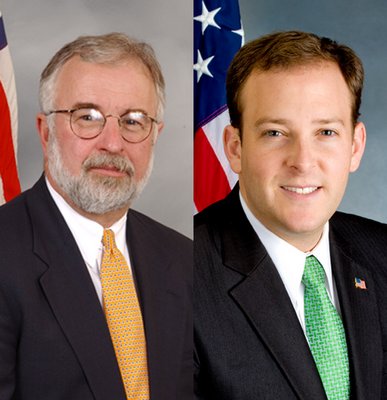

With primary races wrapping up last month, the table has been set for the November elections—and New York’s 1st Congressional District boasts a familiar match-up, as Republican Lee Zeldin will once again challenge Democratic incumbent Tim Bishop of Southampton.
Mr. Bishop and Mr. Zeldin ran against each other in 2008 for the right to represent the district, which encompasses most of Suffolk County, including the entire East End. Mr. Bishop routed Mr. Zeldin in that go-around, finishing with more than 58 percent of the vote, compared to Mr. Zeldin’s 41.6 percent.
However, this year’s election could prove to be more challenging for the six-term congressman, as Mr. Zeldin, who has spent the past four years as a state senator representing New York’s 3rd District out of Shirley, boasts more name recognition, and perhaps a little more polish, than he did when he burst onto the scene as a political newcomer in 2008.
Mr. Zeldin, who also is running on the Conservative Party line, also has the benefit of being on the ticket that stands opposite of President Barack Obama—often a boon for congressional hopefuls during midterm elections, when voters’ dissatisfaction with government often is directed at the sitting president and his party.
Mr. Zeldin, 34, an attorney and major in the U.S. Army Reserve, partially blames his 47,000-vote margin of defeat on the wave of Democratic support that Mr. Obama had inspired during his first run for office against Mr. Bishop in 2008, something Mr. Zeldin said will not be a factor this time around.
“For one, 2008 was a different political year,” Mr. Zeldin said. “Barack Obama was at the height of his popularity, surging into office. There was a lot of [George W.] Bush fatigue, a lot of Iraq War fatigue. The economy was just starting to fall out weeks before the election. There was a lot that was out of our control in races across the country.
“As far as me as a candidate,” he continued, “I started that race with no name recognition and no donors. We started at zero.”
Name recognition has become less of an issue for Mr. Zeldin, who, despite securing the endorsement of the Suffolk County Republicans in February, still had to weather a rugged primary challenge from George Demos, a mostly self-funded candidate from Stony Brook.
While that contest may have gotten Mr. Zeldin’s name out there earlier than expected, thanks in large part to attack ads, it also required his campaign to shell out quite a bit from his war chest—$584,983, to be exact. That added expense has left him with just $149,610 as of June 4, according to the Federal Election Commission’s website, www.fec.gov.
In contrast, Mr. Bishop has more than $800,000 in cash on hand, according to the same website, and is confident that his track record and his ideology will carry him to a seventh term in office.
Mr. Bishop, who also is running on the Working Families and Independence party lines, points to Mr. Zeldin’s opposition to the Troubled Assets Relief Program, or TARP, commonly referred to as the Wall Street bailout of 2008, as an example of his shortsightedness. During their first race, the two debated whether the federal government should spend $700 billion to address the sub-prime mortgage crisis.
“It turns out he was spectacularly wrong,” Mr. Bishop said of his opponent. “TARP worked, it put the economy back on track, and the [U.S.] Treasury has actually turned a profit on it.
“He is a conservative with very radical ideas that are not in line with the voters of the 1st District,” Mr. Bishop continued. “I think he was a Tea Partier before there was a Tea Party. The majority of people in the district share the more mainstream views that I have.”
A Southampton native, Mr. Bishop, 64, attended the College of the Holy Cross in Massachusetts and Long Island University before beginning his career at Southampton College in 1973, where he started as an admissions counselor and worked his way up to provost, a position he held until he was elected to Congress in 2002.
Meanwhile, Mr. Zeldin has a bachelor’s degree from SUNY at Albany and a law degree from the Albany Law School.
In 2004, when he was 23, Mr. Zeldin passed the New York State Bar, becoming the state’s youngest attorney at the time. After completing Army Reserve Officer Training Corps program in law school, he joined the U.S. Army as a 2nd lieutenant in 2004, entering the Military Intelligence Corps. In 2006, he was deployed to Iraq as a member of the Army’s 82nd Airborne Division.
Early indications have Mr. Bishop with a slight advantage, as the Cook Political Report, an independent, non-partisan organization that has been analyzing federal elections and political trends for the past 30 years, categorizes the district as leaning Democratic. However, the Democratic Congressional Campaign Committee included Mr. Bishop on its list of vulnerable incumbents, and other independent groups have the district among the most competitive in the country this fall.
The November race also promises to feature high levels of outside spending from 501(c)(4) organizations, commonly referred to as Super PACs, which are allowed limitless spending as long as they have no direct connection with a candidate or campaign, thanks to a January 2010 ruling known as Citizens United.
During the Republican primary election, New York’s 1st Congressional District saw the fifth-most independent expenditures in the country, with nearly $1.9 million in Super PAC spending. Roughly $1.47 million of that went to attack Mr. Zeldin.
The previous two primary seasons in the district, 2010 and 2012, saw no independent expenditures, according to www.fec.gov.
However, independent expenditures rose sharply in the November races between the 2010 election, when they were at $1.08 million, and 2012, when they skyrocketed to almost $5.5 million.
Perhaps the biggest issue of the 2014 election cycle thus far has been the Affordable Care Act, also known as Obamacare. Republicans have used the health insurance expansion legislation as a means of drumming up opposition to President Obama and the Democratically controlled U.S. Senate.
While some Democratic incumbents have tried to disassociate with Obamacare following the botched rollout of the health care exchange website, www.healthcare.gov, last fall, and anemic early enrollment rates, Mr. Bishop has remained unwavering in his support of the initiative.
“The evidence is mounting that the Affordable Care Act is actually working,” he said. “More people than anticipated have signed up for it, and those who have enrolled are paying a fair price. The cost of actual delivery of health care is at its lowest mark in nearly 50 years.”
According to the Kaiser Family Foundation, a California-based nonprofit that specializes in health care policy and education, 370,451 of the 707,638 New Yorkers eligible for a health insurance plan on the state-run marketplace had enrolled in one as of April.
Mr. Bishop also criticizes Republicans—particularly those in the House of Representatives, who have voted more than 50 times to repeal or de-fund all or part of the Affordable Care Act—for not having a viable alternative. But Mr. Zeldin said there are a bevy of Republican-sponsored alternatives that are gaining traction in Washington, D.C., although he declined to put his support behind any one in particular, not wanting to shortchange any others that might ultimately have a better chance of passing.
“There are several bills, and I wouldn’t want to say that one of the bills is the only bill that I’d be open-minded to supporting,” he said. “I would be open to supporting all the bills. I just want to have the opportunity to work with colleagues to make sure there is a good component for one of the other bills that isn’t left out because it isn’t in another bill.”
Another hotly contested issue is immigration reform, which both candidates agree should be a priority of the next Congress.
Mr. Bishop supports Senate Bill 744, which was introduced by New York Senator Charles Schumer in May 2013 and passed by the Senate last summer. Mr. Bishop is a co-sponsor of the bill in the House and thinks it is the best way to handle the multifaceted issue of immigration on several fronts, including toughening border security, as well as improving the visa system and providing a path to citizenship for individuals who are already in the United States, particularly those born here to immigrant parents or brought to the country at a young age.
“I support what the Senate did—it was bipartisan, and I am a co-sponsor of the same legislation in the House, although slightly modified, to increase border security,” Mr. Bishop said. “It’s a good bill, and the Republican leadership in the House should recognize that.”
Mr. Bishop said he does not believe the House leadership will allow the bill to see the floor before the end of the current Congress, and he is skeptical of it making it any more headway in the next Congress unless House leadership changes.
Mr. Zeldin counters that he does not think the Senate bill adequately addresses the issue of immigration, and he would like to seek out other options once in office.
“It doesn’t actually solve the problem,” he said. “There is an urgent need to secure our borders—this is a very real issue that must be addressed, and it is absolutely impossible to fix any of the other issues if we don’t secure the entry process.”
While he said he has compassion for those who have come to the United States seeking a better life, Mr. Zeldin said he does not think that those who have come here illegally should be able to sidestep those seeking to immigrate legally. He also said he’d like to explore options for retaining individuals who come to the United States for school and obtain an advanced degree.
When it comes to his opponent, Mr. Zeldin maintains that Mr. Bishop has been in lockstep with the Obama administration and argues that he, instead, would be able to act as a check on the president’s agenda, if elected in November.
“He voted to create Obamacare, he has been fiercely loyal to a president that is taking our country in the wrong direction, and I’m looking forward to having a debate to talk about how to best run the country,” Mr. Zeldin said of his opponent.
Mr. Bishop dismissed the criticism, noting that Randy Altschuler, who lost both of his bids to unseat the congressman in 2010 and 2012, tried the same strategy—“It’s standard Republican talking point,” he said dismissively. Mr. Bishop insists that he supports President Obama when he is acting in the best interests of the 1st Congressional District, and opposes him when he does not. Specifically, he cited examples when he did not support President Obama, including the funding of charter schools, as well as the inclusion of provisions under the Affordable Care Act, such as medical device taxes, as examples of things Mr. Obama supports that he does not.


 Kyle Campbell on Jul 15, 2014