


 4 Photos
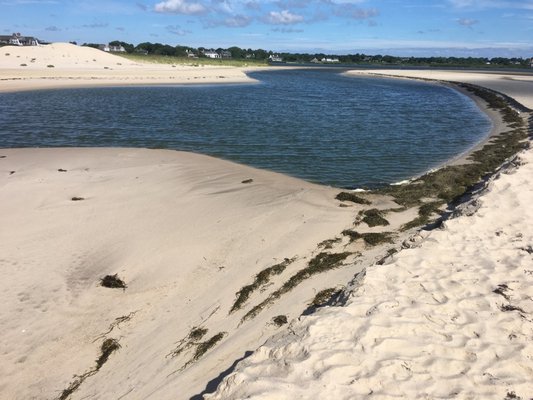
The Sagg Cut in Southampton was opened on August 15 to bring salinity levels in Sagg Pond back up over 10 ppm
after sinking as low as 3.5 ppm in some areas. COURTESY OF SOUTHAMPTON TOWN TRUSTEES
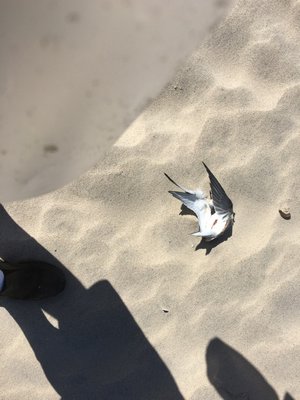
A dead piping plover was found next to the Sagg Cut in Southampton after it was opened on August 15. COURTESY OF THE SOUTHAMPTON TOWN TRUSTEES
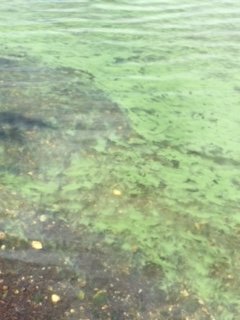
After finding out on Monday that Mecox Bay was listed by the State Department of Environmental Conservation as having blue-green algae blooms
Yet another Southampton water body—Mecox Bay—was confirmed this week to have toxic blue-green algae blooms.
Confirmed by the State Department of Environmental Conservation on Friday, the contamination was reported by scientists at Stony Brook University. The Suffolk County Health Department and Southampton Town Trustees are warning people not to swim or fish in Mecox Bay, as blue-green algae, which are formally called cyanobacteria, can be toxic to humans and animals if the algae start to grow and form blooms.
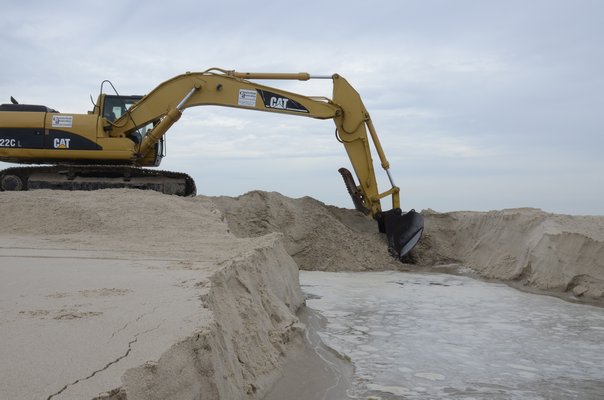
To flush out the bay, the Southampton Town Trustees are looking into having the Mecox cut opened to the ocean again. Trustee Scott Horowitz said on Monday that he had been busy on the phone trying to put everything in place, and that one of the biggest challenges is that the permit to do so was not renewed after it expired earlier this year.
Mr. Horowitz said he hopes to be able to get approval for an emergency opening in the interest of the public and the environment, as was done earlier this summer. In the future, he said, he hopes DEC officials, the Trustees and state legislators can come up with a management plan to schedule regular flushings, rather than doing it on a case-by-case basis based solely on conditions.
Trustee Bruce Stafford indicated that he was upset that county officials had not immediately notified the Trustees about the algae blooms once the testing discovered the situation. He said the county had posted only one sign notifying the public not to take shellfish and finfish from the bay. On Monday, the Trustees had a maintenance crew put up more warning signs.
Sagg Pond was confirmed to have blue-green algae blooms earlier this summer, and it has not yet been removed from the list of contaminated water bodies. Just last week, in an attempt to raise salinity levels in Sagg Pond, the Trustees opened the cut there and flushed out the pond, draining the harmful algae blooms out into the ocean—raising concerns that ocean beaches are now being affected by the blooms.
Dr. Christopher Gobler, a Stony Brook University marine biology professor, said that when algae blooms enter the ocean, they “fairly quickly” become diluted, but that the toxins they produce “could be persistent in the water and could enter the food web.”
Blue-green algae blooms thrive in water bodies that are warm and have high levels of nitrogen and phosphorous, which tend to be ones that also have high levels of Enterococcus, an indicator of coliform bacteria and fecal matter that primarily enters the water through septic systems and runoff.
Colleen Henn, who works with the Surfrider Foundation’s Blue Water Task Force, takes water samples from Mecox Bay and Sagg Pond, among a handful of other water bodies on the East End, to search for high levels of Enterococcus.
“Mpn” is an abbreviation for “most probable number of coliform,” and the Environmental Protection Agency’s standard for safety in water bodies used for recreation is a reading no higher than 104 mpn per 100 milliliters.
Her reading in Sagg Pond on August 2 was remarkably high—24,916 mpn per 100 milliliters. Those readings later moderated to 161 mpn on August 9, and a safe 60 mpn on August 16.
After the cut was opened at Sagg Pond on August 16, the reading in the ocean at nearby Sagg Main Beach was 145, Ms. Henn said, which is above the EPA standard for safety. However, blooms in the ocean are less of a threat, she said, because the water is cooler and in motion, and toxins are diluted relatively quickly.
Residents who live or near the water can take a number of steps to prevent pollution, Ms. Henn said—including making sure that their septic tanks are properly maintained every year, and creating a buffer zone of plants to prevent unfiltered fertilizers from draining directly into the water bodies after heavy rainfalls.
“Nobody is ever going to be upset about investing in their backyards,” Ms. Henn said. “It’s a matter of doing it instead of talking about it.”


 Greg Wehner on Aug 23, 2016