


 1 Photo
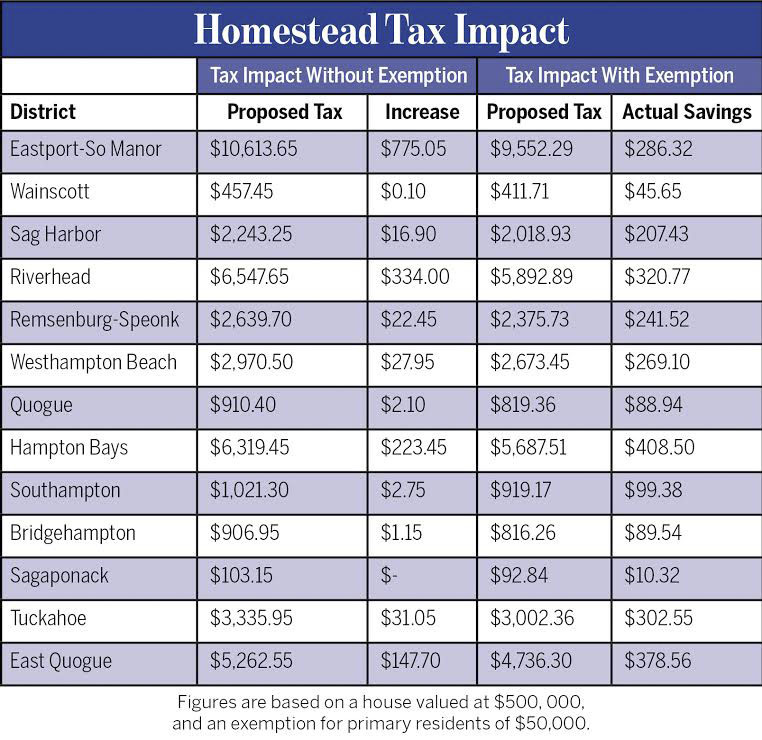
An extension of the freeze would allow state representatives to pursue the creation of a townwide homestead tax relief program. Above, a 2020 depiction of how the exemption would impact the average homeowner.
Officials are hoping one more year might do the trick in the quest for strategies to avoid property tax surges in Southampton.
This week, members of the Southampton Town Board voted unanimously to extend the freeze on property reassessments for another year. The goal of the suspension of the annual analysis of market trends in deriving a property’s value is to continue study of strategies for crafting equitable assessments.
It will also provide New York State Assemblyman Fred W. Thiele Jr. with extra time to work with counterparts in Albany on two initiatives that could help — a 5 percent cap on assessments and a so-called Homestead Tax exemption for year-round residents.
The Town of Southampton is one of very few towns in New York that uses full fair market appraisals to determine property taxes for homeowners.
“We try to figure out what your property is worth and we multiply the tax rate by it to determine how much taxes you pay, with the theory that everybody pays a fair share,” Southampton Town Supervisor Jay Schneiderman summarized during an October 21 work session discussion of the situation. “If your property’s worth less, you pay lower taxes.”
But in recent years, officials noticed that home prices began to soar in certain sections of town. In fact, he explained during the board’s Tuesday, October 26, regular meeting that in some cases the increase — thanks to a pandemic-prompted push to purchase — prices in some areas were up almost 20 percent. “That’s a very, very big jump,” he said Tuesday night.
The board’s unanimous vote continues the freeze on assessments for property owners who haven’t made improvements, such as adding a garage, addition, deck, swimming pool or the like, in the past year. “If you’ve done nothing, normally we would adjust your property based on the real estate market, which I’m hearing, in the last year has gone up on the average by 19 percent,” Schneiderman said. From the end of June 2020 to the end of June 2021 there was, he said, “a very significant jump.”
“But we’re waiting,” the supervisor continued, “with the hope that Albany will give us some tools so that when and if we return to full assessment we’re able to buffer some of the impacts so people don’t see their property taxes spike.”
“I support the town decision to extend the assessment freeze for an additional year as we pursue state legislation to provide for a homestead exemption and a 5 percent cap,” Thiele said Tuesday night via email message. “With a former town board member now serving as our new governor and additional supporting information from the town, I am optimistic that we can provide Southampton residents with real property tax relief.”
Last year, a town-appointed reassessment advisory committee presented proposals that could see tax savings of as high as $400 per year for year-round residents of the Hampton Bays School District, and increases for ineligible second-home owners as high as $775 in the Eastport-South Manor School District.
The two-pronged approach calls for a cap on assessment increases, limiting them to an increase of 5 percent in a year, while a second proposal, a so-called “Homestead Tax,” would offer primary homeowners in the town a $50,000 reduction in their overall property assessments.
At the time, Thiele, who would carry the request for enabling legislation to Albany, explained the Homestead Tax proposal shifts the tax burden away from primary residents to second-homeowners and to businesses, which would end up paying higher taxes.
Describing Homestead Tax strategy during an August 2020 work session, Lisa Goree, the town’s sole assessor, said the committee came up with a program similar to the statewide STAR program. The New York State School Tax Relief program provides an exemption from school taxes for owner-occupied primary residences.
In the Homestead program, full-time homeowners could apply for an exemption that shaves $50,000 from their assessment. The committee shared a spreadsheet depicting the savings — or increases — per school district. In Hampton Bays, for example, an average eligible homeowner could see a savings of $408.50 a year, while those who don’t qualify for the exemption would experience an increase of $223.45.
The exemption application process would mirror the process for obtaining a STAR exemption. About 16 percent of the properties in the town are year-round residences that would qualify for the exemption. And while the $50,000 reduction would apply to all primary households, it would have the most significant impact on the properties with the lowest values.
For the assessment cap, as values soar, properties would continue to be assessed with their new values, but the taxable increase would be no higher than 5 percent from year to year. However, if the house sold, the cap would be lifted for the next homeowner.
The assemblyman’s first effort to carry the enabling legislation wasn’t successful, the supervisor said during last week’s discussion. However, he noted that Thiele chairs the local governments committee,“is in a very powerful position” in Albany, “and said he’d like to try again.”
Discussion last week veered into the decision related to using market trend analysis compared to the state-conceived “equalization rate” system used by most other municipalities.
“Southampton years ago put this system in place and for the most part it’s been a pretty good system,” Schneiderman said.
Councilman Tommy John Schiavoni isn’t so sure. He suspects the town’s use of full market value is the reason why local school districts receive far less state aid than comparable districts in other towns.
Southampton Town has school districts similar to others on Long Island and there’s a wide disparity in aid allocations, the lawmaker said. Where the Hampton Bays school district receives $7 million in aid, a similar district in Miller Place gets $23 million. East Quogue gets $1.4 million while East Moriches, just 12 miles away, received $6.9 million, Schiavoni said.
If the use of the state equalization rate is the reason why neighboring districts receive more aid, Schneiderman mused, changing Southampton’s system may be the way to go.
Goree explained how that would work and look on a tax bill. If the full appraised value is $500,000, she explained, “that’s what we have on the tax roll.” But if an equalization rate of 87 percent is determined, the $500,000 is multiplied by the rate, bringing the taxable assessment to around $435,000.
Tax bills currently show market value and taxable value and, Goree pointed out, “right now those numbers are the same.” If the town switches to the equalization rate system, the two numbers will be different. “You’ll be able to see what your taxable assessed value is and how it differs from your appraised value,” she said.
For now, however, the board decided to extend the freeze one more year and see what happens in Albany. “It’s not outrageous to ask for these mechanisms,” Schneiderman underscored. “Other communities have tax laws catered to their own particular situations. It’s not a ridiculous request … Albany could give us these tools and I think we should continue to ask for them.”
But, the lawmaker noted, “If we don’t get them, we’ll have a difficult decision.” If officials reset property values, he theorized, “Everybody’s gonna go up at least 10 percent.” Goree noted that given the latest analysis by the town’s consultant, the valuation increase would be “at least 10 percent, possibly as high as 15 percent.”
That increase relates to the property’s assessment, not its overall taxes, Town Attorney James Burke emphasized.


