


 1 Photo
Hoping to halt plans for a CVS pharmacy occupying one corner of Bridgehampton’s main intersection, the Bridgehampton Citizens Advisory Committee last week asked the Southampton Town Board to enact a moratorium on any new development along the street until new traffic and parking studies can be completed.
The most recent traffic study of the hamlet’s main thoroughfares was conducted in 2008, members noted, and “the town has changed mightily since 2008,” CAC co-chair Nancy Walter-Yvertes said.
The committee has voiced strong opposition since word of the CVS having its eye on the northwest corner of the intersection where Montauk Highway, the Bridgehampton-Sag Harbor Turnpike, Lumber Lane and Ocean Road come together.
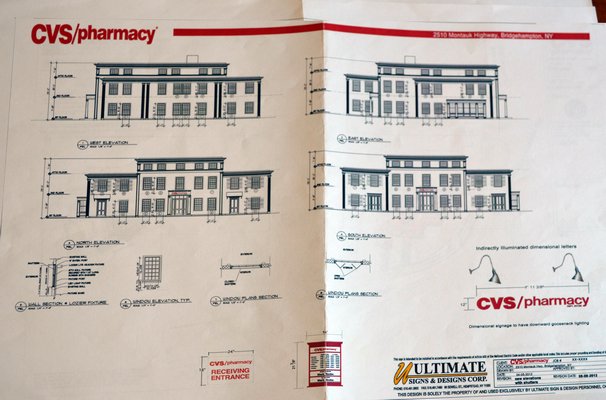
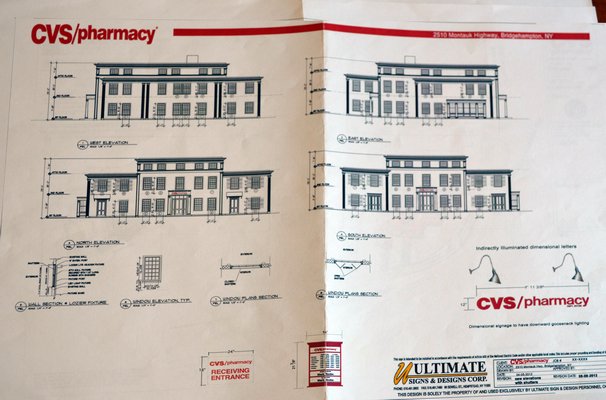
Developers received approval for an approximately 9,000-square-foot building to be built on the property, and CVS recently revealed that it has a lease agreement for the building.
The CAC, empaneled by the Town Board to offer suggestions on local policy related to the hamlet, took a rare step in passing a resolution calling on the Town Board to take official action, particularly the request of something so drastic as a building moratorium. But committee members agreed that stopping the giant pharmacy chain from settling on its busiest—and most historic—intersection is a top priority.
“We are drafting a petition that will go online soon, inviting people to join us in opposing development on that corner and, in particular, in opposing CVS going in on that corner,” Ms. Walter-Yvertes said. “We are concerned about the [precedent] of approving a large retail establishment with high-traffic, late-hour stores. We fear it might start a trend going all the way down Main Street.”
Also along those lines, members of the CAC have formed a new group dubbed “Save Bridgehampton Main Street” and have begun rallying other residents around a Facebook page of the same name. Some residents have already begun raising money to hire an attorney to mount a legal challenge of CVS’s plans for the now-vacant corner.
Representatives of the pharmacy giant have said they intend to seek a “special exception” permit from the Town Planning Board to let them utilize all of the nearly 9,000 square feet of space in the building slated for the corner.
Town code officially restricts the size of any one commercial storefront space to 5,000 square feet. But the law allows for exceptions from the limit if the proposal survives extra scrutiny from the Planning Board.
“All special exceptions have to meet what they call the 13 general standards, which some will argue are very broad and some will argue are very narrow,” Planning Board Chairman Dennis Finnerty said. “They talk about suitability, appropriateness, proper circulation and so forth. So they afford the Planning Board quite a bit of latitude to evaluate a project in the context of its appropriateness for an area. That being said, we’ve always been schooled that a special exception application, if it meets certain conditions, is to be granted approval.”
Mr. Finnerty noted that the most salient terms in the special exception wording, “suitable and appropriate,” are magnets for litigation and often lead to the Planning Board being sued for arbitrary rulings when appropriateness of an application is invoked in a denial. But he also said that most applicants for special exception permits labor to avoid a denial in the first place and tailor their proposals substantially to meet Planning Board criteria. For that reason, the chairman said, it is rare that the Planning Board denies a special exception application.
In the case of CVS, however, there is likely little tailoring that could be done to the plans for the Bridgehampton corner that would mitigate the objections raised by the residents’ committee, short of withdrawal.
Ms. Walter-Yvertes said that the group of residents raising money have chosen an attorney to represent them in opposition to the CVS, but she declined to name him.
As for the moratorium proposal, town officials said such a rare imposition is not likely to be seen as necessary. Councilwoman Christine Scalera said this week that a moratorium is an “extreme remedy” that the board would be loath to enact without a very substantial reason.
Ms. Scalera did say that the sudden turmoil surrounding the CVS has shed light on a gap in the town’s review of projects that have left the laymen of local CACs in the dark about what the full potential for development proposals actually are.
When the CAC was presented with the plans for the building now targeted by CVS, the schematic showed six small retail and office tenants. The building was designed with an eye to the classical architecture of the historic Bullshead Inn and Nathanial Rogers House on its opposite corners and the CAC gave its stamp of support for the designs.
But, Ms. Scalera said, the committee was not made aware of the potential for the number of tenants in the building being cut to two, under the maximum size limit, or even one if a special exception were granted—nor the ease with which a special exception permit is usually issued.
“In the referral for this site plan they were shown a plan that had six different tenants —then it gets shrunk down to one and it is sort of like ‘Whoa, how did that happen?” Ms. Scalera said. “There’s a shortfall there in the information being shared. When we send out referrals, we need to be more specific about what could ultimately be done with an application—a warning that what is shown might not be the only option.”
Ms. Walter-Yvertes said that among the attendees at the committee meeting was former town planner Jefferson Murphree, whose father-in-law lives on Lumber Lane, near the proposed pharmacy building. Mr. Murphree, who led the town’s Planning Department for a decade and is now Riverhead Town’s chief planner, suggested that the committee ask for the moratorium, she said.


 on Apr 30, 2014