


 16 Photos
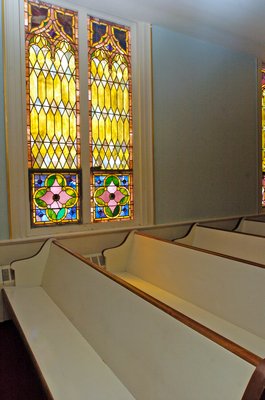
A stained glass window at the Bridgehampton Presbyterian Church. DANA SHAW
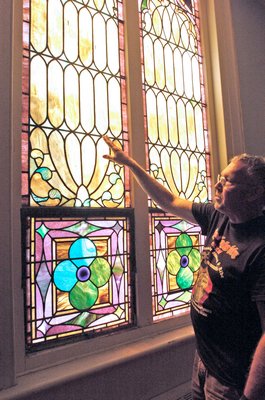
Thomas White points out one of the bowed
stained glass windows. DANA SHAW
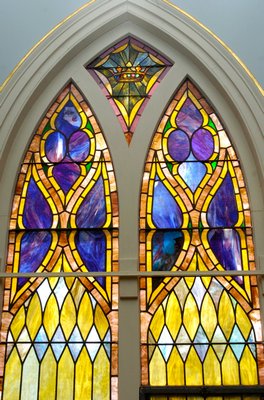
A stained glass window at the Bridgehampton Presbyterian Church. DANA SHAW
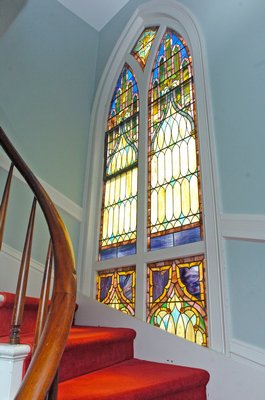
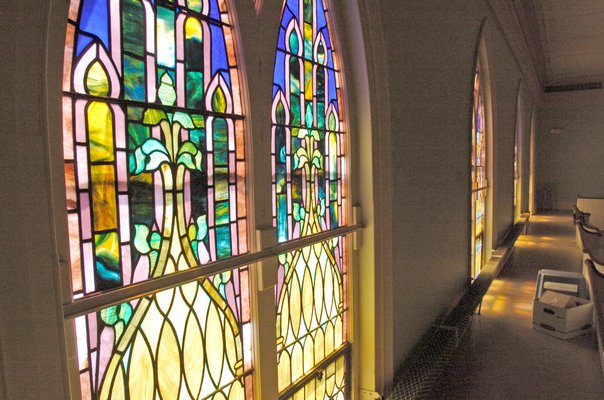
A stained glass window at the Bridgehampton Presbyterian Church. DANA SHAW
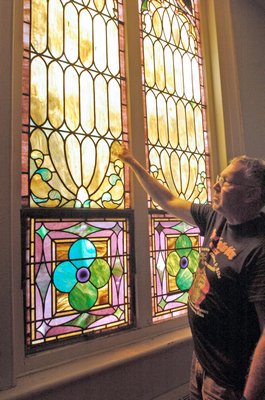
A stained glass window at the Bridgehampton Presbyterian Church. DANA SHAW

Thomas White points out one of the bowed

stained glass windows. DANA SHAW
Organist Thomas White decribes the inner workings of the pipe organ. DANA SHAW
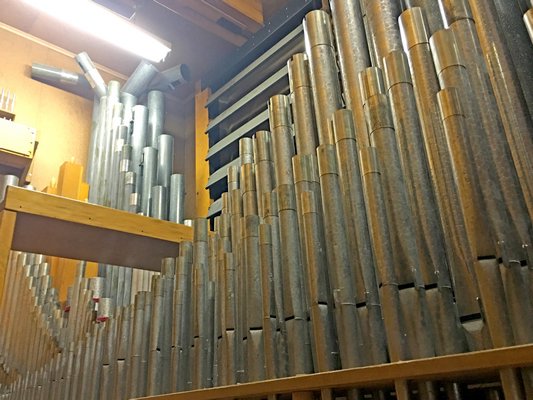
Organist Thomas White decribes the inner workings of the pipe organ. DANA SHAW

The inner workings of the organ. DANA SHAW

The inner workings of the organ. DANA SHAW
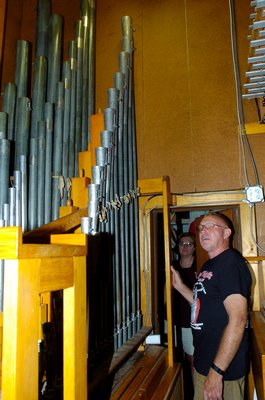
The inner workings of the organ. DANA SHAW
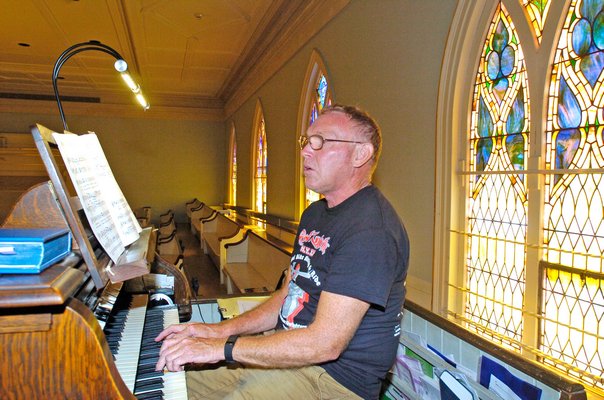
The inner workings of the organ. DANA SHAW
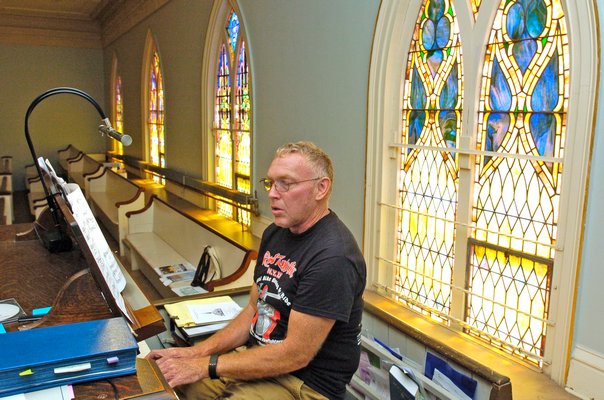
Organist Thomas White decribes the inner workings of the pipe organ. DANA SHAW

Organist Thomas White. DANA SHAW
Tom White, an organist at the Bridgehampton Presbyterian Church, is the only person familiar enough with the particulars of the church’s pipe organ to play it properly.For 45 years, Mr. White, 56, has had unfettered access to the instrument—he’s been stomping on the same pedals and fingering the same keys since he was 10 years old. And that’s because he grew up in the church.
Mr. White’s ancestor, Ebenezer White, was the church’s founding reverend, taking the helm in 1695 at the age of 23, fresh from Harvard’s theological school. Since then, the Whites have remained a staple family in the church.
So even though some of the organ’s mechanical contacts and switches are failing, and much of the lower keyboard doesn’t work, Mr. White compensates by improvising over certain unreliable notes. Still, even for someone as well-versed in the instrument’s quirks as Mr. White, what is often intended to be a climactic, drawn-out fermata—a note of unspecified length—often ends up an awkward, noiseless dud.
“You’ve got to play around some things,” Mr. White said. “But it’s when I’m not here when it’s a problem. I’m used to it, but the people replacing me won’t be—although I don’t go away as much as I should.”
The Bridgehampton Presbyterian Church has announced a fundraising campaign to fix the problem and restore its organ, an Opus 1850, introduced in 1934, as well as several stained glass window fixtures originally installed in 1889. Without a deadline, the church has a lofty goal: $1 million.
On Saturday, July 29, the campaign will kick off with an estate sale beginning at 8 a.m. at 20 Beach Lane in Wainscott. Most notably, a large selection of Ethan Allen furniture formerly belonging to a now-deceased member of the church will be available for purchase, alongside patio furniture, collectibles and general household items.
“Our fundraisers are effective,” said Donna Halsey, a member of the church’s session, or governing board. “But they’re not necessarily bringing thousands of dollars each time. It can be a long fundraiser.”
The campaign’s biggest cost—to the tune of $86,000—would be the rewiring of the organ chests.
Prior to the Opus 1850, the church owned a mechanical organ, one that was hand-pumped by children who were paid a quarter per service for performing the task.
In 1934, pleased by the sound of her New York City parish’s electric organ, Ethel Smith, a member of the church, offered a significant donation contingent on the church purchasing an electrical organ from Austin, an organ manufacturer based in Hartford, Connecticut. And so it did.
But a circuit board is now required to replace the failing mechanical contacts, while the current electrical wire, which totals roughly three miles in length, can be swapped with a single fiber optic cable.
Estimated to cost just less than $22,000 to upgrade, the airchests upon which the pipes stand have developed leaks in their main seals, disrupting air filtration.
A faint yet discernible “whoosh” can be heard from the lower-level pews. For those sitting in upstairs pews, which are situated in front of the organ, that whoosh is more like a gust—much more conspicuous.
Austin, the organ’s manufacturer, offered to sell the church a replacement airchest console originally from an organ manufactured in the late 1990s.
“They said to restore would cost a lot more money,” Mr White said. “Luckily, they have one to give us.”
The organ’s final renovation would be a $26,000 repair and the addition of pipes. Currently, the organ sports 16 ranks, or sets of pipes, that total 480 individual pipes. Some of those could use a touch-up after more than eight decades of use.
There is also a proposal to extend the organ’s oboe rank and introduce a baroque rank, culminating in the addition of about two dozen new pipes. “It’ll add a little more variety to the tone,” Mr. White said.
While Ms. Halsey acknowledges that organ repair is the church’s most immediate focus, she is also fundraising to repair the eight two-story Gothic pointed-arch stained glass windows found in the church’s sanctuary. There are an additional two stained glass windows in the church that have incurred less damage and are situated alongside a less prominent staircase.
Originally installed in 1886, each of the eight windows is embellished with a symbol—such as a six-pointed star, an anchor, an alpha character and an omega character—meaningful to the Presbyterian denomination.
They underwent a renovation in the 1970s, in which a cover glass was fixed atop the stained glass as a protective layer. But the cover glass also insulates the windows, cooking its metals and trapping in harmful humidity.
All of the eight panes need to be taken apart and sent elsewhere to be furnished with new leading, as the local market of stained glass specialization is scanty. “They’ll cost $20,000 to $50,000 each,” Ms. White said.
The church successfully registered its building, erected in 1845, as an officially recognized historical site last fall. As such, the church can now qualify for grants, for which the session has just begun filing.
“We just keep going along,” Ms. Halsey said. “It’s a process.”
Those wishing to fund the restorations may send donations to P.O. Box 3038, Bridgehampton, NY 11932, marked “restoration.”


