


 1 Photo
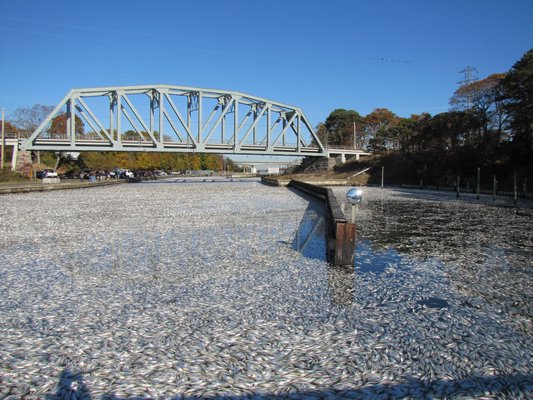
Dead bunker choked the Shinnecock Canal on Monday morning. Michael Wright
It was supposed to be a time for celebration.
The Shinnecock Indian Nation was slated to receive final determination of federal recognition as a Native American nation last Monday, July 19—making it the 565th tribe to gain the status within the country.
Instead, the Shinnecocks found themselves two days later battling the same fight that has gripped the nation for more than three decades. Two objections surfaced within the past week challenging the tribe’s long sought federal recognition, with the main challenge being waged by a Connecticut group vested in that state’s gaming interests.
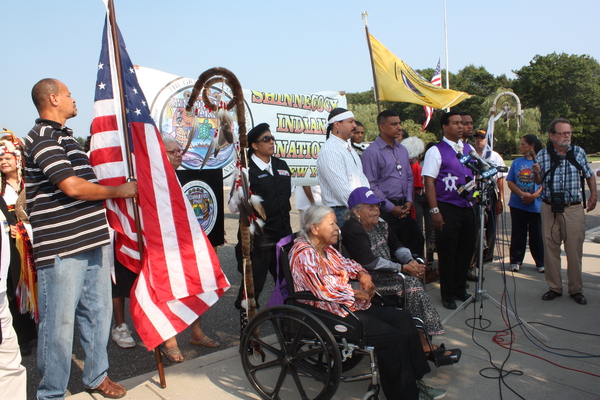
On Wednesday, an outpouring of Shinnecock Indian Nation members, many dressed in traditional Native American garb, united at the U.S. district court in Central Islip at what was supposed to be a federal recognition status update meeting, together sending one uniform message: They’re not backing down.
“The message is that we have proven our case,” said Doreen Pepe, a Shinnecock member. “That we are entitled to the federal benefits being a federally recognized nation … and that we have more than proven we are a proud, traditional people of Native American history.”
The Shinnecocks did breathe some sigh of relief. U.S. District Court Judge Joseph F. Bianco ruled that the Interior Board of Indian Appeals (IBIA), the agency charged with reviewing the appeals and challenges to the Shinnecocks’ federal recognition, is required to abide by hard and fast deadlines to review the objections.
Under Judge Bianco’s order, the Department of the Interior, the umbrella agency for the IBIA, has until July 30 to report back to the court with a date-by-date schedule to review the objections to the nation’s federal recognition.
If the agency fails to provide dates by which to review and possibly resolve the objections, Judge Bianco said he could deem that the tribe has a case of “unreasonable delay,” and thus, he would impose a schedule he has drawn up—which would result with a final decision on the objections by September 24.
Judge Bianco’s decision relieved some Shinnecock leaders, who had fears that the two objections, which surfaced on July 15 and July 19, would indefinitely delay the nation’s federal recognition—a process that has already been ridden with unnecessary and unreasonable delay, they argued, since 1978.
“It’s an absurd situation that the federal government allows to happen,” said Shinnecock Tribal Trustee Lance Gumbs, before entering the courtroom on Wednesday. There are two objections to the nation’s federal recognition. The main challenger is Connecticut group that calls itself the Connecticut Coalition for Gaming Jobs, claiming to represent 18,000 casino employees in that state. According to court officials at the meeting on Wednesday, the main objection outlined by the group points to the tribe’s business relationship with Gateway Casino Resorts, a Detroit casino developer, which has spent millions on the tribe in legal battles, in return for a cut of future casino profits.
Kevin Mulry, from the U.S. Attorney’s office, represented the Department of the Interior at last week’s court proceeding. He argued that the IBIA is an independent board, and that Secretary of the Interior Kenneth Salazar may not have the authority to impose deadlines on them.
But Judge Bianco noted that the main objection by the Connecticut gaming group—the questions of the tribe’s independence surrounding its relationship with Gateway—is “hardly news,” and should be able to be swiftly addressed by the department.
“That’s certainly not something you think the Department of the Interior would have a hard time addressing,” Judge Bianco said.
The second objection was raised by the Montaukett Tribe. That objection, noted representatives of the Shinnecocks, does not even challenge the actual federal recognition. It was a request to be included within the Shinnecock application.


 Rohma Abbas on Jul 23, 2010