


 2 Photos
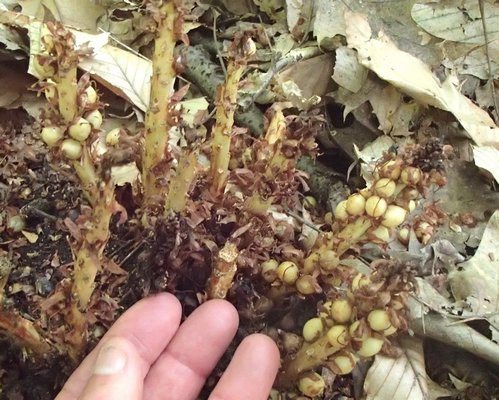
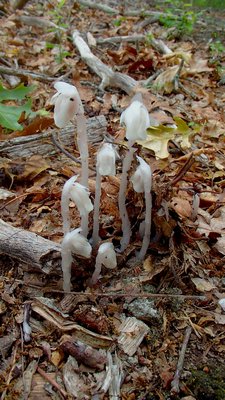
While scouting out a new area on the north shore of Nassau County for an upcoming field trip, I came across a very striking and unusual plant on the forest floor that I did not recognize at all. It grew in clumpy spikes between 3 and 5 inches tall, the central spike being surrounded by brown scales resembling those of pine cones, and yellow, pea-sized spheres that, from a distance, were arranged on the central spike such that it looked like a small corncob.I was accompanied by Peter Walsh of Seatuck Environmental Association, and he thought it was one of our handful of plants that lack chlorophyll, and therefore cannot photosynthesize and manufacture their own food. Collectively known as “heterotrophs,” or “other feeding” plants, they get their nutrition from other organisms. Peter went down the short list of fungus feeding plants found on Long Island that I was very familiar with, and many readers will likely recall these plants names: Indian pipe, pinesap and beech drops. This plant did not resemble any of the latter group.
This interesting group of heterotrophic plants obtains their nutrition indirectly from green plants through an intermediary organism: a mycorrhizal fungus that is attached to the roots of the host green (photosynthesizing) plant. Using Indian pipe (Monotropa uniflora) as an example, the fungus acts as a one-way conduit for nutrients between the Indian pipe plant and the photosynthesizing host plant, with carbon traveling from the host plant through the fungus and into the Indian pipe plant.
So far, no one has determined that the fungus or the host plant derives any benefit in this arrangement, so the Indian pipe could be considered a parasite. But of whom—the fungus or the host plant?
John Turner joined us later and confirmed that Peter was in the right group of plants. This was squawroot (Conopholis americana), also known as bear corn, a heterotroph that does not use an intermediary fungus but has a structure called a haustoria directly attached to the host green plant’s roots to obtain its organic carbon fix. The yellow, pea-like structures in the accompanying photograph are the pollinated flowers in the process of maturing into fruits that will contain many tiny seeds.
The sprouted seeds’ roots must quickly find their way to the roots of an oak or beech, as the seed itself has very little stored nutrients. Red oak is listed as the preferred host plant, and there were many huge specimens of this species where we found the squawroot. Its presence is considered an indication of a mature, well-established forest, and that may be why it is so rare on Long Island.
The seedling grows underground for four years, forming large, knobby growths on the host tree’s root system. At four years, it flowers. Black bear, raccoon and white-tailed deer are among the animals that eat the fruits and stalks of squawroot and help disperse the seeds, which are not harmed as they pass through the respective digestive systems.


 Staff Writer on Jul 8, 2019