


 1 Photo
Dissatisfied with the project's sole access onto County Road 39, the Southampton Town Planning Board opined in opposition to the Liberty Gardens affordable housing environmental impact.
Asked to weigh in on the next phase of the Liberty Gardens affordable housing proposal on County Road 39 in Southampton — a state environmental study and requested code change — members of the Southampton Town Planning Board reiterated prior worries and raised new concerns, ultimately suggesting developers look for a new location.
“Don’t be wishy-washy,” Planning Board Chairwoman Jacqui Lofaro directed Senior Planner Michelangelo Lieberman, the staff member tasked with being a conduit between the Planning Board and the Town Board. “I don’t think any of our criticisms have changed.”
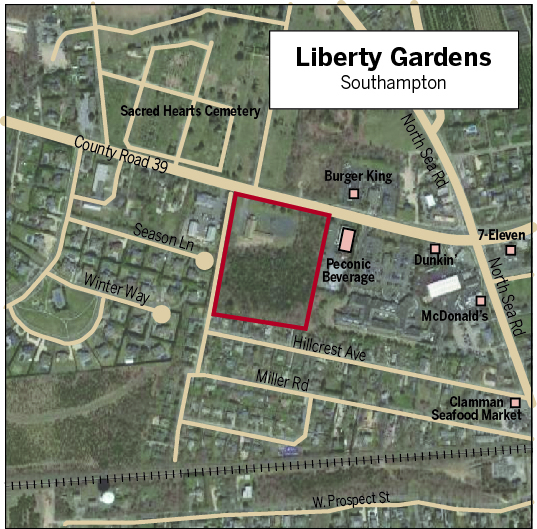
Concern Housing Inc. is looking to develop 5 acres of a total 9-acre site located off County Road 39 with 60 affordable units, a development dubbed “Liberty Gardens.”
Like opponents who spoke at an October 25 Town Board public hearing, board members were troubled by the location of the development, near busy and congested County Road 39. With the project’s sole access onto the main thoroughfare, said Lofaro, “You’re taking your life in your hands.”
During earlier review last year, in advance of the developer’s compiling of a draft environmental impact statement, required under the State Environmental Quality Review Act, board members wanted to see several ways in and out of the housing complex, not just one.
At first, back in 2019, access was additionally proposed through the adjacent Hillcrest neighborhood to the south, and the cul-de-sac at the terminus of Seasons Lane to the west. Lieberman said those access points “were not really contemplated” and are not part of the plan.
Board member Glorian Berk corrected him. The access points were removed because people in both areas were “absolutely against using their roads,” she said.
“Yes, as well as the elected officials,” Lieberman agreed.
Vice Chairman Dennis Finnerty recalled that when the Seasons Lane subdivision was developed, the cul-de-sac was contemplated as an access point to the neighboring property. “The politicians want to get in the muck with this — have at it,” Finnerty said. Seasons Lane was designed to pick up all the westbound traffic and direct it to the signalized intersection at Magee Street, he related.
“That’s good planning,” Lofaro offered.
During the initial review, planners had asked the applicant and elected officials to consider the two additional access points. But, said Lieberman, “We’re moving forward with the egress on County Road 39.”
Board member Tom Neely, who served as a traffic consultant for the town, supported access via the Hillcrest neighborhood, “as difficult as it may be.”
His colleagues did not, with Lofaro citing narrow roads, and Finnerty noting the volume of children playing in the streets in the neighborhood.
Continuing, Neely said the board should be very clear that left turns out of and into the complex should be prohibited.
How often does County Road 39 shut down because of an accident? Berk wondered. “And now we’re putting 60 more families that might not be able to get an ambulance, and they may die,” she said.
Looking to allay concern about access for emergency vehicles, Lieberman said that it is only required when a project accommodates over 100 parking spaces. “This is under 100 spaces and therefore doesn’t require it,” the senior planner said, making reference to a statement in the DEIS. “That was their rationale.”
In terms of ensuring safety for pedestrians, Neely noted there is a crosswalk device at the intersection of County Road 39 and North Sea Road for people looking to walk to 7-Eleven.
The following day, November 18, a pedestrian was struck at the intersection. Southampton Town Police said preliminary investigation revealed the accident was due to pedestrian error.
Berk brought up another issue that was raised during the hearing. She noted, “Based on funding a certain number of these apartments that must go to veterans, and the mitigation for traffic, is that it’s all workforce housing. And therefore we’re gonna take all those people off the road. But if it’s going to veterans, who may not be working here, then that adds to the question of the traffic issue.”
The DEIS describes the individuals who will be eligible as older veterans who served in Vietnam, stating, “Not all will still be driving.” Fewer than 50 percent of them have cars, according to the DEIS. Lieberman said a van service will be available to residents.
“Individuals eligible for the project in question must have a mental health diagnosis and a functional deficit that impacts their ability to remain stably housed. As these individuals are also veterans, the most common mental health challenges these individuals face are post-traumatic stress disorder and anxiety disorder,” according to a letter from Julie Duncan, director of the Bureau of Housing Development and Support from the State Office of Mental Health, submitted to the public hearing file by Councilwoman Cynthia McNamara.
“Did the applicant actually say we want 60 units, with 30 to go for affordable? It’s 50/50,” Lofaro noted: 30 units for affordable housing, and 30 for veterans who may need, according to the DEIS, on-site services to help them attain skills necessary to live independently.
“It slowly revealed itself,” Lieberman said.
“It slowly revealed itself,” the chair repeated.
Town officials are asking for a marketing plan that details fair housing requirements and eligibility under the Office of Mental Health, Lieberman said. “If only 30 of the units are for workforce housing, we’re being told this is going to make traffic so much better, and it’s only half,” Berk reiterated.
“Oftentimes, when we speak of affordability, especially when it relates to veterans, it pulls on your heartstrings, and we have to do our best, but … It’s just a bad location,” board member Craig Catalanotto said.
“A terrible location,” Lofaro enjoined.
“I just don’t want to see anyone get hurt,” Catalanotto said.
“It might not be the best location, but it is addressing a problem. It’s addressing a need,” Lieberman said. To justify the increased density, the DEIS speaks of crushing need for affordable housing in Southampton.
Board member Kate Fullam said she believes segmentation is the biggest issue. Lieberman was uncertain as to whether the DEIS speaks to segmentation.
“This is an entire 9-acre property — how can we be examining only 5 acres? What’s going to happen with the rest?” Lofaro queried.
Looking at just a portion of a property without examining its totality could be seen as illegal “segmentation” under SEQRA. Lofaro directed Lieberman to put the question “all in caps.”
Southampton Full Gospel Church owns the property, but, according to the DEIS, Concern plans to purchase the portion it wants to use, and the church will maintain its current use once the land is subdivided. The environmental study notes, a school may be developed on the church property.
As the discussion drew to a close, the chairwoman summarized that the board suggests Concern find a more suitable location. Sending Lieberman to bring their concerns to the Town Board, Lofaro concluded, “I hope the Town Board listens.”
Concern Housing has asked the Town Board to change the existing residential zoning for the acreage to multifamily and increase the permitted density from six units per acre to 12.
The next step in the review process involves the creation of a final environmental impact statement, which is to incorporate and address comments and questions raised at the October public hearing, as well as issues voiced by the Planning Board.
If the Town Board grants the request, the project will then go before the Planning Board, the decision-makers who will review the application asking to subdivide the church property to allow for the development, as well as the details of the development itself.


