


 6 Photos
Clam seed
Hundreds of scientists and experts from dozens of organizations around the Northeast have spent the last 10 years trying to figure out why shellfish populations on the East End of Long Island have not rebounded since being decimated by “brown tide” in huge numbers in the 1980s and 1990s.
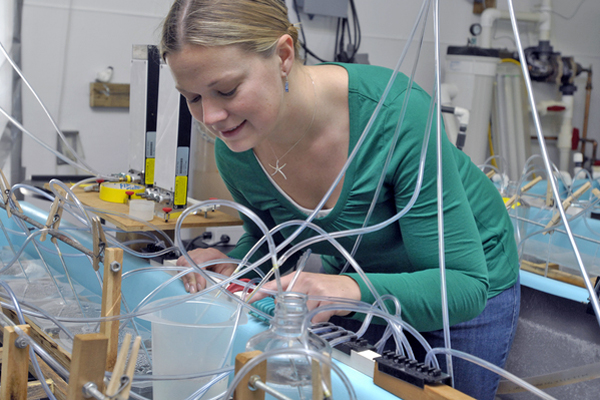
Stephanie Talmage, a doctoral candidate at the Stony Brook University School of Atmospheric and Marine Science, thinks she and her professor might finally have the answer.
Since the first combustion engines were put to use in the late 19th century, humans have been spewing carbon dioxide, or CO2, into Earth’s atmosphere. The effects of such “greenhouse gases” on climate have been well documented. But the effects on the world’s ocean may be just as dramatic, if not more so. About half of the CO2 released by humans is actually captured by seawater rather than lingering in the atmosphere.
As the oceans absorb CO2, the balance of base elements in the water, known as pH, is skewed, distorting the conditions under which many of the ocean’s creatures, in particular shellfish, have evolved.
“We’re seeing a dramatic decrease in survival rates as CO2 levels rise, even to today’s levels,” Ms. Talmage said during an interview at the laboratories at the Stony Brook Marine Sciences Center in Southampton. “Geologically, we’ve never seen the levels of CO2 we’re seeing today, in 25 million years. Throw in a little brown tide and some over-fishing, and of course populations are going to be declining. This could be one of those large explanations for what’s been going on.”
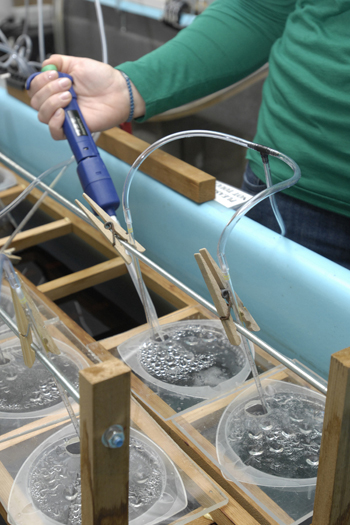
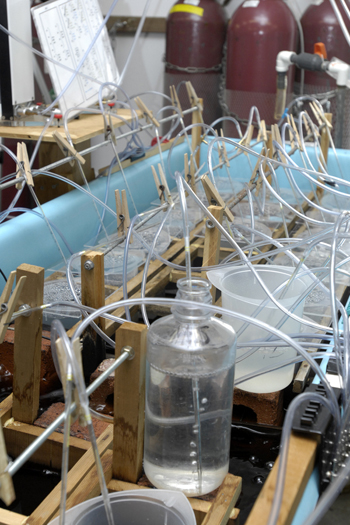
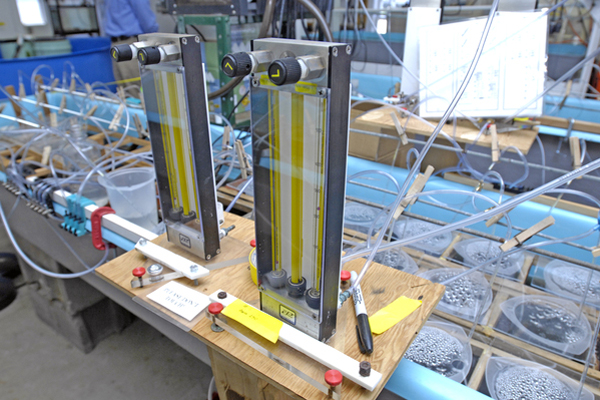
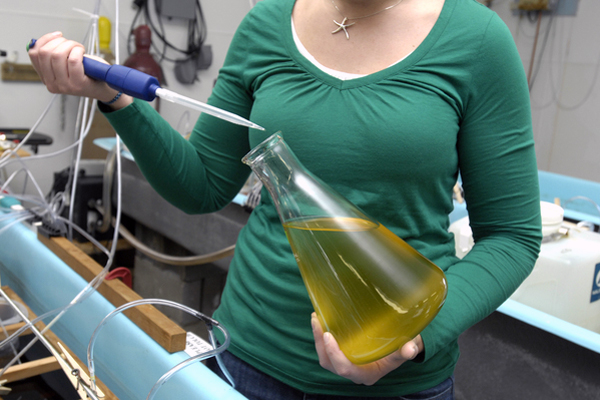
To test the theory, Ms. Talmage and marine science professor Dr. Christopher Gobler have been raising larval shellfish for the last year under a wide array of varied CO2 levels, from those mimicking the pH of ocean water in the year 1600, before the industrial revolution, through today’s range, and extending to forecast levels for the end of this century. What they’ve found is that at ancient CO2 levels, shellfish develop faster and survive at much higher rates than they do today.
“At year pre-industrial levels, we’ve seen survival rates of 70 to 80 percent,” said Ms. Talmage, who is also an East Hampton Town Trustee. “That drops to 20 percent at the levels expected in 2100.”
All shellfish develop their signature shells out of calcium carbonate, Dr. Gobler explained, a chemical compound they create by drawing carbonate and calcium from the surrounding environment. It is the main ingredient in the shells of crabs, lobsters and shrimp, as well as snails.
“The key is that as the pH of the ocean goes down, so do carbonate concentrations,” Dr. Gobler said. “Calcium is ultra-abundant in sea water, but with less carbonate they can’t build a thick shell.”
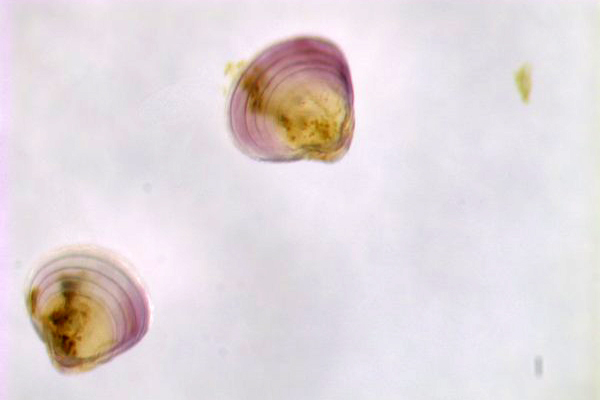
Using an electron microscope at the SUNY Stony Brook campus, Ms. Talmage has documented the developmental differences in the tiny—smaller than a grain of sand, in fact—larval shellfish. “As there is a decrease in the pH, their shells appear to be literally dissolving,” she said. “That makes them more susceptible to predators, but their insides are also being exposed to the outside environment.”
Since the last major outbreak of brown tide—an algal bloom so named for the color it tints the water—in the Peconic Estuary in 1995, once vast populations of bay scallops have never rebounded to historic levels, despite near Herculean efforts by scientists to reseed the wild stocks with hatchery raised broods. Adult shellfish released into the waters seem to survive and spawn as normal, but their offspring’s survivability rates vary wildly from year to year. Thus far, most theories have focused on factors such as pollution and the parallel declines in eelgrass in local bays. The study by Ms. Talmage and Dr. Gobler may have uncovered the root issue that has suddenly made the survival of shellfish that thrived for a century so delicate.
With 15 variants of the study completed—Ms. Talmage has run numerous permutations, like adding the brown tide algae to the water and fiddling with other environmental factors—the pair plan to continue the study for at least another year. Each study cycle takes 20 days, the length of the larval stage for most shellfish. For Ms. Talmage, that means another year of baby-sitting nearly invisible shellfish, feeding them squirts of phytoplankton through a turkey baster and closely monitoring gauges on CO2 tanks—she has a “nanny cam” mounted next to the gauges so she can watch them from home at night.
As to what can be done, aside from joining the global warming crusade against carbon emissions, the scientists say there isn’t much of a solution to dropping pH levels in seawater. The upshot may be that they will be able to help local hatcheries, where CO2 levels in the tanks shellfish are raised in can be manipulated easily, improve the survivability of the shellfish they are raising.
Dr. Gobler says there may be another bonus to the study results, albeit not a positive one.
“Marine scientists are recognizing now,” he said, “that the increase in temperature of the oceans may be the least of our worries.”


 Michael Wright on Apr 16, 2010