


 1 Photo
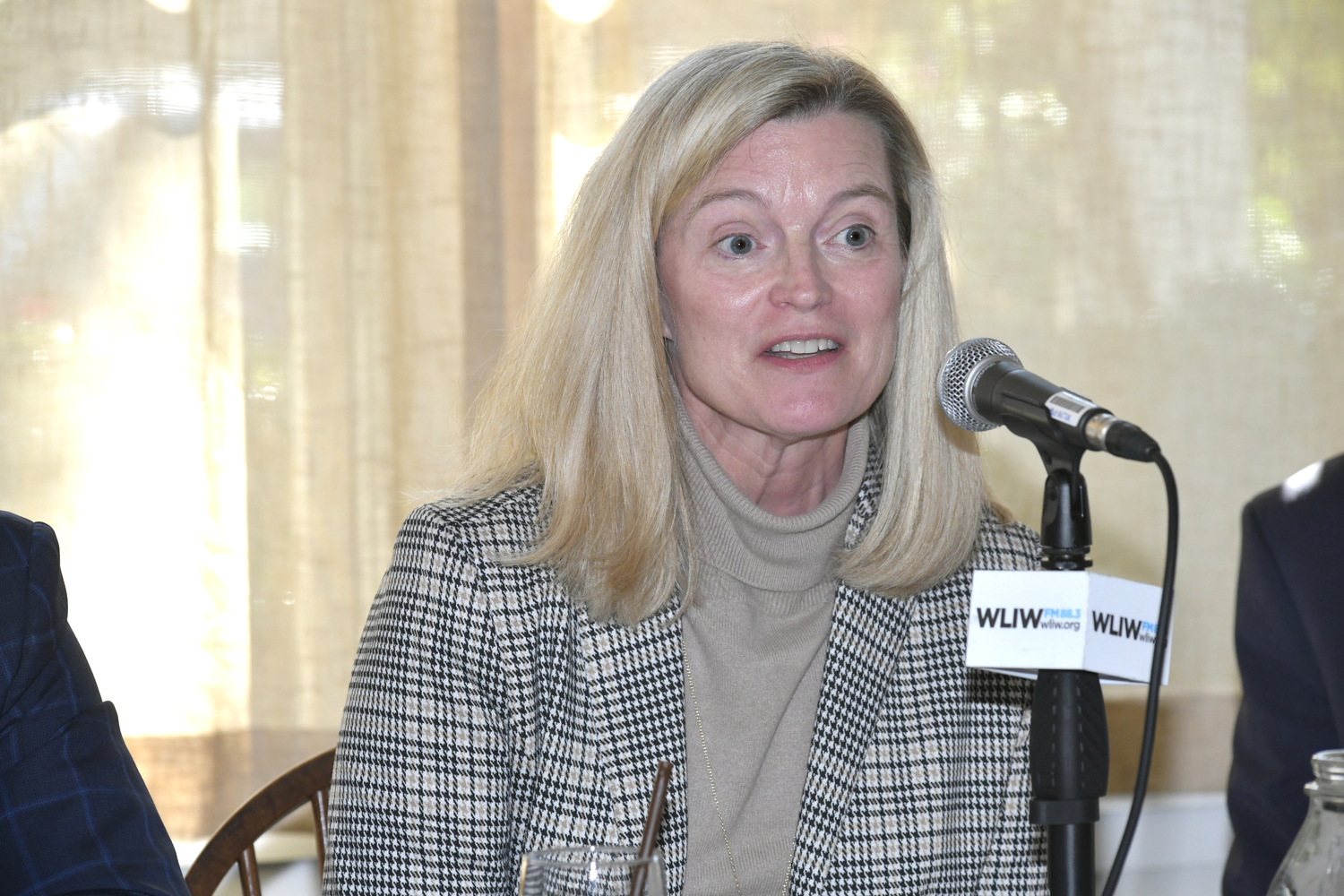
Southampton Town Director of Housing and Community Services Kara Bak. DANA SHAW
The priorities and the particulars of the Town of Southampton’s Community Housing Fund program are coming into focus as the money starts to trickle in via a half-percent real estate transfer tax approved by local voters in November 2022 that’s dedicated to enhancing affordable housing opportunities.
The program has, between May and August of this year, taken in $1.765 million, according to Southampton Town Director of Housing and Community Services Kara Bak — beginning with $55,931 in May and increasing in large chunks each month to an eventual $717,737 haul in August, the last month where figures are available.
“The money is just starting to come in,” Bak told the Southampton Town Board at a work session earlier this month.
Local voters in 2022 came out in support of the state Peconic Bay Region Community Housing Act, which lets the East End towns Southampton, East Hampton, Southold and Shelter Island create the CHF to help with affordable housing initiatives. The State of New York passed enabling legislation in 2021. Voters in the four towns signed on. The Town of Riverhead declined to participate in the program.
The fine print of the CHF program stipulated that any contracts signed prior to April 1 of this year would be exempt from the new tax, though still subject to the CPF levy.
That includes homes under development, Bak observed, that may take a year or more between the signing of the contract and the completion of the home.
Suffolk County, which records the real estate transactions, is currently sending Southampton “one big check” each, said Bak, which is forcing the town comptroller’s office to go through each sale to see whether the money sent to the town is from the CHF or the preexisting Community Preservation Fund, which adds a 2 percent tax on real estate transfers and has been around since the late 1990s.
That’s been a successful program funded to the tune of more than $2 billion since its inception in 1998, but those funds are getting mixed in with the new, smaller CHF monthly takings.
“They have to go through each one to see which program it was under,” Bak said of the town comptroller’s office.
Bak said that over time — and pending the extension of a robust real estate market — that monthly CHF revenues, she hoped, would be around $1 million.
The number of real estate transactions that went into contract in April will dwindle in coming months. Then the town will have a clear picture of what it can expect each month from the CHF program.
“That would be great,” said Bak of the town’s $1 million monthly wish list. “As we get deeper and more into it, that’s our hope.”
In the meantime, Bak has sketched out potential uses of the CHF, which she said would get far more bang for the buck if the town focuses on existing affordable housing opportunities over pricey full-scale developments.
As such, it may consider four different programs for first-time homebuyers, said Bak, which include down-payment assistance, a shared equity program, funds for remodeling, and an employer assisted down payment program.
The town may also consider avenues to encourage developers to repurpose existing infrastructure into affordable housing; a program to build accessory units, motel conversions, and other adaptive reuse schemes; a mortgage program focused on essential workers; and housing programs for seniors and the disabled.
Bak told the board that she drew these options after studying other similar programs that are working elsewhere “and adapted them here.”
The town’s 12-person CHF advisory board will make recommendations to the Town Board on how to proceed with doling out the funds.
The advisory board, said Bak, will be guided in part by findings of a hamlet studies program whose aim is to connect a would-be homeowner to an appropriate program within the CHF programs under consideration. Eligibility is limited under state law to an annual $174,000 income for a family of two and $203,000 for a family of three.
The CHF advisory board includes Jason Belkin from Hampton Coffee, Joy Cianci from Fannie Mae, real estate agent and YIMBY founder Michael Daly and nine other town residents.
At issue is getting the maximum bang for the buck in a town with a median home selling price of $2 million. The ideal approach would be to not create new density, Bak said, but make use of existing infrastructure, all with a goal in mind to keep it affordable and provide options for local teachers, first responders and others of modest means to be able to work and live here.
“A first-time homebuyers program would work better in places where the houses are cheaper,” said Bak, “because we are not going to have a lot of money,” which means the town is more likely to support that approach in Flanders than in Sagaponack.
Those sorts of granular approaches to maximizing the CHF’s community impact is the advisory board’s charge. “Then it’s up to the Town Board,” Bak said.
“We definitely are at a critical stretch,” Bak said of the town’s affordable housing crisis. “The sustainability of this township is going to rely on whether we can provide housing to those who are essential here.
“My office gets calls every week,” Bak added, from people who have lived in Southampton their whole lives as renters, but have had to move elsewhere because the town doesn’t have rent assistance programs.
The CHF is supposed to create ownership opportunities for local people who may find themselves in that situation.
In creating the CHF, the exemption for the existing CPF transfer fee was increased from $250,000 to $400,000 for properties that sell for $2 million or less.
The transfer tax is paid by the purchaser and this tweak meant that, for example, a home that sells for $900,000 would see its CPF/CHF contribution drop from $13,000 under the CPF to a $12,500 combined CPF and CHF. A $2 million home sale would generate $50,000 in combined CPF/CHF, a $15,000 increase over the CPF before the CHF law passed.
The law calls for the creation of “community housing,” which is defined as a house, townhouse or condo anywhere in town with a purchase price of $1.2 million or less.
Southampton Town Supervisor Jay Schneiderman noted that the town is a “victim of its own success,” with property values going through the roof, as he cautioned against any approach to distributing the CHF that might provide an outsized down payment to a would-be homebuyer, but at the expense of the program as a whole.
He noted that it might not be a great use of CHF funds, if, for example, someone was given a $500,000 no-interest loan to buy a home, given that they wouldn’t have to pay back the loan until they sold the home.
“Even if we do have a lot of money in the CHF fund, we have to use it in the most cost-effective way,” Schneiderman said.


