


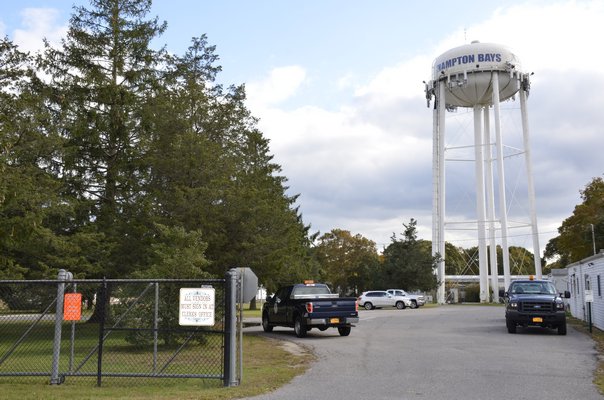
 1 Photo

While discussions continue regarding a potential agreement between the Town of Southampton and the Suffolk County Water Authority to take over operations of the Hampton Bays Water District, some concerns remain about the future of current water district employees.
Last Thursday, October 25, Town Board members, who also serve as commissioners of the Hampton Bays Water District, met with officials from the SCWA to discuss a recently crafted proposal that includes the SCWA takeover of the system in Hampton Bays, which would include implementing $6.1 million in capital improvements over the course of three years.
Town officials were pleased that the plan could offer closer monitoring of the system, but they worried about the possible impact on current employees of the HBWD if the larger county authority takes over and they become part of the staff there.
“We consider the employees of the Hampton Bays district to be resources. They’re our experts,” SCWA Chief Executive Officer Jeff Szabo told board members. “They know the system very well. I would think, initially, those employees would be utilized within the district to ensure there isn’t a misstep, or anybody drops the ball when it comes to customer service or capital work.”
But the future of those employees after integration is unclear. Mr. Szabo would not say whether the employees would eventually be moved to other offices on Long Island—like a regional office in Babylon—once the integration between the two water authorities takes place.
“I could think, at least initially, we could come to some agreement to have them stay on the South Fork,” he said.
Talks to take over the water district, between the SCWA and town officials, began in August after a string of problems were exposed with the water system in Hampton Bays. The problems experienced by residents in the district included low water pressure and discolored water.
Town Supervisor Jay Schneiderman has always held the stance that clean water is important for a community. He said there were a lot of complaints about water pressure and water contamination.
“People started coming to me saying they were afraid to drink the water,” he said on Friday. “They were drinking bottled water … and were afraid to bathe in it.”
When the issues were occurring, Mr. Schneiderman said, tests being conducted by the HBWD employees were not coming back fast enough.
If the town enters into an agreement with SCWA, Mr. Schneiderman said the new authority would be able to provide much better testing than what is being done now.
According to Mr. Szabo, SCWA has one of the biggest groundwater testing labs in the United States, which employs over 40 chemists and lab personnel. The SCWA has water tested for 387 different compounds, or 250 more than required under regulation.
“They have equipment we, I don’t think, can afford,” Mr. Schneiderman said.
But before town officials agree to have SCWA work toward better water for Hampton Bays, some things still need to be worked out—particularly the future for current HBWD employees.
Mr. Schneiderman said he is sure nobody will lose their jobs, but there are concerns with benefits.
Both SCWA and HBWD employees are unionized, although under different unions. Mr. Schneiderman said he wants to make sure there is a smooth transition between the two unions.
He also said he is concerned about the HBWD employees losing seniority.
At the board work session last week, Warren Booth, a maintenance crew leader for the water district, told SCWA officials and Town Board members that he was concerned that he and other employees of the water district would drop to the bottom of the flow chart.
Mr. Szabo said even though the positions with SCWA do not have the same titles, the Hampton Bays employees would be looked at in terms of their duties and experience, and then be matched up to positions.
“I want to guarantee that they would recognize the service in Hampton Bays as if [they worked] in Suffolk County,” Mr. Schneiderman said.
He added that if an agreement is made, the position changes could be challenged by the unions. That would only prolong the start of the agreement.
“I think it’s in the public’s interest in terms of higher purity of water,” Mr. Schneiderman said. “If it gets held up for a while, it will be unfortunate.”


 Greg Wehner on Oct 29, 2018