


 1 Photo
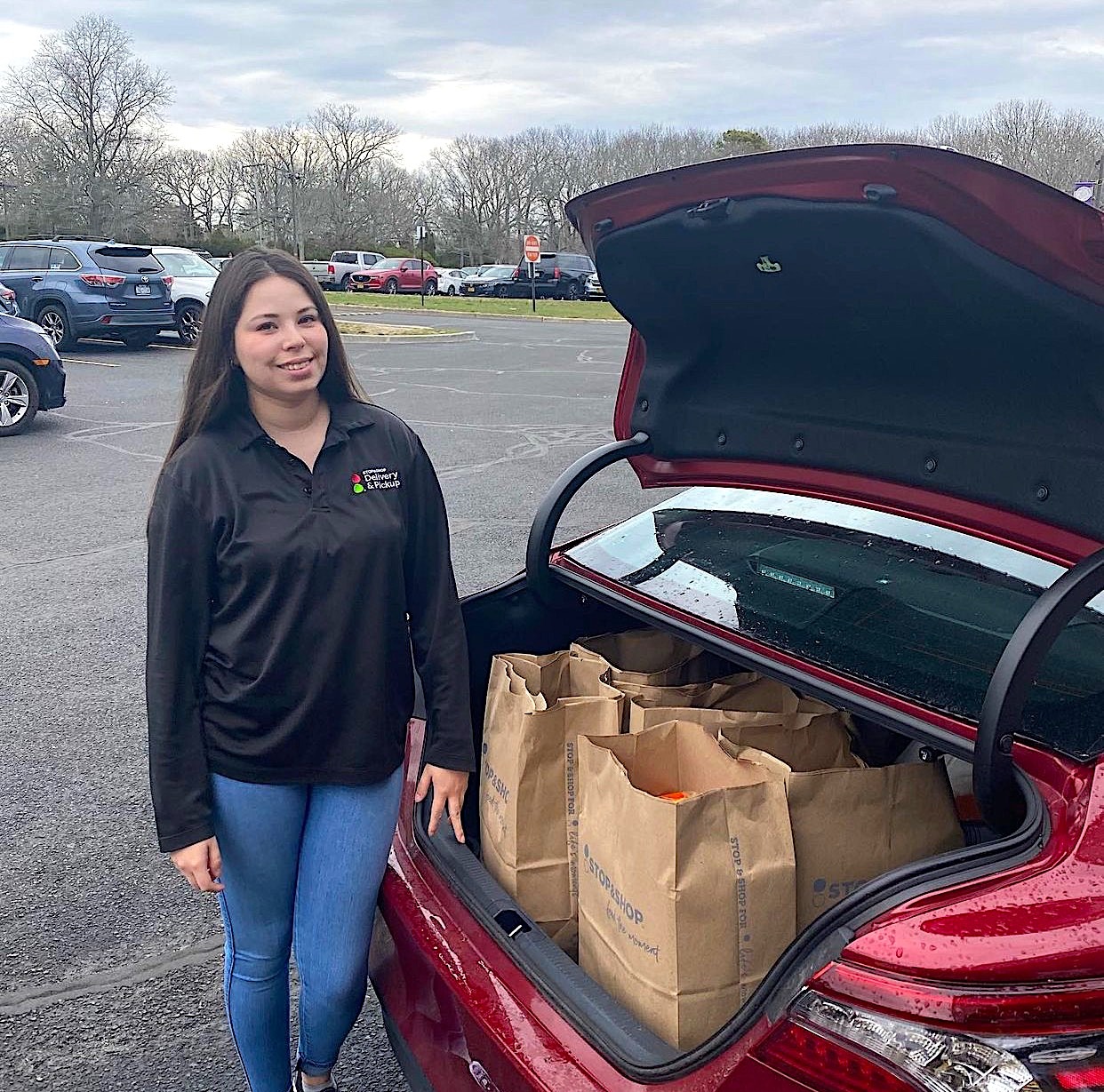
A Hampton Bays Stop & Shop employee delivers food to Hampton Bays High School's food pantry. Hampton Bays SCHOOL DISTRICT
The $3 billion Keep Kids Fed Act, which was praised by advocates who called the school lunch waivers a critical source of nutrition for low-income children throughout the COVID-19 pandemic, has received further funding — but only through the summer.
This means that beginning this fall, parents will have to apply for free and reduced-price meals.
“Our action today staves off a dangerous hunger cliff: ensuring universal free meals for all children throughout this summer, while helping schools keep up with supply chain snags and rising costs for the upcoming school year,” House Speaker Nancy Pelosi said in a statement.
But some, like Lisa Davis, senior vice president of Share Our Strength, an organization fighting childhood hunger, said the change will result in a logistical nightmare, because not only will parents have to remember to fill out paperwork, less children will qualify.
“For two-and-a-half years, families haven’t had to fill out an application,” she said. “Now, all of a sudden, they will, and there’s not a lot of time to communicate with them. A lot of kids will fall through the cracks, and we know families are still hurting with food and gas prices soaring.”
The measure does, though, provide schools with a higher reimbursement rate per meal — up 40 cents for school lunch and 15 cents for every school breakfast above the annual inflationary adjustment — for the next school year, and offers more flexible guidelines for school nutrition programs coping with supply chain problems and short staffing.
To cover the cost of inflation, some districts have already planned to raise prices this upcoming school year. Each meal in East Hampton is going up 15 cents, Superintendent Adam Fine said. Assistant Superintendent for Business Sam Schneider said that is the most the state allows food prices to rise year-over-year.
“I think at a bunch of different levels we are at an inflection point,” East Hampton Board of Education member Jackie Lowey said last week. “Food prices are way, way up, and I want to make sure our kids are still eating. I want to make sure they don’t have to pay too much — because a lot of people are still financially pressed — and that education on that starts this summer.”
In Hampton Bays, breakfast costs $1 across the district; while lunch costs $2.50 at the elementary school, $3 at the middle school and $3.25 at the high school.
Prices are set by school districts, usually with school board oversights, and according to data collected in a School Nutrition Association 2018 survey, which included responses from 1,550 school districts nationwide, median breakfast costs were $1.46 at the elementary school level, $1.53 at middle schools and $1.55 at high schools, while lunch averaged $2.48 at elementary schools surveyed, $2.68 at the middle school level and $2.74 at the high school.
Beginning July 2021, students who were approved for reduced-price meals also received breakfast and lunch and snacks served through the after-school snack program at no charge.
A bipartisan agreement had been reached in the U.S. Senate last month that would have allowed children who are eligible for reduced-price lunch to eat for free this upcoming school year, but that provision was removed from the final agreement.
According to the School Nutrition Association, children from families with incomes at or below 130 percent of the poverty level are eligible for free school meals. Those with incomes between 130 and 185 percent of the poverty level are eligible for reduced-price meals — student pays 30 cents for breakfast and 40 cents for lunch. During the 2021-22 school year, a family of four earning $34,450 or less is eligible for free meals and one earning $49,025 or less was eligible for reduced-price meals.
“I’m disappointed we had to make this change,” said U.S. Senator Debbie Stabenow, of Michigan, chair of the U.S. Senate Committee on Agriculture, Nutrition and Forestry. “But without this bill, we would have no support for kids at all.”
Had the measure failed, advocates estimate 7 million students would have gone without meals this summer. The waivers were extended just days ahead of their June 30 expiration date. The original legislation was intended for the opening of summer meal distribution sites that could operate in any community with need, rather than just where there’s a high concentration of low-income children, and offer to-go meals.
“No one wants a child to go hungry or feel shame — especially those working in school cafeterias,” the School Nutrition Association said in a statement. “School nutrition professionals work throughout the year to enroll struggling families in the free and reduced-price meal program and to make the cafeteria a welcoming, safe space for students.”
Beth Wallace, president of the School Nutrition Association, the trade group for school-food-service manufacturers and professionals, expressed disappointment in the reintroduction of the reduced-cost option, and cited an onslaught of challenges in schools’ efforts to ensure students are nourished in the past couple years.
“Supply chain breakdowns, skyrocketing costs and severe labor shortages are expected to persist well into next school year, and have prevented school meal programs from returning to normal operations,” she said. “Throughout the pandemic, free school meals have ensured students are nourished and ready to learn. The loss of free school meals puts too many students at risk of going hungry.”


