


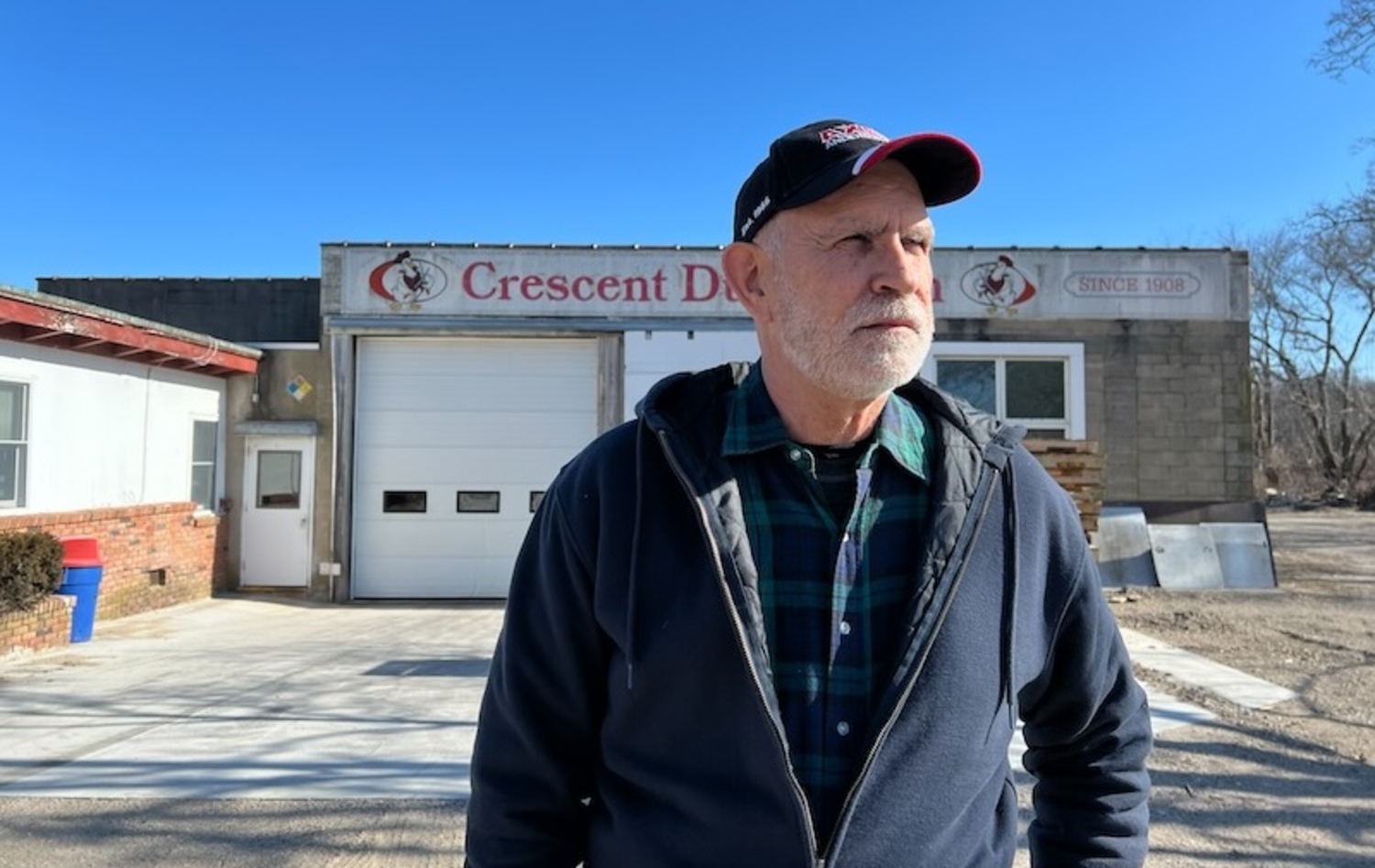
 2 Photos
Doug Corwin, president of Crescent Duck Farm in Aquebogue, outside the farm's office this morning. RiverheadLOCAL/ Denise Civiletti
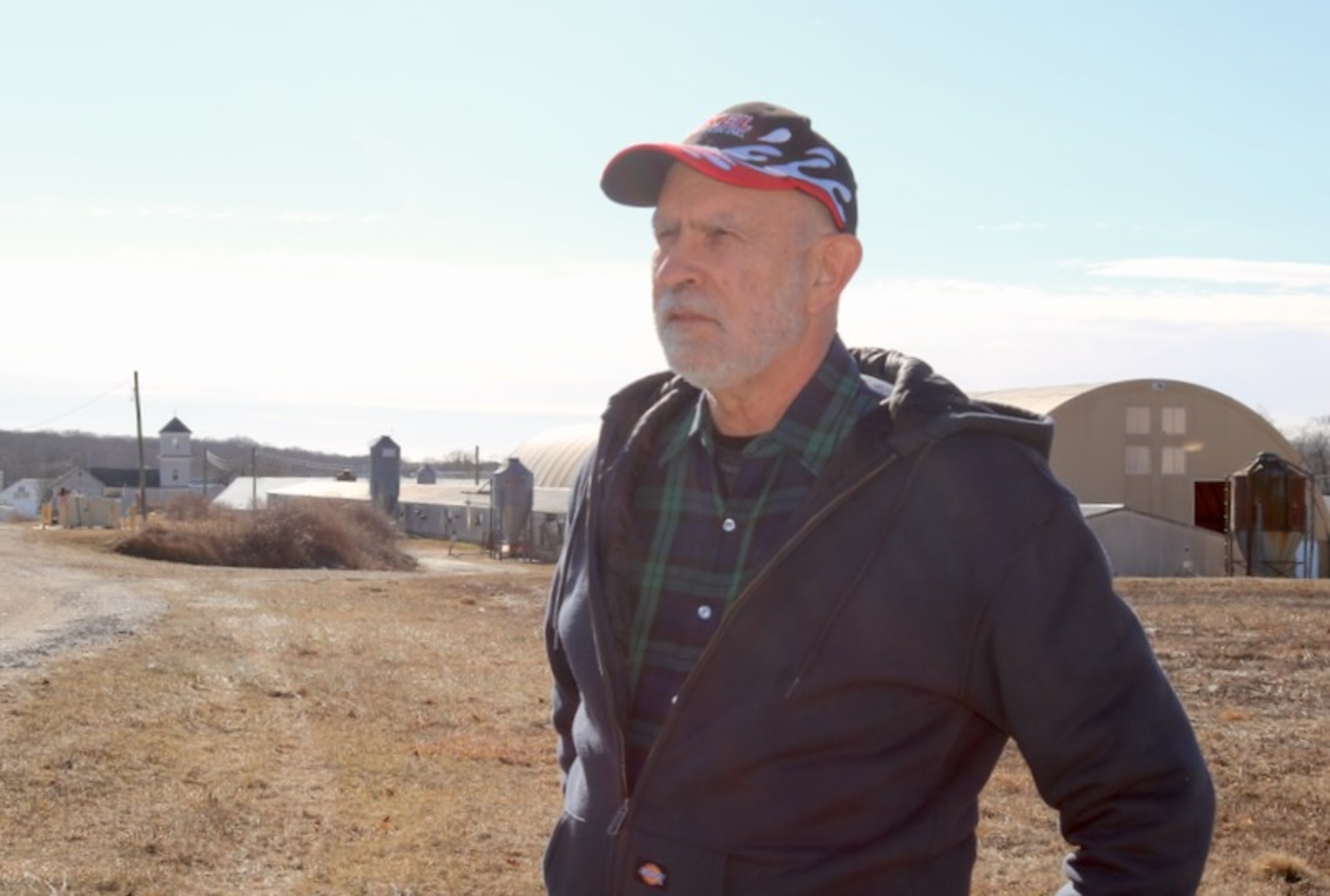
Doug Corwin discusses the prospects of repopulating Crescent Duck Farm’s flock outside the farm this morning. RiverheadLOCAL/ Denise Civiletti
Doug Corwin looks out over the Aquebogue farmland his family has owned for generations. The land stretches south from Main Road as far as the eye can see. Farm buildings are scattered across the landscape.
A few yards south of the fence that separates Crescent Duck Farm from the backyard of his family home is “the quarantine line.” Beyond that line, inside those buildings, workers continue to scrub and disinfect every inch of every building, followed by swabbing and testing to determine whether any remnant of the highly pathogenic avian influenza virus remains.
It’s been just over a month since that cold Thursday night in January when a lab confirmed avian influenza at Crescent Duck Farm, abruptly shutting down its operations.
It’s been a tough month for Corwin and his family: laying off two-thirds of the farm’s workforce, culling the farm’s entire flock of Pekin ducks, nearly 100,000 birds. USDA workers in hazmat suits fanning out across the farm. Television news helicopters circling overhead recording video. Tears flowing. News media from across the country clamoring for interviews about the fate of Long Island’s last commercial duck farm.
The whole world turned upside down.
The soft-spoken Corwin, 66, doesn’t easily lose his composure. That much is obvious. He seems to have taken in stride the tumultuous events of the past month, even the interviews on national television.
“We’ve been through a lot of things,” he said last week. “This is probably the toughest yet. But we’ll get through it.”
For now, though, all he can do is wait.
Over the next several days, the future of Crescent Duck Farm will come into sharper focus. Pekin ducklings hatch in about 28 days.
The eggs laid by Crescent’s hens before the bird flu outbreak were sanitized and moved to an off-site hatchery, with permission of the state. There were 15,000 eggs in all. The eggs were “candled” to determine whether they’d been fertilized.
“We threw out 6,000 of them that were not fertilized,” Corwin said. The remaining eggs are being carefully incubated under closely monitored conditions.
Corwin said he’s not sure how many of the eggs being incubated will actually produce ducklings.
“The eggs are old,” he said. That will affect the success rate.
He’s hoping at least 5,000 ducklings hatch. Roughly half will be hens. Those ducklings represent the future of the 117-year old Crescent Duck Farm. The hens will start laying eggs at about six months old. If all goes well, Crescent will be able to bring its signature ducks to market again in the fall of 2026.
If fewer than 5,000 ducklings hatch, the process will take longer, Corwin said.
Either way, it’s a long way off for a family farm with a large payroll and a significant overhead to cover — with no income.
But Corwin is as determined as he is stoic. They’ll get by, he said.
“We wouldn’t be doing this were it not for the tremendous support we’ve gotten from the community,” Corwin acknowledged.
He said the Corwin family is very grateful for the support from residents, businesses, customers, elected officials from Riverhead Town Hall to Albany and Washington, D.C., and even duck farmers in other states. The support for Crescent’s laid-off workers has been especially meaningful, he said.
The outpouring of support keeps everyone’s spirits strong.
Being able to save thousands of eggs for hatching was key to securing the farm’s future, Corwin said.
Crescent has “developed a meatier bird that has enough skin fat to make it really, really succulent when you cook it, without making it overly fatty,” Corwin said in an interview last month. For that reason, it’s the duck of choice among the “white-tablecloth trade” to which his business caters. That selective breeding is “what’s kept us in business,” Corwin said. Retaining the Crescent duck’s genetic material is essential.
Corwin has become an outspoken advocate for a change in U.S. policy to allow poultry to be vaccinated against avian influenza. A killed virus vaccine exists and is in use on duck farms in Europe. Progress is being made on an mRNA vaccine as well, he said.
The U.S. Department of Agriculture on February 14 issued a conditional license to a New Jersey company for its avian influenza vaccine, a killed virus vaccine that is labeled for use in chickens.
Current U.S. policy is to “contain” the virus by culling flocks on farms where avian flu is confirmed. But the virus is spreading so rapidly across the U.S. — affecting 162.77 million birds nationwide as of February 8 — that critics say current U.S. policy isn’t working.
Newly confirmed Agriculture Secretary Brooke Rollins is expected to announce a new strategy to fight the virus “in the coming days,” NBC News reported last week. A USDA spokesperson did not comment on whether vaccines would play a role in the new strategy, according to NBC.
Corwin said a small family farm like his — however beloved it may be by local residents and chefs across the region — is an insignificant part of the market.
“I read Monday about a farm that had to cull 2.6 million birds,” Corwin said. Large commercial poultry farms have so many locations and suppliers all across the country, he said. If one of them has to shut down for a while, the others keep going. The loss is a cost of doing business.
The loss of a small family farm’s entire flock, even though its numbers are small in comparison, is devastating.
Absent an available vaccine, Corwin can only hope that, if Crescent succeeds in repopulating its flock, it won’t find itself in the same situation.
He tries to put that out of his mind for now, focusing instead on the next several days, when Crescent duck eggs begin to crack open and hatchlings emerge from their shells.
Meanwhile, he waits.
This article originally was posted on RiverheadLocal.com and is published here with permission—Ed.


 Denise Civiletti on Feb 24, 2025