


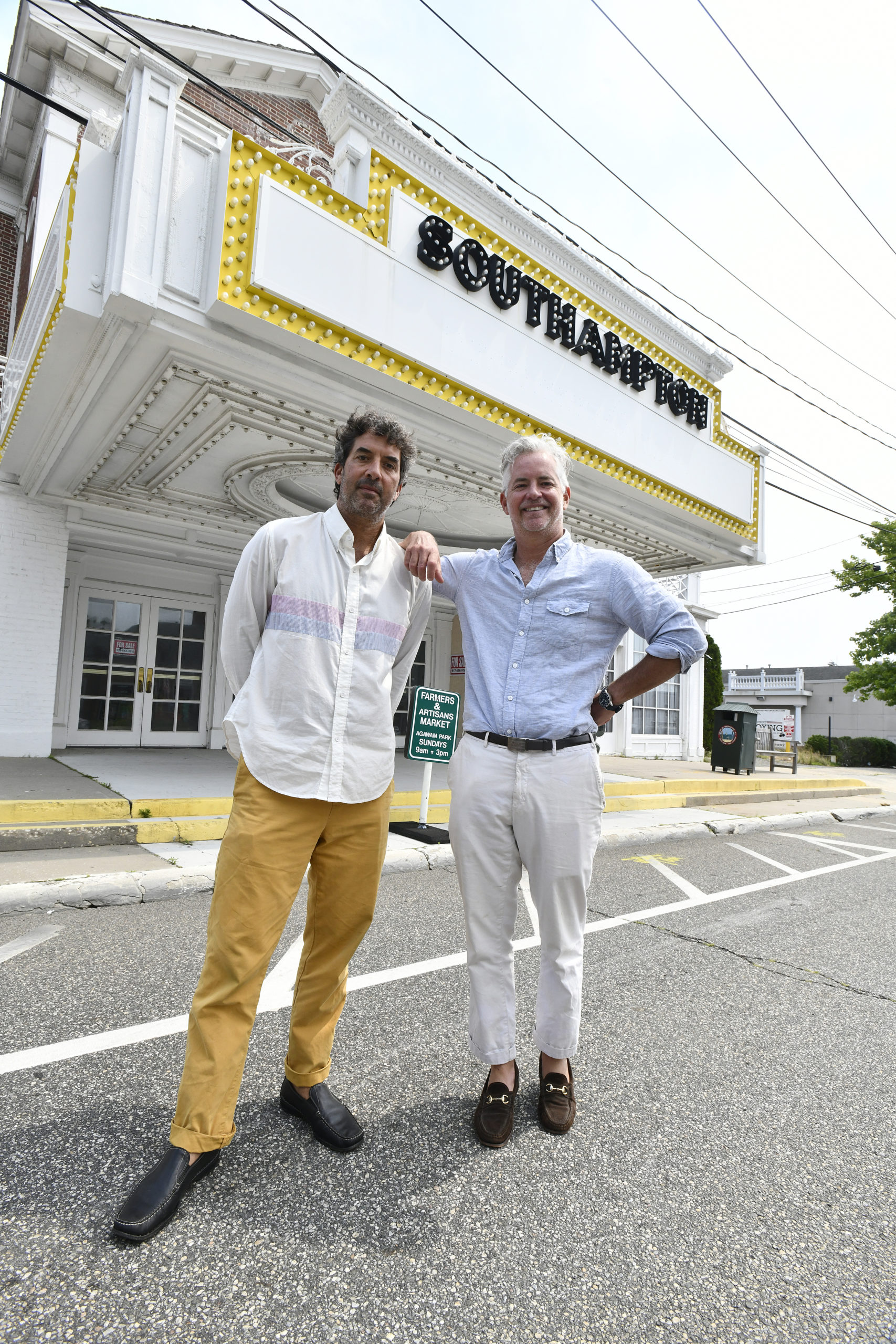
 2 Photos
Orson and Ben Cummings in front of the Southampton movie theater on Tuesday afternoon. DANA SHAW
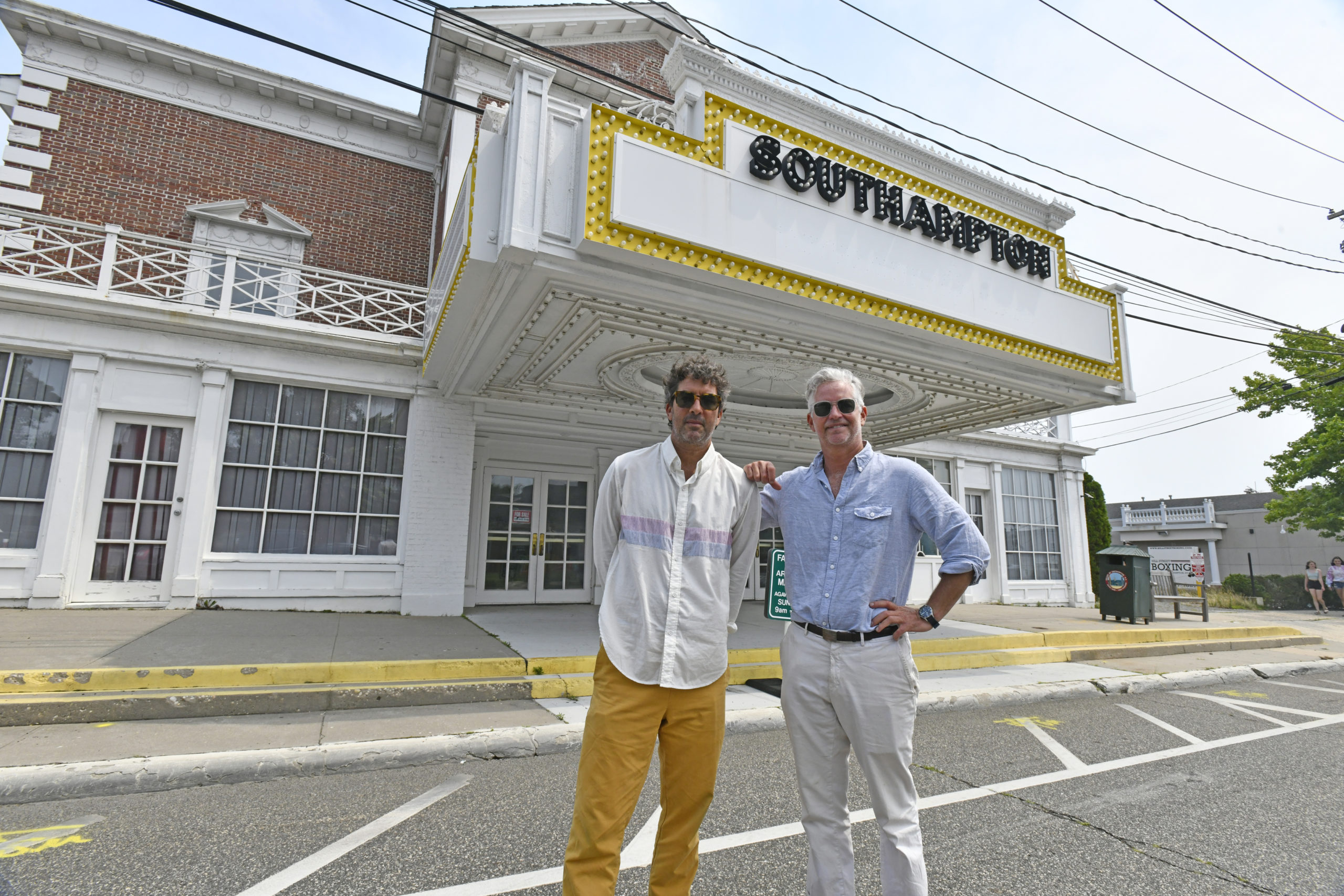
Orson and Ben Cummings in front of the Southampton movie theater on Tuesday afternoon. DANA SHAW
They’re ready for their closeup … and the closeups of plenty of others — of movie stars on the screen, musicians on the stage, maybe even local children performing in community holiday shows.
Filmmakers Ben and Orson Cummings of “Killer Bees” fame have crafted an ambitious plan to save the Southampton movie theater and transform the once elegant, now vacant, building into a lively cultural hub.
“Growing up out here, and going to the movies,” Orson recalled, “we made movies our life. But it started with going to the Southampton theater. It was one giant room and they had that huge chandelier we were terrified was gonna fall on us and we were gonna die, but we went anyway. The memories are great.”
As the national conversation turned to the future of movie houses, and whether they’re a necessary part of a community, the brothers felt the time was ripe for stepping up and saying yes, particularly against the backdrop of the successful effort to restore the Sag Harbor Cinema after it was destroyed by fire in 2016.
“We saw what happened in Sag Harbor — and that theater’s incredible — and we thought we’d test the waters and see how people felt,” Orson said. Gauging the energy level of the community, they learned desire to keep movies in the village was overwhelming.
And while Marc Chiffert — who is helping theater owner Ken Karlin field offers to buy the theater — was skeptical of the brothers’ ability to raise the $8.9 million price tag for the Hill Street property, they feel they’re well on their way to amassing the money through contributions from several well-heeled benefactors.
The brothers plan to offer a down payment.
“We are going to make them an offer of 10 percent. We’ll make that offer in the next week, ideally … We have real commitments and we have real heavy hitters on our team,” Orson informed. “We look forward to letting them know how serious this is.”
They’re just waiting for their registration as a nonprofit to complete the state process.
Reached for comment at the end of June, Mr. Karlin said, via email, “There are quite a few active inquiries, however none are in contract. The theater and the 2 acre lot it sits on is for sale. The listing price is $8.9 million. It is zoned village business. It will be sold to whomever or whatever entity pays the price.”
Bay Street Theater has been among the interested parties, although this week representatives from there are expected to meet with Sag Harbor Village officials to continue discussions about keeping the theater there.
If the Cummings brothers and the coalition they’ve formed, which includes their mother Mary Cummings, Eric Ruttenberg and Perri Peltz, Christine Di Donna, Bill and Pam Michaelcheck, Christina Redding, John Shea, and others, are able to secure the funding, the vision for its restoration and reimagining laid out in a proposal they shared with The Press, is vivid.
The pair sees a state-of-the-art three cinema movie house with one main room honoring the grand original theater, one mid-sized room and the third more cozy. The main room would be convertible into performing arts space with a stage for live performances. In high season, there would be music every weekend, and in the off-season, movies could be occasionally interspersed with holiday acts.
The vision calls to mind the theater’s early days, Ben pointed out. When it was Glynne’s Theatre in the 1930s, vaudeville acts performed on the stage, he explained. The design would do away with the more recent “rat’s maze” of smaller theaters crammed into one building, and status as a nonprofit would offer flexibility in terms of what entertainment is offered. The theater won’t be tied to corporate productions that come with commercials and “17 trailers,” Orson explained.
Key to the plan is a cafe and second floor bar that would serve small bites. “Imagine the two terraces next to the marquee as part of the rooftop cocktail lounge, where visitors can come before or after a show for a libation and something to snack on while they watch folks coming into town on Hill Street,” the proposal posits, predicting the current dead space would become “a beacon of energy that will draw people in.”
Mayor Jesse Warren holds a similar hope. Speaking of the proposal, he said, “There is a great idea being championed by local filmmakers who love the medium and want movies in the village … The goal is to keep film, arts and culture in the village and continue the momentum we currently have with all of the new cultural institutions in the village.”
The brothers noted that during the recent campaign for village offices, candidates on both sides of the aisle were excited about the proposal and helped introduce the filmmakers to local “movers and shakers.”
The siblings plan to create the new Southampton Theater as a not-for-profit entity. As such, grants for state or town Community Preservation Fund monies could be pursued. Although village officials balked at their first foray into achieving landmark designation, they believe it is attainable, which would open the building up to funding for reconstruction and enable the theater to remain a cultural center in perpetuity. State officials are supportive of grants for downtown revitalization projects, especially when arts are a way to revitalize the area, Ben said.
The proposal also includes an idea that could appeal to residents and business owners who aren’t necessarily movie fans. The brothers suggest that a portion of the property’s back parking lot could be used to place the village’s long-awaited sewer treatment plan.
“We are more than happy to work with the village to place a system on the property and guarantee the district we think of as WESO (West Southampton) grows into a lively place for people to enjoy, especially young people who need vibrancy here in the village,” the proposal asserts. Getting the system up and running soon could be the spark that ignites light on the “inexcusably darkened area of Windmill Lane.”
If the lot could be used for a treatment plant, Ben said, “Then you could have apartments above the stores in that part of town. And those are traditionally affordable housing.”
New life, restaurants, apartments, and housing above the old Verizon building could transform that section of the village the same way Bushwick in Brooklyn has changed, Orson theorized.
The financing for the theater is coming from residents of Southampton Village, not outside forces, the proposal asserts. It forecasts, “a true community theater and not a land grab from outside developers seeking luxury condos.”


