


 2 Photos
When the Parrish Art Museum leaves Southampton Village next summer, the village-owned building and grounds it currently occupies on Jobs Lane will undergo an approximately three-year, $20 million renovation and expansion project to make way for its replacement: the Southampton Center for the Arts, a multi-disciplinary arts institution that supporters say will serve as a destination point for another century, while retaining the property’s historic flavor.
The Parrish ultimately decided to leave the property after an expansion it first proposed for the site more than a decade ago was rejected by the village over concerns that those plans would have destroyed the property’s historic elements. Those plans called for a 35,000-square-foot addition as well as several proposed structures, including a 3,744-square-foot glass pavilion along Jobs Lane, which opponents at the time complained would mean less open space.
The plans unveiled last week call for an addition as well as new structures.
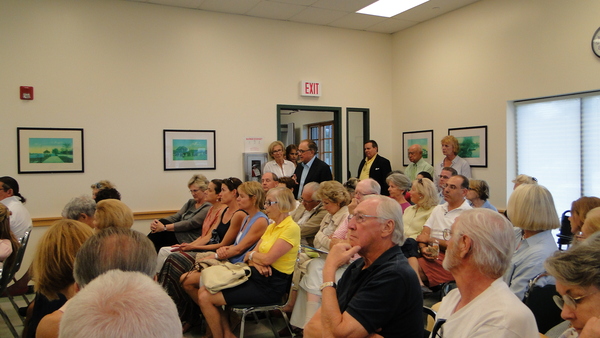
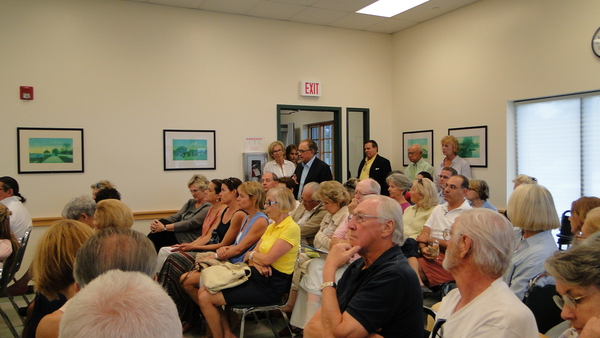
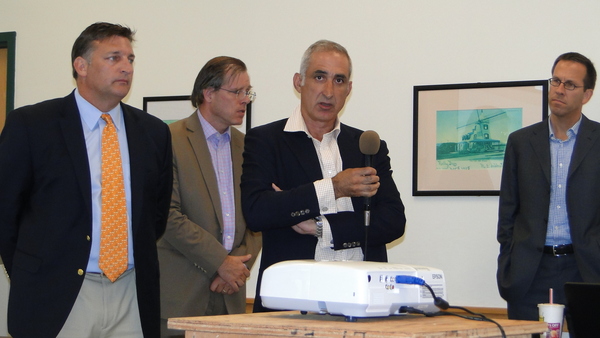
Four possible plans, or “test fits,” for the site were presented by Duncan Webb, president of Webb Management Services, and Douglas Moss, a partner in the New York-based planning firm ForeSite Facility Planners, at a Village Planning Commission meeting last Thursday, July 7, at the Village Justice Center, which was packed with attendees. All four plans involve expanding the building’s footprint, while seeking to preserve and enhance the surrounding arboretum.
Representatives at Thursday’s meeting did not offer any figures for estimated costs, citing the early stage of the process, but village officials said later the renovation and expansion of the building could cost about $10 million to $12 million, with another $8 million to $10 million for operational costs. A capital campaign and private donations will pay for the work.
The one that involves the most minimal change would add a 7,500-square-foot amphitheater and a 3,000-square-foot building housing a horticulture center and greenhouse. Both structures would occupy the northwest corner of the property.
A second scheme calls for a 25,000-square-foot addition in the northwest corner, housing a theater, theater support room, lobby, horticulture center and multipurpose room. That building would be connected to the main building via a plaza/amphitheater of unspecified size.
A third possibility would add a large building, connected to the current building, and would include a courtyard. Mr. Webb did not provide an estimated size for that building, but it would include a theater, theater support room, two multipurpose rooms and a lobby. In addition, a horticulture center and greenhouse would occupy a second building to the northwest.
The fourth diagram presented calls for a 5,000-square-foot multipurpose room building to occupy the northeast corner. A performance courtyard, with stage seating, would sit directly to the north of the current museum building, while to the northwest there would be a 20,000-square-foot building including a theater, theater support room, classroom, catering support room and multipurpose room. Farther to the northwest would be a 3,000-square-foot building housing a horticulture center and greenhouse. The main building would be connected to the 5,000-square-foot multipurpose building and the 20,000-square-foot building housing the theater via pergolas.
The main building, in all cases, would feature, from south to north, a grounds exhibit, espresso bar, gallery, lobby and exhibition gallery/multipurpose room. A walkway from Main Street would lead to the lobby—a historical element that village officials hope to resurrect.
“At the end of next summer ... we’ve gotta have a game plan ready. We’ve gotta start whatever type of construction we’re gonna start,” Mayor Mark Epley said. “Because we want that space—whether it’s internal and external—utilized next summer.”
An exhibit featuring photographs of the landmarks of New York will be presented at the Jobs Lane building next summer, once the museum moves to its new building in Water Mill.
According to a survey currently being administered by the consultant, 78 percent of respondents so far believe the property should continue to serve a cultural use, and 76 percent believe it is important or very important for the architecture and grounds to be preserved to the extent possible.
The Manhattan-based consultant was hired by the village to help plan the future use of the site.
Some residents in attendance said they felt Southampton needs a vibrant arts center because it has been falling behind East Hampton’s Guild Hall and Sag Harbor’s Bay Street Theatre, for example. Others expressed concerns that it might be in direct competition with already existing institutions, like the Southampton Cultural Center. Mr. Epley and other officials countered that the new center would enhance the offerings at the cultural center.
Resident Jay Diesing questioned whether the focus would be year-round or seasonal and expressed concern over parking and density issues. “You don’t build the church for Easter Sunday,” replied Mr. Webb.
Dr. Morrell Avram said he would like to see Stony Brook Southampton play a role in the new arts center’s use as well.
Anyone wishing to participate in the survey can still do so by clicking on “Parrish Visioning Survey” at southamptonvillage.org.


 Colleen Reynolds on Jul 8, 2011