


 8 Photos

Southampton Town Supervisor candidate Jay Schneiderman.

Richard Mishaan in the studio cottage he calls, "Mixology." DANA SHAW

In response to public backlash to its proposal last year to eradicate mute swans, the State Department of Environmental Conservation this week rolled out a new policy to deal with the birds on Long Island and elsewhere in the state—one that is less focused on slaughtering them.
While the original plan allowed for the capture or killing of all free-range mute swans, with the goal of eliminating every mute swan in the state by 2025, the new proposal, which was announced Monday, has a more nuanced approach that emphasizes education and regional handling of the issue, and targets the impact of the swans rather than the animals themselves.
However, killing the swans is still an option in the new plan, albeit one reserved primarily for state-maintained lands and situations where the birds are considered an imminent threat to public safety—such as airports—or the local ecosystem. The new plan, however, no longer specifies a deadline for elimination of the species, as the original plan did.
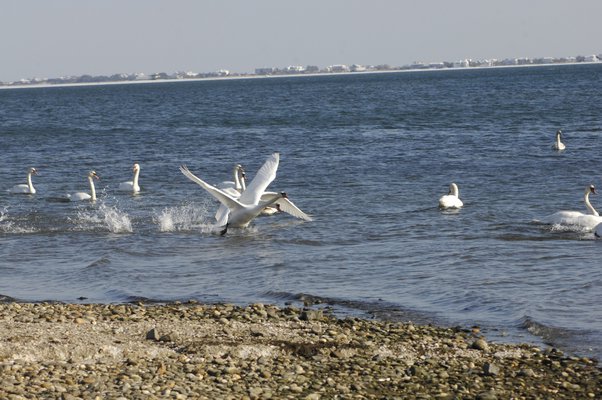
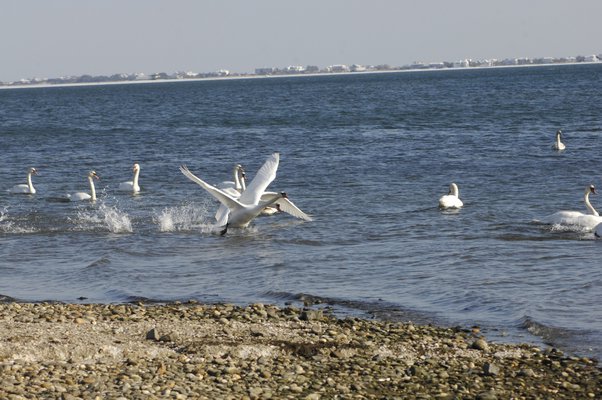
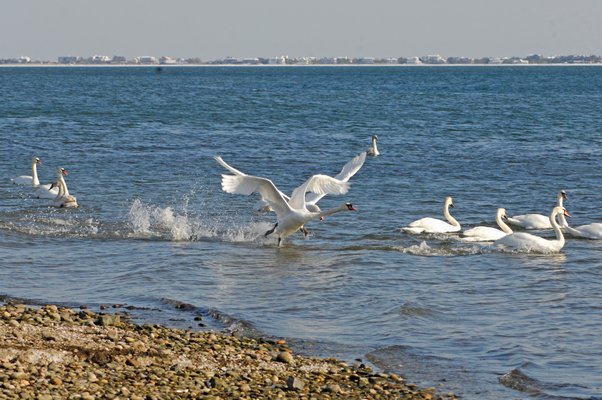
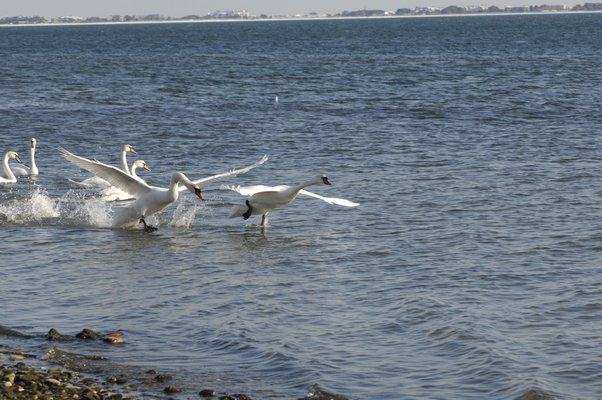
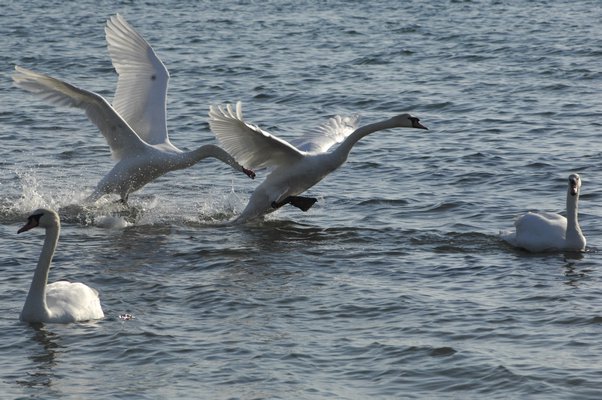
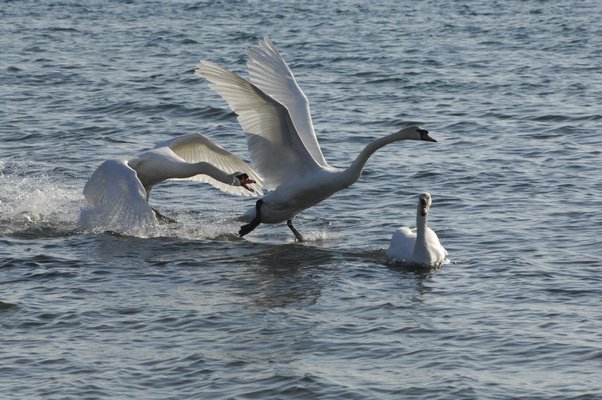
Known to frequent prominent local bodies of water, such as Town Pond in East Hampton Village and Lake Agawam in Southampton Village, and making the occasional appearances on the bays of western Southampton Town, mute swans are both spectacles and menaces on the South Fork. There are roughly 300 mute swans in Southampton and East Hampton towns, DEC spokesman Bill Fonda said.
They are a non-native species in New York, according to the DEC. Mute swans were first brought here from Europe in the late 1800s and were used to beautify private estates on Long Island and in the Hudson Valley.
Over time, the birds have gotten loose and populated their surrounding areas, which has become problematic, because they are over-consuming and destroying underwater vegetation that supports marine life and sustains other species of waterfowl, including black ducks, canvasbacks and Atlantic brants. Mute swans are also known for being aggressive and killing other birds, according to the DEC, and even attacking humans.
The new plan focuses on population control and encourages non-lethal measures, such as targeting eggs, discouraging nesting, regulating more strictly who can own mute swans and how they are kept in captivity, and interfering with breeding, or neutering, which would be performed while the swans are in captivity. The DEC is hoping to partner with local municipalities and non-governmental organizations to empower them to take the reins on the issue.
“I’m glad, number one, that they’ve changed the report in response to the public outcry,” Assemblyman Fred W. Thiele Jr. said. “I’m going to reserve my decision on the report as a whole, but I do think the DEC made a good-faith effort to address public concerns.”
Mr. Thiele, along with Senator Kenneth LaValle, both of whom represent the East End, introduced bills into their respective legislative houses in 2014 seeking a moratorium on the proposed eradication of the swans. Although both the Assembly and the Senate approved the bill that Mr. Thiele helped introduce, Governor Andrew Cuomo vetoed it last year. Mr. Thiele said he reintroduced the bill earlier this year, but he doesn’t expect any action to be taken on it until after the state’s budget is finalized.
The state also is pushing for the swans to be managed regionally, differentiating between upstate and downstate methods. For example, the DEC said shooting free-ranging mute swans would be more applicable upstate, where the emphasis is on preventing the birds from creating a solid foothold.
When the idea of curtailing the swan population was first raised in January 2014, the Eastern Long Island Audubon Society was split on the issue. “We decided to step back and let individual members take their own stances,” Eileen Schwinn, the group’s vice president, said Tuesday morning. “We, as a group, didn’t come to an endorsement or a condemnation of the plan.”
Likewise, she said, the group still has not formed a collective opinion on the new plan, although that is primarily because they haven’t had a chance to discuss it at a meeting.
Byron Young, the group’s president, said any plan where more options are provided beyond simply killing the birds is a plus.
“The issues were voluminous,” Mr. Young said of the first plan. “It was not well put together—it called for the complete extermination of mute swans, which we did not support.”
During the past three decades, mute swans have come to populate portions of upstate New York near Lake Ontario and the Finger Lakes, many of them flying over from Canada and causing similar issues as the downstate swans. There are approximately 200 mute swans upstate, compared to more than 2,000 on Long Island, in New York City and in the Hudson Valley.


 Kyle Campbell on Mar 10, 2015