


 1 Photo
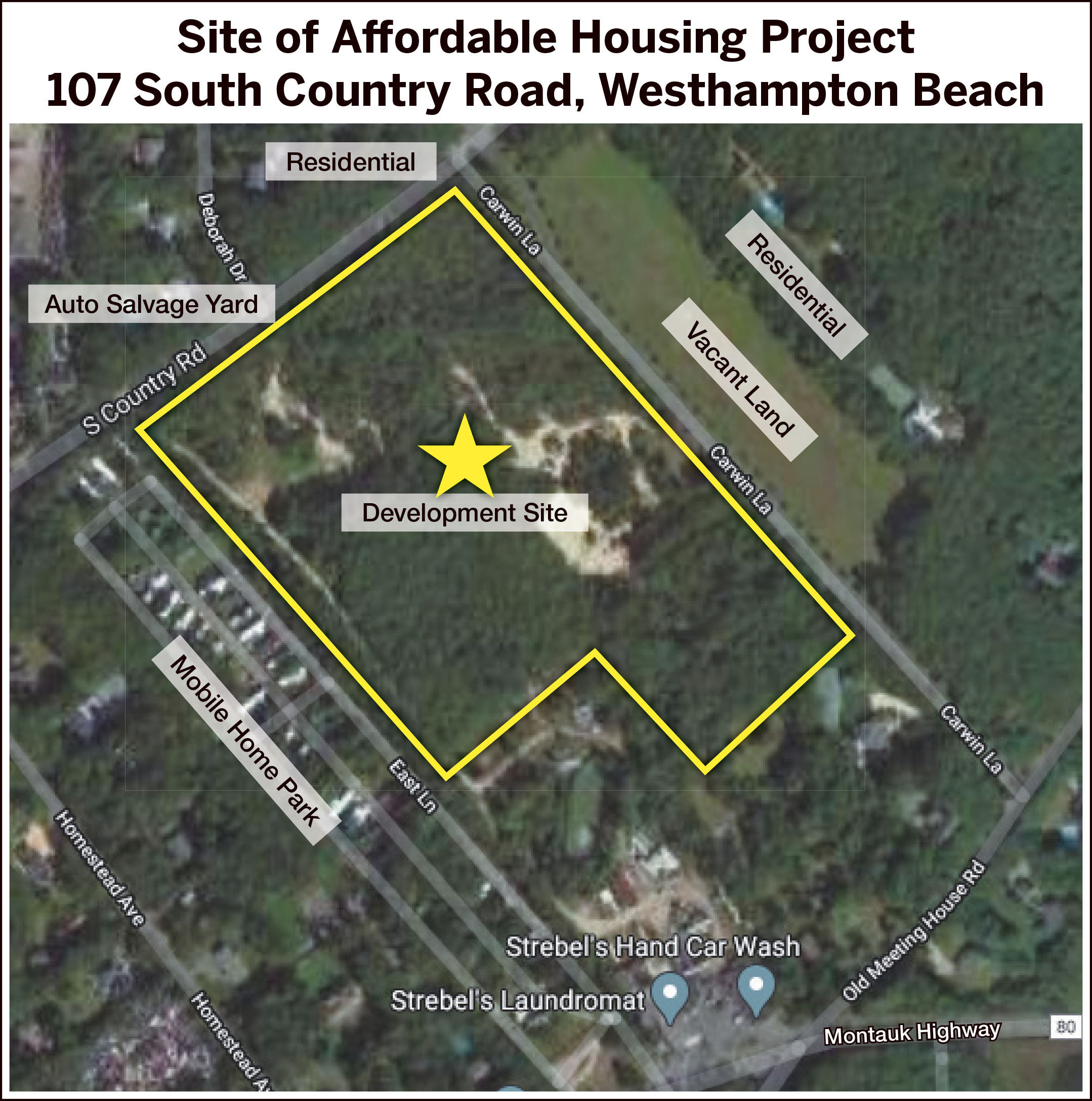
The site of The Preserve at South Country.
Offering comments on the comprehensive environmental review of The Preserve at South Country, a proposed 104-unit affordable housing development in Quiogue, the Southampton Town Planning Board last week voiced an extensive list of concerns about the project, running the gamut from its density to lease agreements for tenants.
The developer, NPR Group, is asking the Town Board for a zone change to allow the project. Taking note of the project’s potential environmental impact, the Town Board last year directed NPR to compile a draft environmental impact statement. As required by the State Environmental Quality Review Act, a subsequent hearing on the zone change and DEIS drew few speakers.
Some neighbors of the site — located between South Country Road and Montauk Highway — expressed opposition to the size of the project near their homes. Generally, however, the project has not been the subject of controversy and extensive opposition.
The Planning Board, which will be tasked with closer review of the development should the Town Board grant a zone change, also weighs in on the DEIS and zone change request, providing a written referral. Members say what they want to see included in the final environmental impact statement.
During review of the DEIS at a recent work session, Planning Board member Craig Catalanotto underscored that once a zone change is granted, “the density is set.” The board’s referral document states, “Given this existing rural population density of Quiogue, limitations of emergency services, and the lack of community amenities, the Town Board should require a project with a reduction in density in efforts to maintain consistency with the existing character of the hamlet.”
It states that even by conservative estimate, an increase of 250 new residents would mean a population increase of 46 percent. Catalanotto said he’s never seen a workforce housing project increase a hamlet’s population so substantially.
“Those are huge numbers,” he said. “We’re talking about a tremendous amount of density.”
Quiogue is a single-family home hamlet, board member Thackoor “George” Mootoo noted. Density goes hand-in-hand with a change of character in the hamlet, he said. And, because the proposed apartments will be affordable rentals in perpetuity, he noted, “You potentially have a transient population coming through.”
Looking at the information contained in the DEIS during a work session last month, Planning Board Chairwoman Jacqui Lofaro questioned the figures presented. With 40 one-bedroom units, 48 units at two bedrooms, and 16 three-bedroom units, she calculated a low end of 288 people and a high end of 352.
Discussing the potential impact on local schools, the referral document notes that when comparisons of projected school-age children and actual counts of recently approved townwide affordable housing projects are made, the actual counts appear to be significantly higher than projected. The referral suggests the town factor that discrepancy into its deliberations and possibly consider reducing the density of the project.
Catalanotto recalled the initial analysis for the Speonk Commons development estimated four schoolchildren, when the actual number turned out to be 12. Comparing that to the payment in lieu of taxes, or PILOT, payments made by the developer, the shortfall was in excess of a quarter of a million dollars. He calculated, “being extremely conservative,” a roughly $800,000 shortfall for The Preserve project.
“There are going to be impacts here to the community that need to be addressed,” he said.
Board member Thomas Neely said the impact of the density on emergency services needs to be fully explored.
Potential impacts can be lowered by reducing the number of apartments, board member Glorian Berk pointed out. “If we think the projections are too low and the system can’t support it then you have to have fewer apartments,” Berk said.
“There’s probably a threshold where if you get too low, they’re not building it,” Town Land Use and Development Administrator Janice Scherer said.
Speaking to traffic, Mootoo looked askance at the number of parking spaces proposed. With 184 rooms, there are 226 parking spaces provided. People tend to have multiple cars per apartment, Mootoo said. Where would overflow parking go? “Are they going to clog the streets?” he wondered.
Given the distance from downtown areas, “People are going to be car-dependent,” Lofaro predicted.
Board members also favored consideration of a secondary access point, particularly from a public safety standpoint. Getting people out of the development in the event of an emergency should be considered.
Also on the topic of traffic, the board felt trip generation figures seem low and the intersection of South Country Road and Montauk Highway is problematic.
Planners want to know what the leases will look like, in terms of such aspects of the community as commercial vehicles parked in the lot overnight. Many trade people have their personal vehicle at home and come home with an extra vehicle, Kate Fullam observed. That makes providing adequate parking important. Motto was curious if measures would be included in the leases that keep tenants from renting out rooms in their apartments.
Looking at potential environmental impacts, the board asked the town to hire its own professional to review conclusions related to existing environmental conditions, water and ecological resources, construction impacts, cumulative impacts, and potential soil and groundwater contamination drawn by the DEIS authors, land use consultants from the firm Nelson Pope Voorhis.
Should the zone change request be granted, planners will review the proposed subdivision. It carves 23 acres into two parcels. One, at 5 acres, will remain in use by Strebel’s Laundromat and Hand Car Wash. A larger portion — some 17 acres — will be used for a cluster development of housing units that leaves approximately 5 acres as open space.
Completed as proposed, the project would comprise eight two-story residential buildings, a clubhouse and open space containing recreational trails and amenities, plus 148 parking spaces and an onsite sewage treatment facility.
Lofaro characterized proposed amenities like two outdoor grills as “woefully inadequate.” She suggested looking at alternative designs. Trying to compress the development into the allowable acreage “gives up a lot of community spirit,” she said.
“The applicant should consider including/expanding the following amenities: A community garden; a larger playground to accommodate the projected number of children; additional outdoor grill space and community gathering space,” the referral document states.
Comments from the Planning Board will be folded into the Final Environmental Impact Statement. From there, the Town Board may vote to adopt it and the zone change.


