


 1 Photo
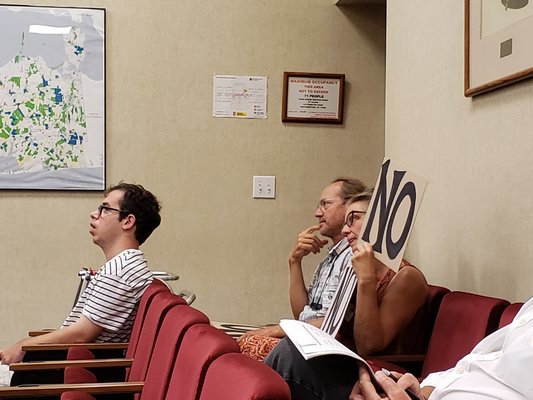
People opposed to a 60-unit affordable housing complex held up signs that read "NO" during a Southampton Town Board work session on Thursday, August 1, when the topic was discussed. GREG WEHNER
Developers proposing an affordable apartment complex behind the Southampton Full Gospel Church soon could be able to apply for a zone change that would allow the 60-unit housing development to be constructed, if Town Board members give their approval in a vote next month.
Representatives from Concern for Independent Living — an organization that creates affordable and workforce housing opportunities, and also provides services to those in need — made a second plea to the Southampton Town Board on Thursday, August 1, seeking permission to file an official application.
Ralph Fasano, the executive director of the organization, first met with the Town Board in February to gauge the board’s interest in the development on the 9.4-acre parcel off County Road 39, to the rear of the church property.
If the board members give the group a green light, the organization would be allowed to submit a formal application to change the zoning of the property from half-acre residential zoning to multi-family housing.
Under half-acre zoning, the developer could construct seven single-family homes on the site. If changed to multi-family zoning, Mr. Fasano and his team would be permitted to construct six units per acre, or 30 units. But because the units would be offered as affordable housing, the number of units can increase to 12 units per acre, or 60 units in total.
In February, Mr. Fasano was directed by the board to reach out to the community and listen to their concerns about the project. Nearly six months later, he was back in front of the board asking to move forward with the application.
Mr. Fasano told the board during the work session that he had met with the community, even touting that 60 to 70 letters had been submitted by community members in support of the project through East End YIMBY — which stands for “yes in my backyard” — a local initiative that advocates affordable housing.
The biggest concern Mr. Fasano said he heard from community members was the ingress and egress from the development, which includes one leading to the Hillcrest community, another to a development to the west and a third to County Road 39.
When asked by Town Supervisor Jay Schneiderman if a solution to the roads to and from the development had been created, Mr. Fasano said it was still being worked on.
Town Board member Christine Scalera asked about density and said when the Speonk Commons development, a 38-unit affordable housing development on North Phillips Avenue, was pitched in 2015, it was proposed as a 50-unit development. After community members attended meetings in droves to oppose the development because of its density, the project was downsized to 38 units.
Mr. Fasano said if he and his team lower the number of units to 50, which Town Board members have requested, his organization will fall $1.7 million shy of the required amount to cover the costs. “Our density is really low in terms of people,” Mr. Fasano said.
But Ms. Scalera said 50 is still too large, especially since the largest development she has seen go up while serving on the board was 38 units.
If built as a 60-unit complex, the development would consist of 36 one-bedroom units and 24 two-bedroom units, amounting to 84 bedrooms. A one-bedroom would rent for anywhere between $550 and $800 per month and a two-bedroom would rent between $1,100 and $1,200 per month, according to Mr. Fasano.
At least 15 of the units are required to go to veterans, although he said he would rather see 30 go to veterans.
Mr. Fasano has not held a community meeting and said during the work session that he preferred meeting in smaller groups. He also said there are people out there with images of what Concern for Independent Living plans to do that “aren’t accurate.”
Once he has a plan, he said, he will go back to the community.
“There is validity to the people’s concerns,” Ms. Scalera said. “It’s not that one side is right or wrong … it’s a compromise.”
Mr. Schneiderman asked if there was a way to guarantee that the units go to people who work in the Southampton community, whether for the town, for the school districts, or any other business based in the town.
Mr. Fasano said there was no way to guarantee that all of the units are kept within the workforce, but it could be marketed in a way to get more applications from people living and working in the community. Ultimately, anyone eligible will be able to enter a lottery for the right to rent an apartment.
A big part of the money that is helping to pay for the development is coming from the state in the form of grants. The organization recently obtained a 9 percent low-income housing grant, and when combined with other sources of money, Mr. Fasano said, it pretty much has all of the funding necessary to build the development.
“These grants are highly competitive,” he said of the grant. “About one out of every four applications get funding. Those who get funded have a solid track record in doing this and build high quality housing where there is a dire need for such housing.”
Still, the board still has a number of questions concerning the development, including its density, the ingresses and egresses, traffic, energy efficiency and the number of units.
Town Planning and Development Administrator Kyle Collins advised Town Board members that they should say no if they are not in favor of Mr. Fasano and his organization submitting an application.
Going through the process will answer questions regarding traffic and density because traffic studies will be conducted as will a State Environmental Quality Review Act study and an environmental impact statement process, all of which will look into the effects the development will have on the area.
Until those studies are completed, many answers will not be available, Mr. Collins said.
The board directed Mr. Collins to complete a report on the application that will be due by September 9 for the board’s review. In addition to his report, the Town Board would need to approve a resolution, possibly at the same meeting, to allow Mr. Fasano and his organization to file the application.
Town Board member John Bouvier told Mr. Fasano that he is taking a risk because even though the application would be allowed, the Town Board could put a stop to the application at any time.
Mr. Fasano acknowledged the risk. He also warned the board not to make the process difficult.
“If there’s going to be more affordable housing here in Southampton, the funding source is going to be the state,” he said, adding that if the state experiences difficulty, future projects may suffer. “It’s in the best interest of the town.”


 Staff Writer on Aug 5, 2019