


 2 Photos
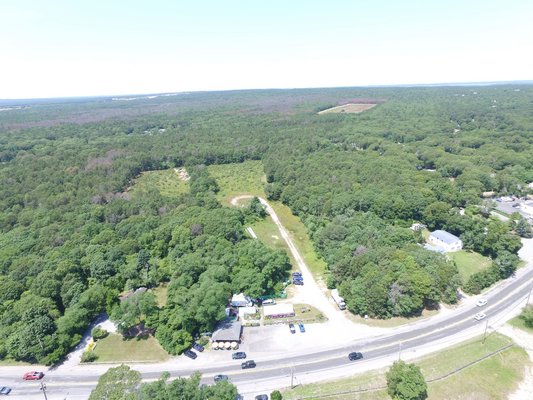
The East Quogue property.
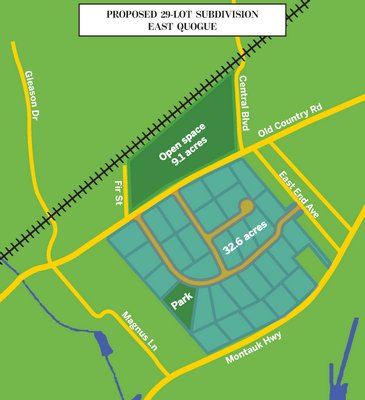
Proposed 29-lot subdivision in East Quogue
The Arizona developer looking to build a luxury golf resort community in East Quogue keeps sweetening the pot.
In addition to addressing scores of concerns raised over four lengthy public hearings, Discovery Land Company revealed in its highly anticipated Final Environmental Impact Statement, filed on Friday with Southampton Town, that it now intends to buy—and preserve—an additional 33 acres in the hamlet on which 29 new single-family houses could be constructed.
The developer already owns nearly 600 acres in East Quogue, on which it wants to build an 18-hole golf course, a 155,760-square-foot clubhouse and 117 residential units. In its filing, the company says it is now in contract to buy the 33 acres, located between Montauk Highway and Old Country Road, from the Parlato family.
Earlier this year, the family filed an pre-application with the town to subdivide the parcel, on which the Hampton Fruit & Vegetable farm stand currently operates, into 29 housing lots. The property sits to the east of the nearly 600 acres already owned by Discovery Land.
The developer is seeking Town Board approval of special zoning, called a planned development district, or PDD, in order to construct “The Hills at Southampton” golf course community. Most of the development would be constructed on 168 acres along Spinney Road in East Quogue.
Randall Weichbrodt, a private attorney in East Quogue who is representing the Parlatos, said on Friday that the contract between his client and Discovery Land specifically states that the sale will only happen if the Town Board signs off on the PDD.
“If The Hills doesn’t get approved, they don’t have to close on the land,” Mr. Weichbrodt said.
Sidestepping Rules
On Affordable Housing
Another change to the proposal—an expected one, town officials say—calls for the elimination of one of the 10 proposed clubhouse condominiums, reducing the number of units from 118 to 117. By doing so, Discovery Land can avoid potentially paying millions of dollars into the town’s affordable housing fund, according to Town Supervisor Jay Schneiderman.
He explained that a state law requires that developers either sell 10 percent of their units as affordable housing or set aside funding—to the tune of almost $300,000 per residential unit—to help build affordable housing elsewhere in the municipality.
But the state law has a loophole: A developer can simply reduce its total density, even by one unit, to sidestep the requirement.
Discovery Land could have been required to pay an estimated $3.5 million into the town’s affordable housing fund, according to Mr. Schneiderman. The developer now intends to build 117 housing units, including 108 single-family homes, as well as the 18-hole golf course, according to the FEIS.
The supervisor noted that most developers, not just Discovery Land, have been able to avoid the affordable housing requirements due to the loophole in the state’s Long Island Workforce Housing Program. A new law introduced by Councilwoman Christine Scalera, and recently approved by the Town Board, closes that loophole locally by eliminating the provision that exempts developers if they lower the overall density. It was not immediately clear if that new town law would have any effect on The Hills application.
“The proposed project is designed and intended for second- or- third-home buyers, for occupancy on a seasonal basis,” the FEIS reads. “It is neither designed for nor appropriate to occupancy by workforce households. Therefore, the requested yield of the proposed project has been reduced by (1) unit, to a total of 117 units.”
Mark Hissey, vice president of Discovery Land, was not able to be reached this week for comment.
Additionally, the FEIS notes that the developer still plans to purchase, and retire, 30 Pine Barrens credits unless the PDD is ultimately rejected by the Town Board. If that occurs, Discovery Land representatives previously stated that they would transfer the credits, which cost roughly $70,000 each and represent an estimated $2.5 million investment, to their main property and increase the number of proposed houses to 165—though, under that scenario, the golf course would not be permitted.
If Discovery Land retires the credits, no other developers would be able to use them to add density elsewhere in the town.
The FEIS also addresses many of the points raised by residents during four lengthy public hearings on the draft version of the document, which was filed at the end of last year. The updated document, however, offers no additional reduced-impact alternatives for the land, in spite of repeated requests from environmentalists who insist that Discovery’s Land’s proposal, which includes 118 residential units but no golf course, is not a true reduced-impact alternative. The developer dismissed that request, stating that the Town Board’s approval of the draft document is proof that the requirement had already been fulfilled.
“The project as proposed represents the optimum balance between the applicant’s goals and capabilities, the roster of proposed community benefits, the applicable zoning-related restrictions, the applicable recommendations of numerous planning documents (particularly of the East Quogue [Generic Environmental Impact Statement]), and the aesthetic conditions of the neighborhood,” the FEIS reads.
Critics of the project—including Robert DeLuca, president of Group for the East End—have repeatedly noted that the alternative is still asking for too much and that Discovery Land is not guaranteed 118 units “as of right.”
Biggest Changes
The most surprising change to the final version of the document is Discovery Land’s added intention of buying and preserving a swath of land owned by the Parlato family of East Quogue, just east of the 600 acres already owned by the developer. The family’s pre-application sought to subdivide the 33 acres at 436 Montauk Highway into 29 lots—though that figure could increase to 44 houses if the Parlatos agree to build some affordable housing. There are several proposals now on file with the town, including one that preserves 9.1 acres while clustering 29 single-family houses.
Mr. Schneiderman, who said he has not yet made a decision on the PDD application, said Monday that he likes the idea of the land being preserved, noting its proximity to the headwaters of Weesuck Creek. “It’s in, I believe, a really environmentally unsound location,” he said. “It would be a good piece to see preserved.”
If the purchase is approved, it would not be the first time Discovery Land and the Parlatos have done business together. Last year, the developer purchased 52 lots—totaling 17.17 acres—from the family. With that purchase, however, Discovery Land wants to transfer the development rights to the larger property so it can increase density.
“If [the PDD is] not approved, we will just subdivide,” Mr. Weichbrodt said, referring to the 33 acres that Discovery Land is interested in acquiring for preservation.
Even though he supports the preservation of the additional property, Mr. Schneiderman this week said Discovery Land representatives must still prove that their proposed development would damage the environment less than if they were required to build as of right. All of the land already owned by the developer is 5-acre residential zoning, the most restrictive in the town.
Specifically, Mr. Schneiderman said it must be clear beyond a doubt that the PDD would generate less nitrogen than a normal subdivision—with nitrogen levels being one of 10 criteria he is using to help guide his decision on the application. The other factors, he added, include potential impact on traffic and the East Quogue School District, property taxes, the use of pesticides on the golf course, community support and so on.
He added that the Draft Environmental Impact Statement came up short.
Though he is still reviewing the FEIS, which is 131 pages not including appendixes, Mr. Schneiderman said this week that he expects to require some conditions, such as mandating the use of only organic fertilizers and placing a hard cap on the amount of nitrogen introduced by the development. The proposed cap, which has never been used before, would require that Discovery Land shut down he golf course if the nitrogen levels exceed acceptable levels.
The project has been closely reviewed by Dr. Chris Gobler, one of the East End’s most well-respected water quality experts and a marine science professor at Stony Brook Southampton. Earlier this year, Dr. Gobler, who lives in East Quogue and had been reviewing the proposal pro bono for the town, questioned some of the calculations included in the draft environmental statement in a 16-page report. Filed in April, his report concludes that the proposed project would further damage already compromised groundwater in the hamlet—pollution that would eventually threaten Weesuck Creek and Shinnecock Bay. Dr. Gobler concluded that a subdivision, permitted under current zoning, would have less of an impact on the environment than the PDD.
In its FEIS, Discovery Land officials point out “critical issues” with Dr. Gobler’s calculations, charging that he grossly overstated the amount of acreage that would be fertilized, which threw off his nitrogen calculations, and also miscalculated that amount of fertilizers to be used on the golf course. The FEIS also notes that Dr. Gobler’s report fails to note proposed mitigation efforts that are “projected to remove 2,500 pounds of nitrogen per year,” making the Hills PDD “nitrogen negative,” thereby improving water quality in the aquifer.
The document also takes several pages to bash the reduced-impact alternative proposed in December by the Group for the East End, and specifically by Mr. DeLuca and Lisa Liquori, an environmental planning consultant and a former East Hampton Town planning director hired by the organization. That plan, which the developer previously dismissed, calls for a mix of 64 cottages and single-family houses, along with a pool, spa and fitness center, as part of an equestrian facility featuring a lodge, paddocks and a riding ring.
The developer rejected that plan in its FEIS, while offering no additional alternatives.
“The ‘lesser-impact’ scenario proposed by the [Group for the East End] is actually a ‘higher-impact’ scenario due to the nitrogen contribution of the horses at the proposed equestrian facility and other nitrogen contributions,” the FEIS reads. “No lesser-impact alternative would produce the same set of community benefits as proposed; in fact, such benefits might not be proposed at all as, in the absence of a PDD, there would be no mechanism for the Town Board to require them.”
Other Issues
Even though they intend to eliminate one of the condominiums, Discovery Land’s proposed clubhouse would still measure 155,760 square feet—making it one of the largest structures on the South Fork. If approved as-is, the three-story clubhouse would be nearly the size of Southampton Town Hall (48,000 square feet), the Stop & Shop in Hampton Bays (50,000 square feet) and the main house on the Ira Rennet estate in Sagaponack (66,000 square feet) combined.
For comparison purposes, The Bridge’s clubhouse in Bridgehampton is roughly 40,000 square feet, while the Sebonack Golf Club clubhouse in Tuckahoe is roughly 34,500 square feet.
As proposed, the nine clubhouse condominiums would take up approximately 39,000 square feet of space. The clubhouse also would feature a private dining room, yoga studio, a spa, golf cart storage, an activity room for children and other amenities.
Beneath the clubhouse would be a 35,000-square-foot parking garage with 94 spaces, according to the application.
Despite its massive size, the proposed clubhouse, if approved, would not be the largest building in the town. The Suffolk County Criminal Court in Riverside holds that honor, at 270,734 square feet.
The FEIS also elaborates on a proposed covenant that would restrict occupancy of those who eventually purchase the multimillion-dollar estates, by only allowing them to reside in the community 183 days each year. Additionally, they would not be permitted to reside in their homes for more than 30 consecutive days in the off-season, which runs from October through April.
The restrictions are intended to discourage homeowners from enrolling their children in the fiscally challenged East Quogue School District though, according to the FEIS, those policies could eventually be challenged.
“There is no restriction on school-age students,” the document reads. “There is a covenant restricting the duration on occupancy, which is designed to avoid enrollment pressure for the East Quogue UFSD. Occupancy restrictions are common, legal, valid and enforceable. The restriction could be challenged but not invalidated.”
The Next Steps
Southampton Town officials expect to spend the next several weeks reviewing the document, with Mr. Schneiderman speculating that the Town Board could vote to accept or reject the FEIS by early August. If it is approved at that time, the town would then order a finding statement to ensure that the document is completed.
Once that happens, possibly by late August, the board would schedule one final public hearing on the application. That hearing, according to the supervisor, would most likely be held in East Quogue.
Once that hearing is closed, the Town Board can vote on the application itself. In order to earn approval, four of the five board members—known as a super-majority—must approve the zoning change.
“That’s a lot of votes—especially for something controversial,” Mr. Schneiderman said.
If its project gains approval, Discovery Land would then have to clear several more hurdles, including securing permission from both the Pine Barrens and Suffolk County Planning commissions.


 Amanda Bernocco on Jul 4, 2017