


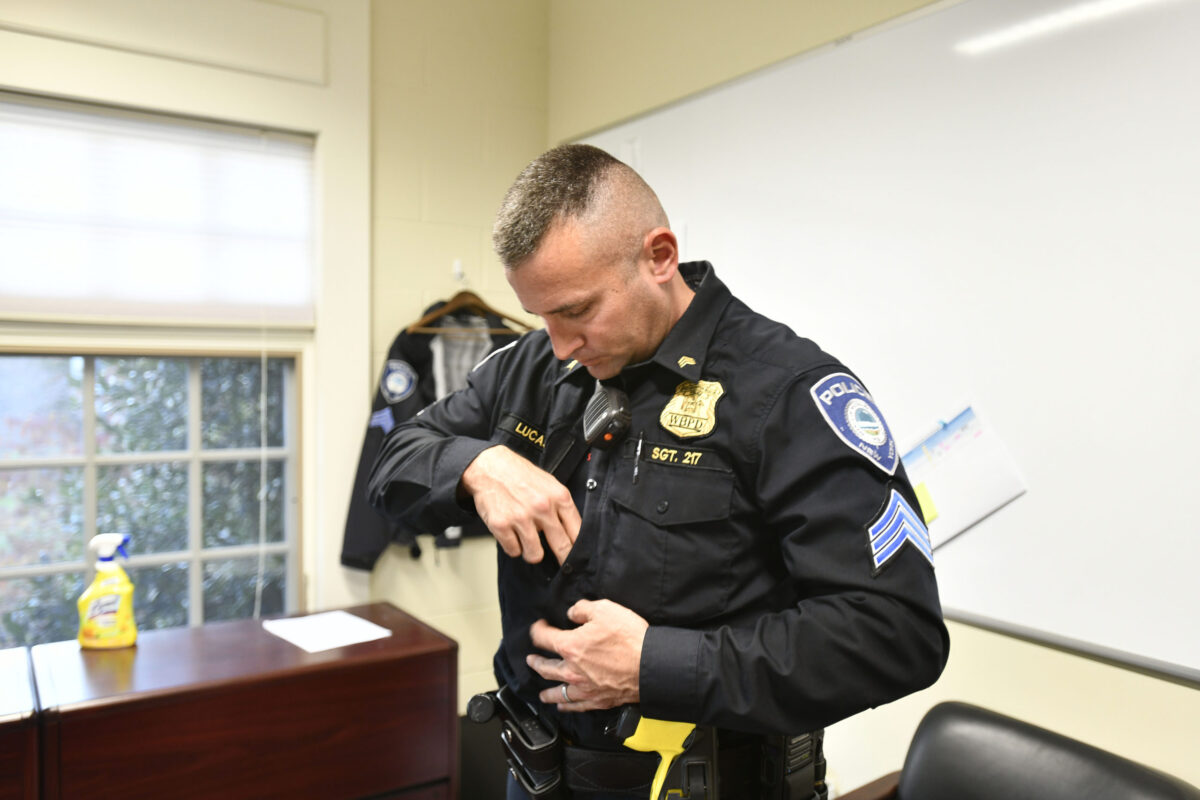
 5 Photos
Westhampton Beach Police Sergeant Ryan Lucas demonstrates the body cameras. DANA SHAW
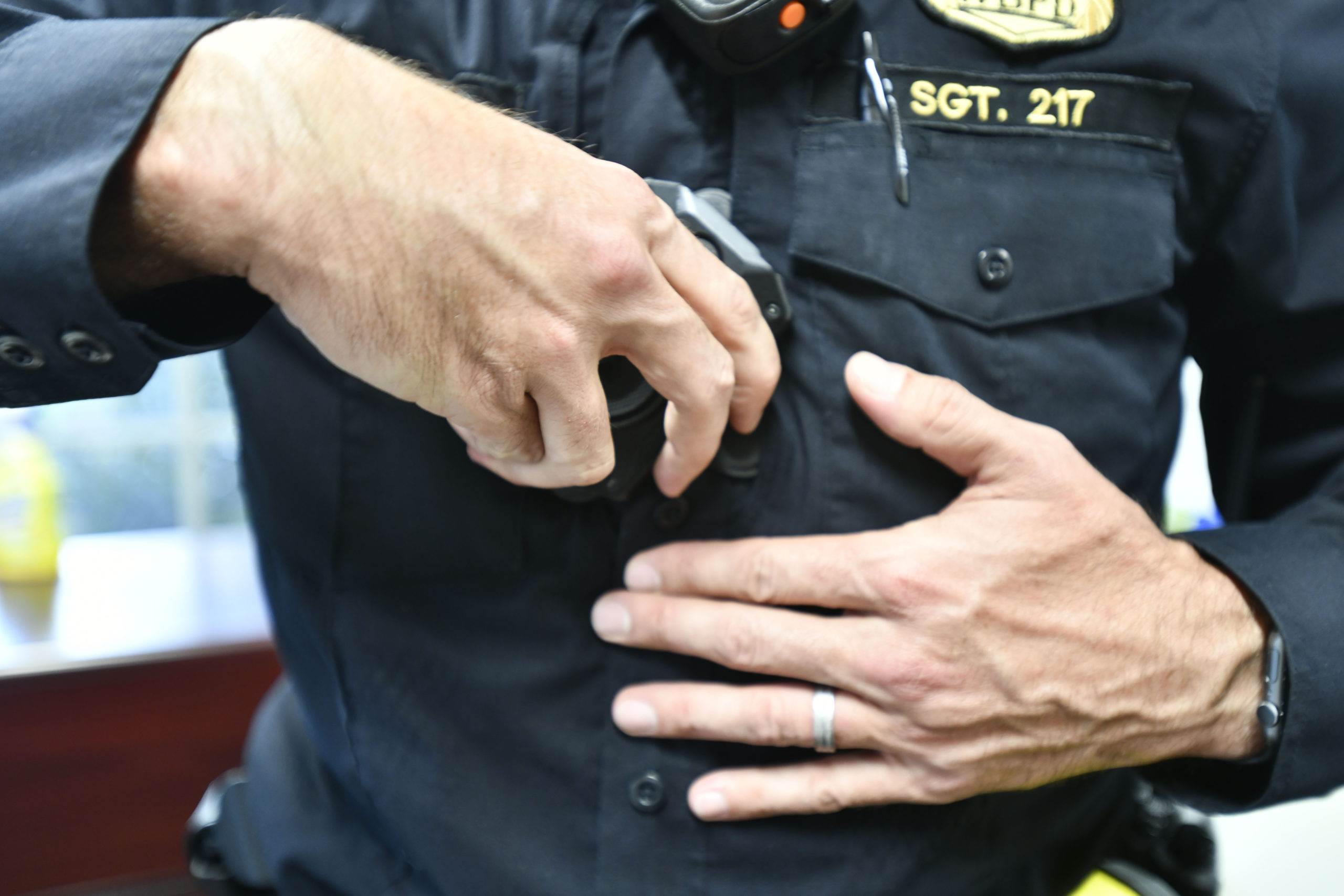
Westhampton Beach Police Sergeant Ryan Lucas demonstrates the body cameras. DANA SHAW
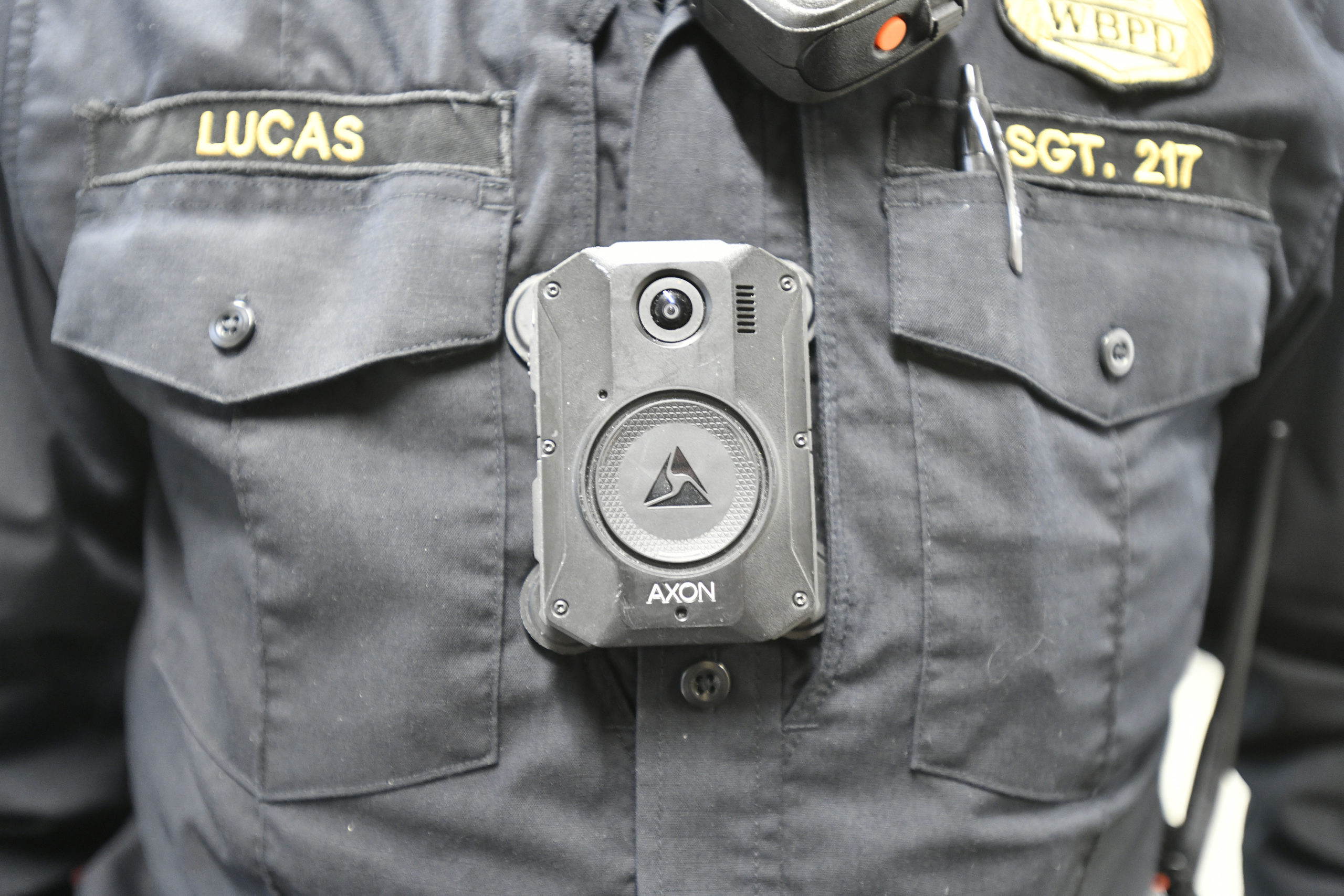
Westhampton Beach Police Sergeant Ryan Lucas demonstrates the body cameras. DANA SHAW
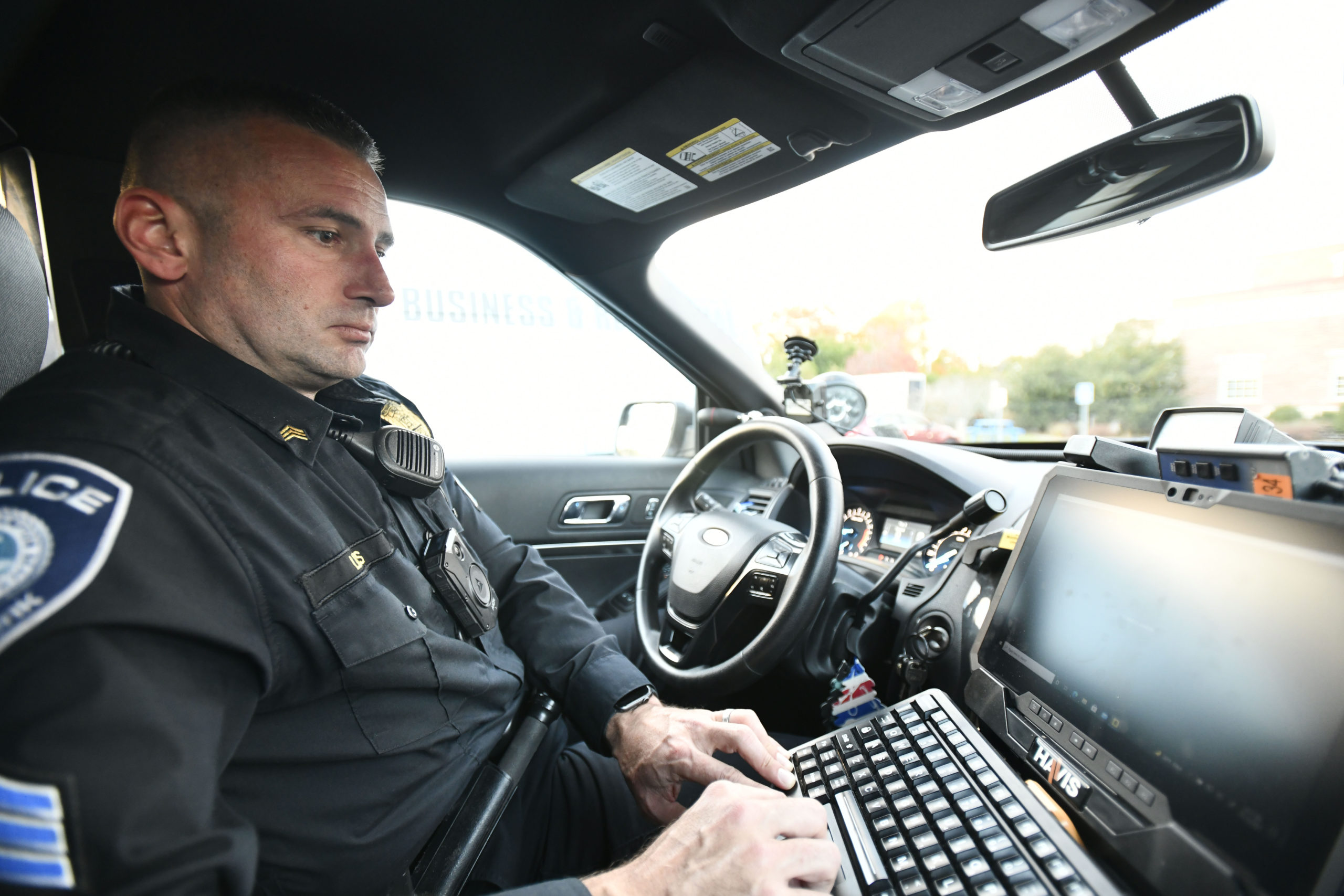
Westhampton Beach Police Sergeant Ryan Lucas demonstrates the body cameras. DANA SHAW
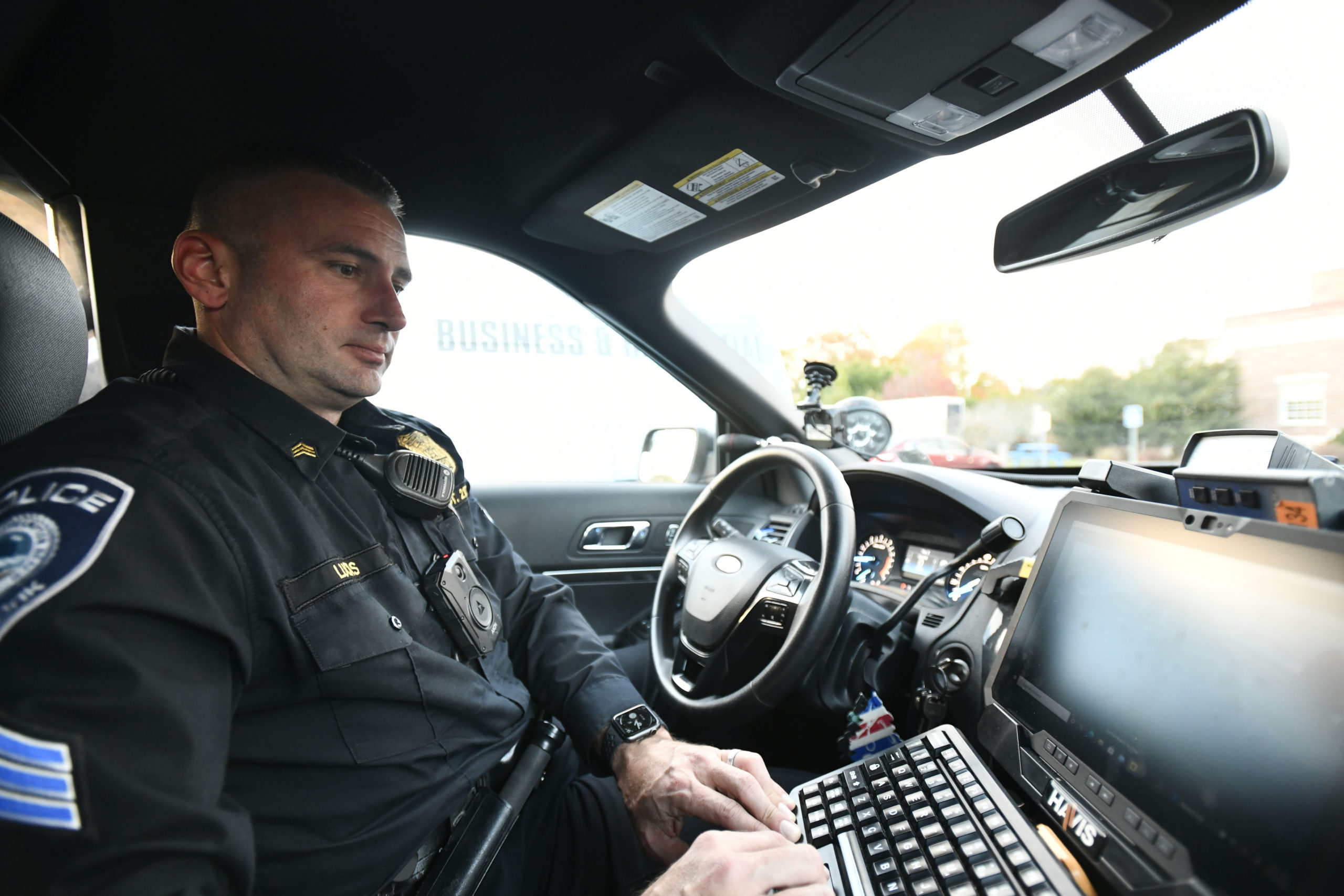
Westhampton Beach Police Sergeant Ryan Lucas demonstrates the body cameras. DANA SHAW
Police Officers in four departments on the South Fork will be wearing body cameras by the end of the year— a significant evidentiary reform on the heels of 2020’s movements for police reform and racial justice.
“We work for the public and we have to adapt to what society is asking us to do,” said Steven McManus, chief of the Westhampton Beach Police Department, which upgraded its department-wide body camera program in May.
Currently, Westhampton Beach is the only department on the South Fork with an operational program. The Sag Harbor, Southampton Town and Southampton Village police departments all plan to roll out the use of body cameras, according to interviews with department chiefs.
“I think [the cameras] help everyone: It helps the officers, and it helps the people they’re interacting with,” McManus said.
For activists, the cameras come as a necessity — both for police accountability and heightened reliability of police reporting on incidents.
Lisa Votino served on both the Southampton Village and Southampton Town police review committees — a body that was required in every community statewide under an August 2020 executive order on police reform from former Governor Andrew Cuomo.
On body cameras, Votino said agreement was broad among committee members and police alike: “It was one of the things that pretty much everybody was on the same page about, and it was like a no-brainer.”
Votino, who played a central role in organizing some of the protests for racial justice on the South Fork in 2020, said she saw body cameras as a tool for building trust between cops and community members — both increasing the likelihood of professional conduct by officers and decreasing the opportunity for incidents to go undetected or misreported.
“It doesn’t seem as arbitrary as without a body camera,” Votino said. “There’s … got to be checks and balances in anything.”
Minerva Perez, executive director of Organización Latino-Americana of Eastern Long Island, also served on the Southampton Town committee. She drew parallels between other forms of video surveillance used by police and body cameras.
“If cameras are accepted as a way of documenting what actually happens, as a way of deterring things from happening, however cameras are being used, clearly, it’s the time that we need them,” Perez said. “It’s there also as a security and a safety in the event something doesn’t go well or is purported to have not have gone well, that there’s something to look at there.”
While body cameras indeed provide a video record of police officers’ interactions, evidence of other benefits to policing are mixed. Several large-scale research projects — including a study of 2,200 officers in Washington, D.C. — have found that when body cameras are introduced, an officer’s likelihood of using force or of facing a civilian complaint does not change.
But cameras may help reduce underreporting by police. A November 2020 report on police in New York City from a federal monitor found that officers who wore body cameras reported 40 percent more stops than officers who did not wear cameras.
“It’s great to have body cameras, but you also have to have up-to-date policies, procedures and laws that support those body cameras,” Votino said, referring to other police reform measures like re-examining use-of-force policies. “First step is always getting the body cameras, seeing what we’re doing right and what we’re doing wrong.”
Southampton Town Police started a pilot program in 2020 that set up two patrol vehicles with body camera equipment. The department is currently testing three different products, with six officers sporting the cameras daily, Chief Steven Skrynecki said.
Skrynecki said he plans to outfit every officer on duty with a camera by the end of the year, with hopes of a summertime rollout.
“I’m feeling pretty good about funneling down, and we’re closing in on a final product,” Skrynecki said. He noted that labor discussions are ongoing with the Town Board pertaining to what is needed from officers while off duty — he cited Wi-Fi and home charging — to maintain their cameras.
Unlike the area’s smaller departments, Southampton Town’s officers don’t end their shifts at headquarters — they are relieved in the field instead. Because of this, Skyrnecki said officers will either have their own cameras or the department will utilize other emergency service headquarters on the East End to store the cameras.
For the Sag Harbor Village Police Department, which has 12 officers on staff and only two in the field at a time, issues of off-duty labor and camera costs are less of a factor.
“We’re in the pilot program. We have the money to do it,” said Austin J. McGuire, Sag Harbor’s police chief. “It’s happening. I imagine we’ll have something in place by the summertime.”
McGuire is hopeful that the cameras provide additional evidence to justify his officers’ actions. He said that “99.9 percent of the time, these cameras are going to be in our favor, meaning that it’ll justify whatever we do — that’s just my experience.”
Suzanne Hurteau, acting police chief in Southampton Village, in an emailed statement, confirmed that the village plans to outfit officers with body cameras in the spring.
“We will be implementing body cameras, hopefully, by the spring of next year,” Hurteau said in the statement. “The equipment has been ordered, and we are currently looking into creating a model policy to guide our officers once it has been deployed.”
But not all East End departments have plans in motion: Both the East Hampton Village and East Hampton Town police departments do not have concrete plans for their officers to wear body cameras.
East Hampton Village Police Chief Michael Tracey, in an email, cited collective bargaining as an obstacle. “I have been advised that to implement their use would be a subject of collective bargaining, and it has not come up as a proposal,” he said. “I am sure that at some point it will, as more agencies get them, most on the island have not at this point.”
In East Hampton Town, Chief Michael D. Sarlo, wrote in an email that he expects to have cameras in the “not too distant future,” but that current proposals are unfeasible for the town.
“At this time, the initial start-up costs, as well as the ongoing data storage, maintenance and labor costs associated with this project, are prohibitive for us to proceed,” Sarlo said. “Most mid-sized agencies would like to see federal- or state-funded programs to implement body cameras.”
In Westhampton Beach, McManus said the body cameras and storage system were projected to cost the village around $14,000 a year — 11.8 percent of the department’s requested equipment budget and less than 1 percent of the department’s total budget for 2021-22.
The Westhampton Beach Police Department first implemented a body camera program in 2016 under chief Trevor Gonce, who retired suddenly in November 2020. The cameras experienced “consistent issues” with data synchronization and activation, McManus said, which prompted him to upgrade the system in 2021 as the department’s chief.
Skrynecki noted that the next budget for his department, Southampton Town, includes a new staff member who will manage video material from the body cameras. “We’re going to need more clerical staff to manage that,” he said. “We’re not far away from finalizing something.”
Suffolk County also plans to outfit 2,600 officers with body cameras by the end of the year — the move comes after the county and the powerful law-enforcement union representing county police officers reached a labor and reform agreement in December.
While the Southampton Town and Westhampton Beach departments engaged in body camera conversations before their policies and actions underwent mandatory review — pursuant to Cuomo’s police reform order — Perez, the OLA director, expressed her thanks to the departments for listening.
“I want law enforcement to understand that we value those conversations, and we were valuing them before they were kind of required to do XYZ,” Perez said.


 Alec Giufurta on Jan 6, 2022