


 1 Photo
When 11-year-old Kole Tokarski left her East Quogue home wearing a red devil costume on Halloween, she had no way of knowing that, the very next day, she would start fighting for her life against a potentially deadly autoimmune disease.
Kole, a sixth-grader at East Quogue Elementary School, was diagnosed last month with macrophage activation syndrome, a rare and potentially fatal rheumatic disease that usually begins with a genetic defect and manifests itself during the patient’s first 14 years of life. The disease targeted Kole’s kidneys, liver and skin, leaving her in a coma for nearly two weeks last month.
Residents of East Quogue came together to donate blood and platelets to the Stony Brook University Medical Center over the past month which were used to treat Kole, according to her father, Paul Tokarski, a single dad and New York City firefighter. Mr. Tokarski said he was unsure how many people donated blood, but noted that several of his co-workers from around the five boroughs made the trek to Stony Brook to help his daughter.
“I’m grateful for all of the support,” Mr. Tokarski said, noting that the final batch of platelets was administered to Kole last Thursday, December 9. “I can’t thank everybody enough that gave blood or platelets for her.”
He said Kole first showed symptoms of the disease on November 1, when he kept her home from school. It was unusual for Kole to miss school, he noted. “She’s always healthy, she had a few years with perfect attendance,” he said.
According to Mr. Tokarski, Kole was home sick the entire first week of November, running high fevers and showing signs of what appeared to be a stomach virus. The next week, the symptoms subsided and Kole returned to school. However, after a couple of days back at school, Kole again began to run a high fever. Mr. Tokarski brought his daughter to her pediatrician’s office in Smithtown three times over the next week. Doctors ran blood work and found nothing of concern in the young girl’s results. Kole returned to school, and even went on a field trip with her father and classmates from the Hampton Bays School of Dance to see “Billy Elliott” on Broadway in Manhattan.
But on November 15, while eating at Panera Bread in Hampton Bays, Mr. Tokarski discovered a large bump on Kole’s neck, a swollen gland stemming from the illness. Mr. Tokarski said he brought his daughter back to her pediatrician, who still could find nothing wrong with the ailing girl. The following night, Kole stumbled into her father’s bedroom in the middle of the night and collapsed on the floor. According to Mr. Tokarski, Kole had little red dots all over her shins. The bumps, he later found out, were blood clots beginning to form, a side effect of the autoimmune disease.
Kole’s pediatrician advised her father to rush her to the emergency room at Stony Brook University Medical Center, where she was given 15 different intravenous medicines upon her arrival, according to Mr. Tokarski.
“I’m thinking we’ll be here for an hour,” said Mr. Tokarski, of his initial thoughts upon entering the emergency room. Instead, he said, Kole was going into septic shock, a condition that occurs when a infection in the body drives a person’s blood pressure to dangerously low levels. “It was just like, this can’t be happening,” said her father.
After three days in the hospital, Kole developed a “softball sized” blood clot in her abdomen. As doctors struggled to determine what illness was plaguing the young girl, Kole slipped into a coma on November 18. Her father stayed by her side, combing the knots out of her long blonde hair, which later had to be cut off.
Doctors determined that they had to remove the growing blood clot, and told Mr. Tokarski that Kole only had a 50 percent chance of surviving the surgery, he said. They worried that the teen would lose too much blood during the procedure, and could die.
But the surgery was a success, and after removing the clot, doctors were able to determine what the rare condition was that had been attacking Kole’s body. Pharmacists at the hospital then sent out an “all points bulletin” looking for Kineret, a rare, experimental injectable drug used to treat the rare illness, as well as rheumatoid arthritis. The drug was located at a CVS in Queens, and brought to the hospital the day before Thanksgiving. After receiving the drug, color began to return to Kole’s face and her fever dropped.
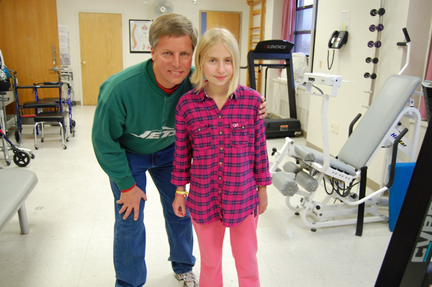
On November 30, Kole came out of the coma—and on Friday, December 10, after 10 days of steady improvement at Stony Brook University Medical Center, she was transferred to St. Charles Hospital in Port Jefferson to begin a rehabilitation regimen, where she remained this week. Her treatment at St. Charles focuses on building back the muscle she lost while hospitalized.
During a physical therapy session at the hospital on Monday, Kole said that her brush with death was “very scary” and that she was excited about the possibility of leaving the hospital—hopefully in time for Christmas.
Mr. Tokarski said his daughter asked two questions when she awoke from her coma: what date it was and whether or not she had missed Thanksgiving.
“I look out the window and stuff,” Kole said about what she has been doing to keep busy while in her hospital room. “I go on Club Penguin,” she said, referring to an online video game in which players interact with friends using penguin avatars.
According to Mr. Tokarski, the East Quogue community has come out in force to support his daughter during her time of need. He added that almost every one of Kole’s teachers, past and present, have stopped in to visit. Additionally, friends, teachers, classmates and even East Quogue Elementary School Principal Robert Long, came to Kole’s bedside during her recovery.
As for Kole, she said she looks forward to resuming dance classes, particularly a tap dance class. She also looks forward to Santa’s arrival later this month. She’s asking for a new bike.
Doctors cautioned that although her condition has subsided for now, it could come back with a vengeance at any time. They’re still unsure what triggered the mysterious ailment, but say that with frequent monitoring, Kole should live a healthy life.
“I’ve done my share of crying—we both have,” Mr. Tokarski said. “She’s fought like crazy, and she’s going to beat this.”


