


 2 Photos
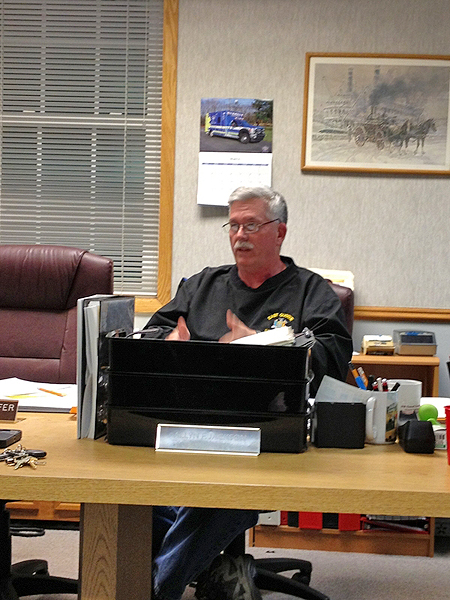
East Quogue Fire District Commissioner Allyn Jackson at a meeting Monday night. CAROL MORAN
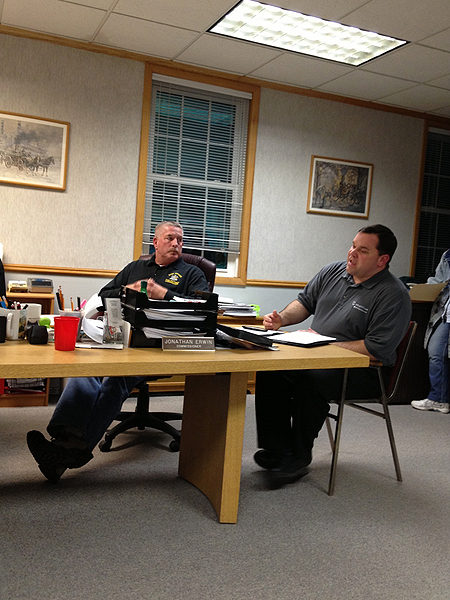
East Quogue Fire District Commissioner Jonathan Erwin
East Quogue Fire District commissioners announced Monday night that they have quashed all plans to allow an outside company to install a cell tower behind the hamlet’s firehouse, and are instead considering installing their own 100-foot-tall antenna that will improve radio communications.
During a work session held at the Montauk Highway firehouse, the commissioners explained that they chose not to renew a contract with the mobile carrier T-Mobile in October after community members expressed strong opposition to the proposed cell tower, which would also have been 100 feet tall.
Instead, the commissioners said they met with Andrew Hintze, a consultant with Integrated Wireless Technologies in Quogue, to discuss the possibility of installing an antenna on a new pole, upgrading their communications system and replacing their siren. The district’s new antennas will also be installed behind the firehouse; commissioners said they conducted tests near their substation off Head of Lots Road, but discovered that the antenna would have to be at least 130 feet tall in order to provide ample coverage.
The project now on the table will cost about $300,000 in total, and that figure includes the purchase and installation of the upgraded communication equipment, and repairs to the roof where the fire district’s old antennas currently sit. Commissioners Allyn Jackson, Jonathan Erwin, Mark Gregory and Edmund Densieski said they would allocate about $150,000 from the fire district’s reserves to cover those costs. They also discussed possibly bonding the remainder over several years, but District Treasurer Nancy Knotoff said it might be more beneficial to taxpayers to raise the funds through property taxes, rather than paying an estimated $50,000 in interest for the upgrades.
That option could require the commissioners to propose a budget that exceeds the state-mandated 2-percent tax levy cap. Ms. Knotoff estimated that taxpayers would see their fire district tax rate increase by about 8 cents, to 71 cents per $1,000 of assessed valuation for the 2013-24 fiscal year. That means the owner of a home assessed at $600,000 would pay about $426 in fire district taxes each year, or $48 more than the current year. The district’s current budget totals $1,225,000, and covers both the fire department and the East Quogue Fire Department Emergency Medical Service.
Mr. Jackson said Monday that the geography of the district creates “dead zones,” or areas where radio communication between dispatchers, firefighters and paramedics fails, causing confusion and slower response times. He said the commissioners and Mr. Hintze conducted tests that showed the antenna would need to be at least 100 feet tall in order to hit the required 95 percent coverage rate in the district.
“It needs to be flawless, and it’s not,” Mr. Gregory said of the current system.
He shared specific instances when firefighters and EMS personnel had difficulty communicating while responding to calls on Sunrise Highway, partially due to heavy traffic. In 2011, East Quogue EMS officials responded to a fire in Hampton Bays, but due to the faulty radio communications did not know until they arrived at the scene that the first floor of the structure had collapsed, injuring five firefighters, some severely, Mr. Gregory said.
The proposed antenna would sit on a pole that measures about 10 feet wide at its base and 4 feet wide at the top. A new siren would also be attached to the pole about 20 feet higher than where the current one now sits. Mr. Jackson said raising it would help carry the sound over longer distances and reduce the impact on neighboring homes.
Dennis Finnerty, chairman of the Southampton Town Planning Board, said Tuesday that the commissioners would need a building permit, but would not be required to apply for site plan approval to install the pole. He added that the pole could require a variance from the Southampton Town Zoning Board of Appeals if its height exceeds the town’s “fall zone” standards. T-Mobile’s proposed tower, which would have been the same height as the antenna, did not meet those standards on one side due to the proximity of the East Quogue Post Office.
To quell concerns from community members—about 14 attended Monday’s meeting—Mr. Hintze pointed out that the pole cannot be retrofitted for any type of cellular use. “If anything, the community should welcome this,” he said.
Under the prior plan, T-Mobile would have leased the land from the fire district, a financial incentive, commissioners said, and the fire department would have been permitted to install an antenna on the company’s tower. In addition to not liking the idea of leasing space to a cellphone carrier, residents were worried that T-Mobile could eventually sublease the pole to additional carriers.
“I think we need to hear a little more about it,” said Joan Hughes, an officer of the East Quogue Civic Association. “We need assurance that only the fire department will have their antennas on that pole.”
She added that she is still concerned about the physical appearance of the pole and antenna, which could tower over Main Street. Al Algieri, another officer for the civic association, said community members will hold a meeting to discuss the plan once it is official.
Mr. Gregory said the revised plan is beneficial because it would also improve communication between the dispatchers in Southampton or Yaphank and the responders, reducing the need to sound the siren multiple times after each call. Firefighters would also have quicker electronic access to the location of hydrants.
Mr. Erwin explained that the board has sought solutions to the faulty communications system for about seven years, with no success. “It’s been very frustrating,” he said.
“I think we’re doing the right thing for the department, and we’re doing the right thing for the taxpayers,” Mr. Jackson added.


