


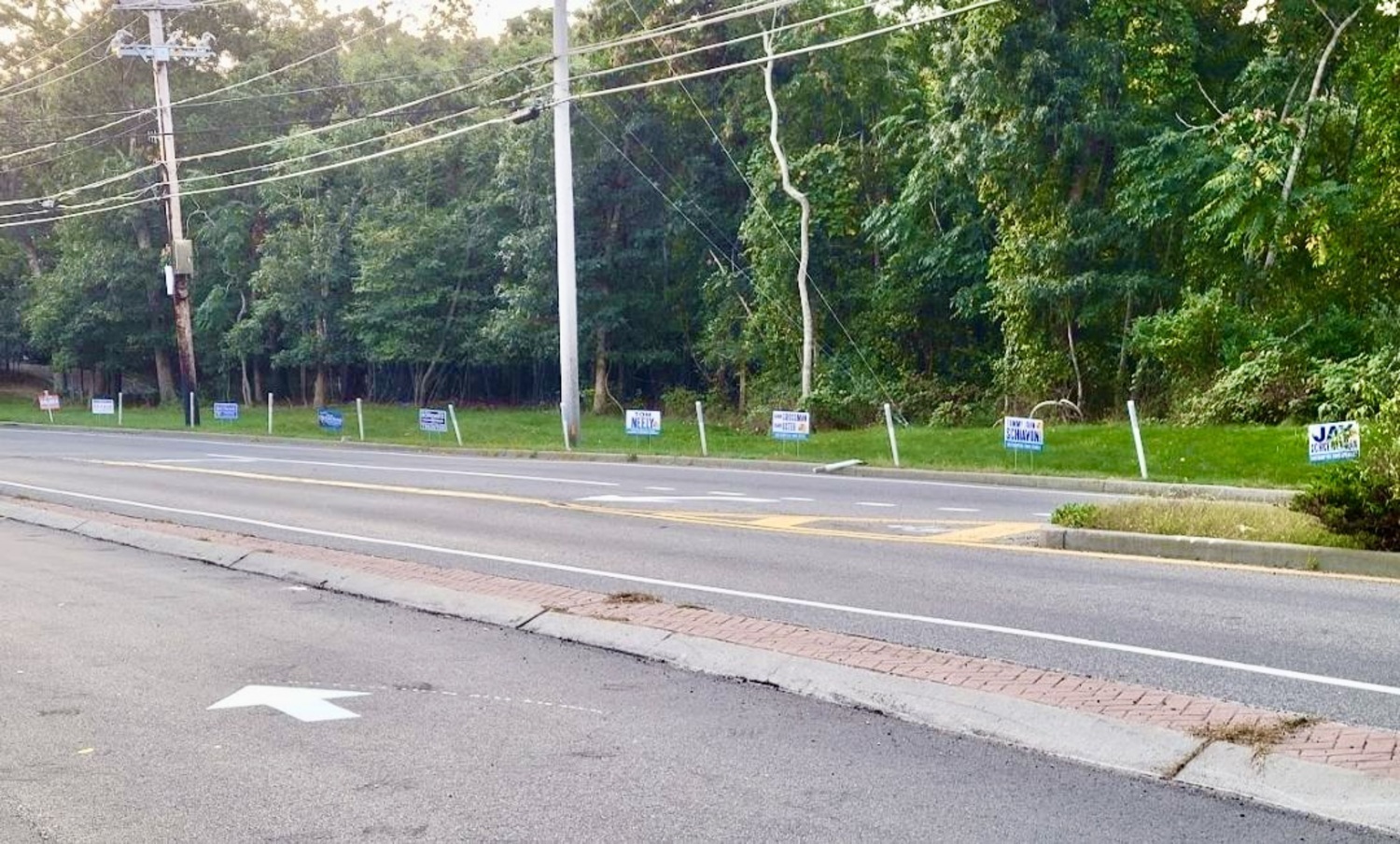
 1 Photo
Southampton Town is considering a new law to bar political campaign signs from town roadsides and public property and to limit the amount of time they may be displayed on private property.
The Southampton Town Board appeared poised to impose new rules to limit the use of public property and town roadsides for displaying political candidate yard signs, which officials say leave some areas “trashed” during the campaign season — until three board members apparently changed their minds and left the proposal legislatively dead in the water.
Councilwoman Cyndi McNamara had introduced the idea of adopting similar restrictions on the displaying of political signs to those most local villages impose — barring them from municipal properties, preserved lands and the municipally owned roadside right-of-ways that are off limits to other signs but left open to political signs in town code.
At a discussion last Thursday, August 8, she pointed to the stark aesthetic difference during election season between town intersections and those inside the incorporated villages, where local governments have long been more strict about the visuals of local election campaigns.
“I believe signs belong with supporters,” McNamara said. “It really bothers me when you go through the ‘Five Corners,’ David Whites and 7 Ponds, and areas of Hampton Bays that are just trashed with signs. The corner of Noyac Road where the big triangle is, it’s sign upon sign upon sign upon sign.”
Of particular issue is the proliferation of signs on the streetfronts of properties preserved by the town with Community Preservation Fund money, sometimes specifically to preserve scenic views, Assistant Town Attorney Sean Cambridge said.
The proposal, at the time, seemed to draw sound support from others on the board.
Councilman Bill Pell asked Cambridge to shorten the amount of time that signs could be displayed from the proposed 90 days down to just 60 days. Supervisor Maria Moore agreed with his suggestion, said she was surprised that all signs were not banned from town road right-of-ways and said the amendment “makes sense.”
Councilman Michael Iasilli did express some reservations because, he said, he’d heard many complaints from residents about the town’s enforcement of its sign code in a broader sense, and that since many of the code’s specifics rely on the exemption for political signs, perhaps it would be wise to examine the code holistically. But he also said on Thursday that the proposal was “a really good step toward reducing debris, especially on CPF properties.”
Councilman Tommy John Schiavoni, who is running this year for election to the State Assembly, recused himself from discussion of the code amendment.
But come Tuesday afternoon, when McNamara read out the resolution on the Town Board’s agenda that would formally introduce the law and schedule a public hearing on it, other board members were silent when asked for a second to advance the measure to a vote.
Without a second, procedurally the bill was stalled and could not even be discussed further. But as her colleagues looked down silently at their agendas, the visibly shocked McNamara demanded to know why there was suddenly no support.
When McNamara suggested that perhaps Democratic Party leaders had given new marching orders — McNamara is the lone Republican on the five-member board — the others broke from legislative protocols and said they’d simply rethought their support.
“For myself, I had some concerns after the work session, thinking it through … I’m just not sure about limiting the political speech,” Moore offered, saying that she had reservations about the impact it would have on candidates who are trying to make political inroads in new areas. “I think it advantages people that have property on highways, it advantages incumbents. I want to review the whole sign code — I’m not sure I want to focus on the political aspect of it at this time.”
Iasilli reiterated his concern about the role the political signs exemption plays in the overall code and would prefer to see that code — which he referred to as “a behemoth” and “immensely complicated” — looked at in a broad sense.
An exasperated McNamara noted that the amendments proposed mirrored those that were in place in the Village of Westhampton Beach, where Moore was mayor prior to running for supervisor, and that the main focus was on aesthetics.
“This is just changing the exemption to say that political signs can’t cause line-of-sight issues in the town right-of-ways and have to be respectful,” she said. “It would just be giving the unincorporated areas of this town the same consideration granted to every single [village]. This is why I supported incorporating East Quogue, because, once again, the unincorporated areas get dumped on.”
Pell said the change of heart among the Democratic majority was not political marching orders. “This is not politics — this is doing our homework,” he said. “We have to look at it more.”
McNamara herself had waffled on some of the provisions in the law and whether the version she asked the town attorney’s office to present for public consideration would include the provision placing limits on the amount of time that even political signs on private property were allowed to be displayed.
Early on Tuesday, when asked whether the restriction would apply to homes where large banners, flags and signs expressing support for a candidate have been displayed year-round, she had considered asking Cambridge to remove the clause impacting private properties and leave the law to focus only on the decluttering of public property.
But then she herself reconsidered and said that she thought the amended code should put reasonable bookends on political expression that is visible to neighbors and passersby unconcerned with support for a candidate who may not be on a ballot for a year, or more.
Cambridge had cautioned the board last week that, legally, the town has to be somewhat careful in how it limits political expression, and that the proposed law placed only bare-bones restrictions on the location, size and amount of time a sign can be displayed so as not to be seen as stifling political discourse.
“Specifically, CPF properties have been inundated,” Cambridge said. “Things like Highway Department yards, Parks Department yards, people just go ahead and put their signs up.”
The draft law had put political signs onto the same stopwatch as those advertising special events, which must be removed no more than 14 days after the event they advertised was concluded.
“In the past, there were complaints about the signs remaining up indefinitely — I use the Green Party, for an example, and maybe you don’t mind the ‘legalize it, man’ signs before the election, but you don’t want it there when your family is coming over for Christmas,” Cambridge said. “In the past, there were cases of signs being left up indefinitely, where people had covered fences, sides of their homes, garage doors, signs that are six years old and all weathered and it just become an eyesore for everybody.”
McNamara said following Tuesday’s derailment of her plans that she will reintroduce it later this month with a more narrow focus in the hope that she can convince her colleagues to support it before this year’s election season gets rolling.


 Michael Wright on Aug 14, 2024