



 6 Photos




The Southampton Town Board on Tuesday deemed the third version of a draft environmental impact statement for a proposed luxury golf community in East Quogue incomplete—a decision that renewed demands among the most ardent project opponents that the board flat-out reject the developer’s application.
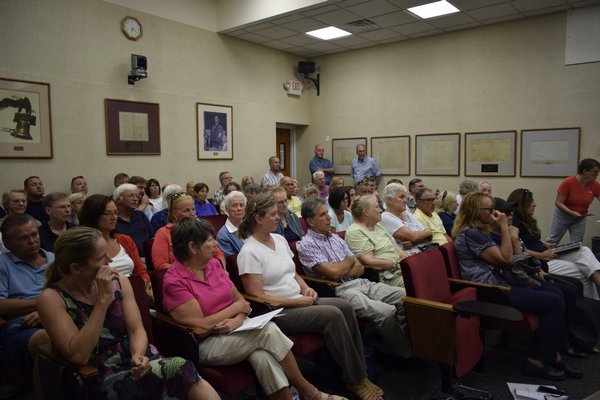
Most of the estimated 50 people attending Tuesday night’s meeting at Town Hall asked that the board kill the application submitted by Arizona-based Discovery Land Company, which seeks to build 118 residences and an 18-hole golf course concentrated on 168 acres in the hamlet. With many holding black-and-white signs reading “3 Strikes You’re Out,” residents and environmentalists again called upon the board to reject the application, dubbed “The Hills at Southampton.”
In addition to submitting a completed draft environmental impact statement that meets all of the town’s requirements, Discovery Land would still have to convince Town Board members to approve a special zoning, called a planned development district, or PDD, that would allow it to bypass established zoning—the strictest in the town, requiring 5-acre building lots—in exchange for community benefits.
“I think it’s a travesty,” said Susan Wittenberg of Hampton Bays about the application targeting her former hometown. “I think the community has made it clear over and over again that they’re against it.
“I think it would decimate this community,” she continued. “We are now at a point where everyone is very environmentally aware—no one with any integrity could possibly think this development will not harm this community irreparably.”
“The developer, Discovery Land, reminds me of the gang that can’t shoot straight,” added Richard Amper, executive director of the Long Island Pine Barrens Society and who has repeatedly called on the board to reject the application and also eliminate its PDD legislation altogether.
Tuesday’s rejection of the draft environmental impact statement, or DEIS, was expected as board members were informed at last week’s work session that additional information must still be provided by Discovery Land to round out the document. The ongoing review of the document, which is supposed to acknowledge and address any significant and potential environmental issues with a project, is being facilitated on behalf of the town by AKRF Inc., an environmental, planning and engineering consulting firm with offices in Bohemia.
According to the firm’s report, the third draft did not fully address what the property’s tax and fiscal contributions would be to the East Quogue School District—a huge sticking point as the project, if approved, is expected to generate millions of dollars in tax revenue for the district. The DEIS also lacked a completed traffic analysis of the project or address construction-related traffic conditions that could result from the work.
Additionally, the report from AKRF states that the finalized DEIS must consider an alternate to the project, namely one that would require less grading and, as a result, have less of an impact on the environment. It also requests the inclusion of minor maps, tables and legends, as well as certain wording changes that must still be addressed.
The firm, however, did note that the third draft did address most of the issues from the section version, which was submitted to the town in April. Most of those issues focused on land use, zoning and planning, soil and topography, water resources, and clarifying wastewater treatment concerns.
Mark Hissey, a vice president with Discovery Land, said Tuesday that the fourth—and potentially final—version of the DEIS could be submitted by the developer as early as next week.
“I’ve said all along that I think there is absolutely nothing wrong with being as thorough as possible,” Mr. Hissey said. “I think a project of this profile absolutely needs it.”
Town Planning and Development Administrator Kyle Collins said it is not unusual for a DEIS to undergo several revisions, pointing to the scope of the project.
Whenever they deem the DEIS complete, Town Board members would then begin accepting public comments on the document.
But on Tuesday evening, most of those sitting in the audience at Town Hall urged the board to reject the application altogether. Mr. Amper described the intensity of development proposed as “outrageous for such an environmentally sensitive area,” and took a shot at Town Supervisor Jay Schneiderman’s $35 million offer to buy all of property now held by Discovery Land for preservation, calling it a “fake” offer. Discovery Land rejected the offer.
Mr. Hissey, in turn, said that opponents who charge that golf courses are harmful to the environment are making false claims, adding that they do not understand the checks and measures employed by modern facilities that limit the amount of nitrogen entering the groundwater.
“I just think it’s astonishing that this lie keeps getting repeated,” he said. “It’s absolute nonsense. I really care deeply about water quality—it’s on my mind constantly. The likes of this unscientific opposition on it drives me crazy.”
Pointing to ongoing water quality issues across the East End, Mr. Amper again asked the board to reject the application.
“You know this is the wrong project, targeting the wrong place,” he said. “You need only look at the brown tide sweeping across Shinnecock Bay to know that it’s high time to halt this endless scandal and to stand up for the people of Southampton Town and the environment most of us defend.”
Mr. Schneiderman, who said he has not yet made up his mind about the project, said he and his fellow board members must allow Discovery Land to move forward with its application.
“It is my lawful responsibility to process that application,” Mr. Schneiderman said. “He wants to deny due process and not allow the community to be heard. I have attempted over the last decade or more to preserve this property—today, we don’t have a willing seller. I want to preserve it, too. If that’s not possible, it’s the board’s responsibility to determine what is better for the community.”
Al Algieri, president of the East Quogue Civic Association, also urged the board to reject the application, pointing to the third rejection of the DEIS.
“Preserving acreage and open space with a golf course? That’s not preservation when you clear the land and take down the trees necessary to filter out nitrogen,” he said. “I say three strikes, you’re out. Enough is enough.”
But not everyone in attendance opposes the application. Quogue Mayor Peter Sartorius, after clarifying that he was speaking as a village resident only, said he does not believe that most residents oppose the project.
“I agree that nitrogen is a problem for our water,” he said. “This project proposes some solutions for the nitrogen problem. I think it would be wrong to short circuit it at this point. Let’s get the draft EIS done and let’s have public hearings and see what the comments of all the people really are.”
Brian Babcock, an East Quogue resident and ambulance volunteer for the past 20 years, said he also supports the PDD, stating that the addition of a new subdivision on the property would further strain emergency services and the school district. Discovery Land says that its as-of-right development of the land means it could construct almost 90 single-family homes—all with individual and outdated cesspools.
“I feel like most people don’t want to speak up to the majority and speak in favor of it,” Mr. Babcock said. “I myself am in favor of it. I think they’re putting forward an effort—they could have given up a long time ago. I have kids in school, I see how hard it is to pass a budget as it is. I can see the how detrimental it would be to our community to East Quogue. It’s hard enough on the volunteers as it is, it would certainly make a major impact.”


 on Aug 24, 2016