


 1 Photo
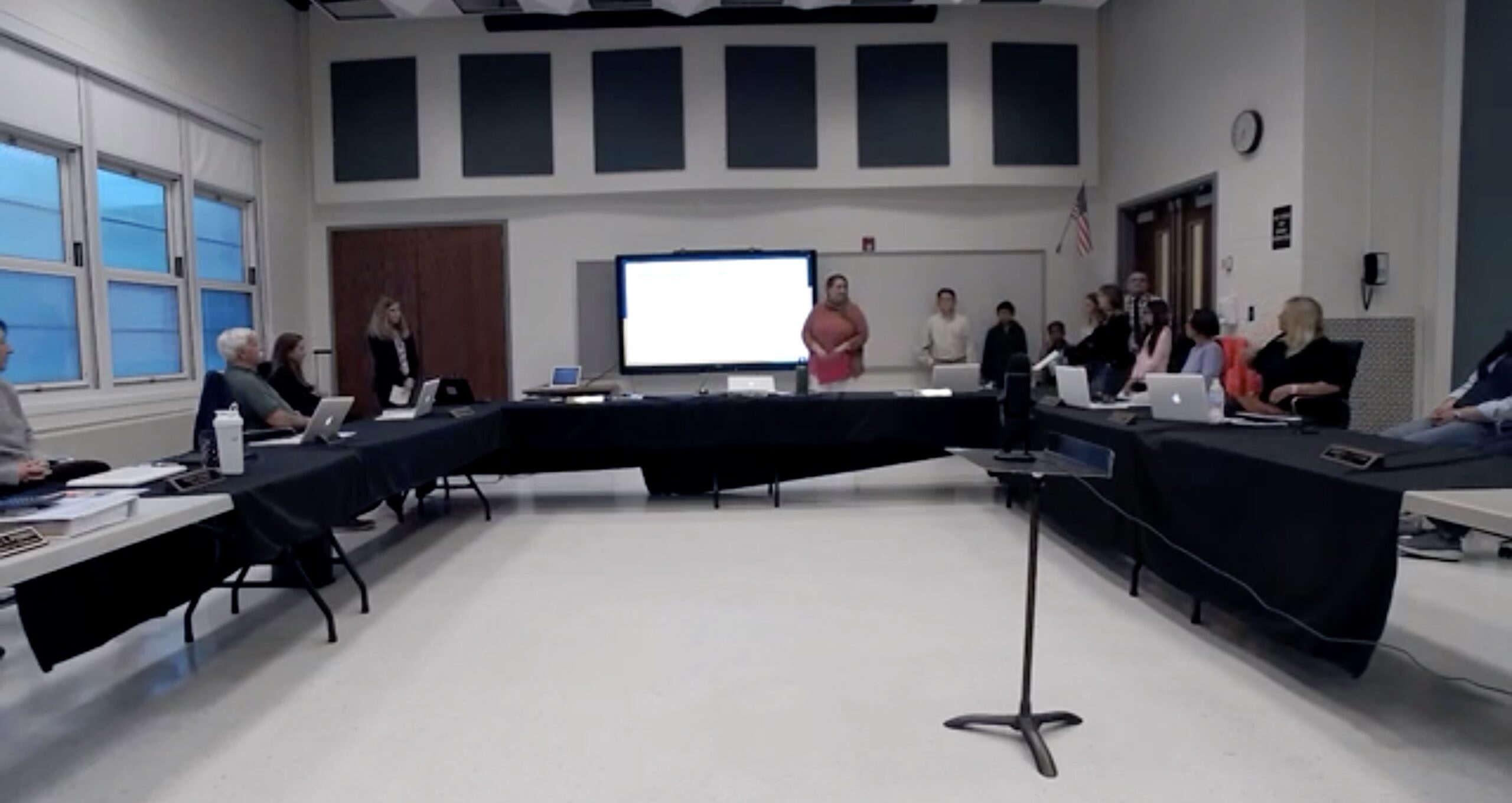
Westhampton Beach Elementary School Assistant Principal Lisa Menegio and equity committee members present what they've done and learned to the board of education during its May 9 meting.
Westhampton Beach students say there’s no place for hate in their school district.
“Being different means having your own special qualities,” fifth-grader Anthony said. “Even though we’re not the same, we should treat each other equally and with respect.”
On Monday, the equity committees from all three district buildings presented the projects they’ve worked on and what they’ve learned so far this school year to the Board of Education.
“We want to create a culture of inclusivity,” Director of Curriculum and Instructional Technology Dr. Jessica Williams said. “The goal is to celebrate diversity.”
One way to do that is to apply for the No Place for Hate program, which involves school committees assessing their climates, signing pledges and completing a minimum of three projects to earn the Anti-Defamation League designation. All three schools will earn the No Place for Hate school certification by the end of the school year.
The building-based committees, made up of students, staff and parents, meet once a month and additionally as needed for schoolwide activities or character education theme celebrations, including the ADL’s Walk Against Hate, Black History Month and Spirit Week.
Districtwide initiatives include the digital sign on Mill Road now conveying messages in English and Spanish, and ParentSquare, a school-to-home communication platform that allows for two-way communication in multiple languages, being introduced to families.
In the elementary school, students signed the No Place For Hate pledge, which they turned into a promise representative of the student body that is announced each morning.
“Together, we will treat everyone fairly and with respect. We promise to do our best to be kind to everyone. If we see someone being hurt or bullied we will tell an adult,” fifth grade students Summer and Angelina said, reading the students’ daily declaration. “We promise to create a school where we all feel safe and happy. Together, we can create a school where everyone feels included.”
Fifth-graders Jose and Grayson said the students learned to be empathetic and what it means to walk in someone else’s shoes. Fifth-grader Maria talked about researching leading African Americans to learn how they influenced our lives as part of Black History Month, and promoting autism awareness as part of Spirit Week.
Fifth-grader Anthony said a diversity chain was created, where Hurricane Buddies designed links representative of who they are and what makes them unique.
“Quotes around the building remind us to celebrate our differences,” Anthony said. “Diversity is the one thing we have in common. In diversity, there is beauty in strength. Being different gives the world color.”
English as a new language teacher Thomas O’Leary said 30 high school students came to the elementary school to read books with the students, and that, in the future, the students would like to do more read-aloud activities, provide more of their own project ideas and generate more student involvement. The committee is already looking to integrate the celebration of Hispanic Heritage Month in September.
“I was so impressed by the fact that these students volunteered to be in these positions,” Westhampton Beach Elementary School Assistant Principal Lisa Menegio said. “They wrote their own pieces from the heart. This is all them and what they’re passionate about.”
Sixth-grader William said a pledge was also signed in his middle school building, and the equity committee displayed a video made up of interviews of school students and staff who were asked their feelings on equity and other questions promoting inclusivity.
“The video also incorporated skits which depicted situations of bullying and the outcomes,” he said. “It also showed what to do if you see someone getting bullied, or if you are getting bullied. After this, all students and staff were invited to sign the pledge outside of the cafeteria, which was their agreement to help make the school a better place.”
From the meetings also came the creation of a rock garden in a proposed outdoor learning space. Seventh-grader Elizabeth said it can be a place where students can interact with others, meet new friends or sit quietly if they need a moment to themselves. Elizabeth said studies show that 1 in 10 children don’t feel they have a close friend and often feel uninvolved in school.
“We hope the outdoor learning space can change that,” she said. “It is a safe place where students of different races, ethnicities, backgrounds or genders can come together.”
Isabelle, Luke and Eddie explained a Hurricane kindness project, restorative justice project, a community read and discussions on global issues, tolerance and stereotyping.
Middle school guidance counselor Ellen Griffin said a new program being rolled out next week will focus on identity.
“We’ll start with personal strengths, characteristics, their attributes, and link that to possible careers,” she said. “And then we’ll expand that into how that individual identity plays into the community identity.”
Librarian Yvonne Perez said one goal for next year is to create a community recipe book, where dishes with different cultural origins could be featured during a dinner.
In the high school, Assistant Principal Kerry Pillittier said focus was placed on translating home communications to students and parents. Sports announcements and high school contact information are now broadcast and listed on the district website in Spanish, and students can translate daily announcements on the website and PowerSchool — a cloud-based student information system — through Google Translate on their computers.
Senior Jessicka Alvarado, who said classroom doors were decorated to celebrate language and culture, enjoyed taking part in the read-along with the elementary school students.
“What stood out to me the most is the majority of students who said that they had been friendly to a new student or had helped someone feel welcomed to our community,” she said.
High school students completed an “identity iceberg,” which showed that 68 different countries are currently represented by students and staff. The flags of each will be displayed in the library, and a QR code can be scanned by students and staff if he or she wants to add a country.
“We want to make sure that we are representing all of our staff and students,” Pillittier said.
Special education teacher Joanne Williams said the identity iceberg was one of her favorite character education activities.
“It likened identity to an iceberg. When you initially see somebody, all you see is that tip — what’s on the surface — but the bulk of who a person is lies beneath,” she said. “To understand people, you don’t judge based off that little tip, you need to take some time to get to know someone. We all realized we really have so much in common.”
Superintendent Dr. Carolyn Probst said she knows there’s even more on the horizon for the students on the committees, but noted she has received questions from parents and community members about the groups, and felt the need to clarify.
“It is not uncommon for equity work in education to be mistakenly conflated with Critical Race Theory,” she said. “Our district does not teach Critical Race Theory, nor do we have intentions of doing so.”
Dr. Probst also unveiled prior to the district’s budget hearing that all future board of education meetings will be recorded and posted to the district website. The videos are listed under “meeting recordings,” found under the BOE drop-down tab on the main page of the district’s website.


