


 3 Photos
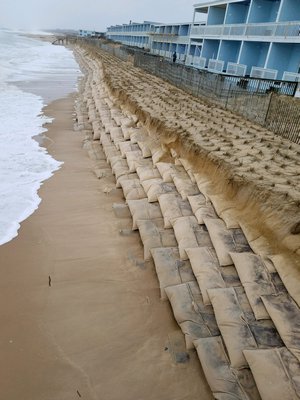
The sandbags that form the revetment across downtown Montauk's oceanfront were exposed this week
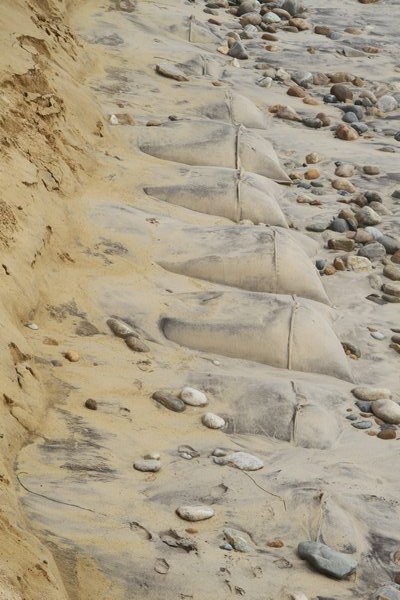
the first time they've been uncovered by erosion during the summer. Michael Wright
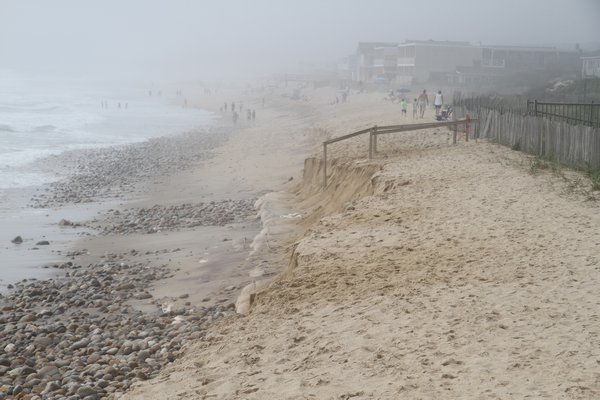
The sandbags that form the revetment across downtown Montauk's oceanfront were exposed this week
The relative calm of summer was not kind to the Montauk beaches this year, and has left them in poor shape to fend off the onslaught of the winter storm season.
Some of the large sandbags that make up the 3,100-foot revetment protecting the oceanfront in downtown Montauk were exposed over the summer and again early this week, and the beach along all of the revetment’s face remains very “low” as the season when beaches typically are building came to an end.
Town officials said the condition does not bode well for the coming winter. Last spring, the town spent some $1 million re-burying the revetment beneath thousands of tons of sand, as required by the Army Corps of Engineers, which constructed the revetment.
“There was a scarp there, probably a place where it’s a little deeper offshore, and it gets washed away faster,” Supervisor Peter Van Scoyoc said. “I’m concerned. I’ve been concerned about it from day one.”
The revetment was built in 2015 to protect the foundations of the major hotels that line Montauk’s anemic beachfront from the impact of severe storms. The $9 million cost of constructing it was borne by the Army Corps, but the town is responsible for maintaining the artificial “dune” that covers it.
On Tuesday, the town said it plans to borrow $200,000 to hire consultants to draft an erosion control district for the downtown area, which could be used to fund a much larger beach restoration project along the hamlet’s oceanfront—hopefully in partnership with the Army Corps.
A committee of town officials and Montauk business and community leaders has already estimated that the town will need to kick in up to $17 million to augment what the Army Corps has said it will be willing to contribute to sand replenishment in the hamlet as part of an Island-wide storm resiliency effort that is expected to kick off in 2022.
The town could borrow the money and then tax property owners in the special district to repay the loans over several years. The arrangement would mirror the one employed by Southampton Town in 2013 to replenish sand along 6 miles of beach in Sagaponack and Bridgehampton—a $25 million project that homeowners agreed to fund to protect their homes from erosion.
The town has yet to determine what the boundaries of the district should be or how to apportion the tax levy to recoup the costs. Mr. Van Scoyoc said that the push for the district has been broadly supported by the major hotels along the downtown that would likely bear the lions share of the costs.


 Michael Wright on Sep 12, 2018