


 1 Photo
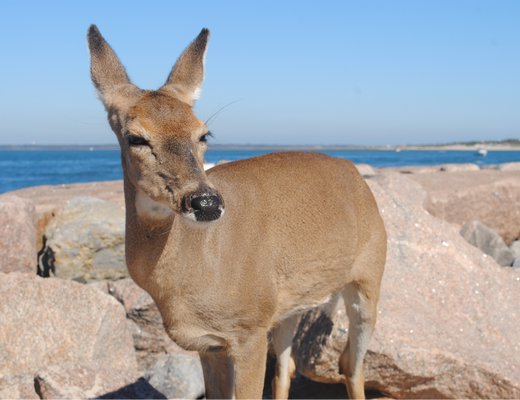
The friendly Hampton Bays deer was rescued by the Evelyn Alexander Wildlife Rescue Center. AMANDA BERNOCCO
The friendly deer that spent most of the past month hanging out on the western side of the Shinnecock Inlet was rescued Saturday afternoon.
Volunteers from the Evelyn Alexander Wildlife Rescue Center in Hampton Bays picked up the doe on Saturday, approximately three weeks after the center first started receiving calls from concerned citizens about the animal, which was tame and regularly interacted with visitors to the inlet.
After receiving yet another report, two staff members from the rescue center caught the deer by luring her with apples and tranquilizing her, explained Virginia Frati, executive director of the rescue center. She was not at the scene when the deer was collected.
“I was there the other day,” said Molly Fargo, a 14-year-old from Hampton Bays who had been regularly visiting the animal that she nicknamed “Elliot,” after the deer from the 2006 animated movie “Open Season.” “It was a little bit of a sad day for me because they tranquilized her and took her to the wildlife place.”
Once she was tranquilized, the doe was put in one of the rescue center’s vans and transported to the Hampton Bays facility. The deer will be living in a room inside the facility, with access to plenty of food and water, until Ms. Frati arranges for a licensed sanctuary to take her. Ms. Frati would not share the name of the sanctuary she is trying to transfer the deer to, explaining that nothing has been finalized yet.
Ms. Frati explained that the deer is in a private room away from volunteers and staff members as a safety precaution, because it is unclear if the animal is carrying any diseases. A state veterinarian, who will also determine what sanctuary the deer can be transferred to, will examine the deer in the days to come, she said.
“I’m trying to get different permissions, but I expect it to happen quickly,” Ms. Frati said of the deer’s pending relocation.
“We don’t anticipate [her] being here very long,” she continued. “[She] is in a quarantine and we are going to be transferring [her], again, to an undisclosed, licensed facility when we get the okay from the appropriate officials.”
Marisa Nelson, assistant director of the Quogue Wildlife Refuge, who also received several calls about the deer, said she was glad to hear of the rescue center’s plans to transport the deer to a sanctuary. “The best thing is for them to find a home like that,” she said. “It needs to be in a place where it would be safe.”
While visiting the inlet, the tame deer became somewhat of a local celebrity, with many stopping to take photos of her while others brought her food. Fishermen, among others, enjoyed the deer’s company over the past few weeks, feeding her apples, carrots, lettuce and other vegetables.
Although those feeding the deer said they were doing so because they feared she couldn’t fend for herself, the State Department of Environmental Conservation stresses on its website that it is illegal to feed wildlife, noting that those who do can face fines up to $250 and up to 15 days in jail. The law is in place, it continues, because such action can cause more animals to survive than the natural habitat can support, and some animals can develop digestive problems if their diets are suddenly changed.
Though she is sad that she can no longer visit Elliot, Molly said she knows that this is the best ending for her furry friend.
“Elliot knew something was going on. She was running away from them and coming over to me,” Molly said of the rescuers. “But I’m happy Elliot is going to be safe now.”


 Amanda Bernocco on Oct 18, 2015