


 1 Photo
Neighbors and their lawyers push back on Farrell plan to build a medical facility in Bridgehampton's historic district.
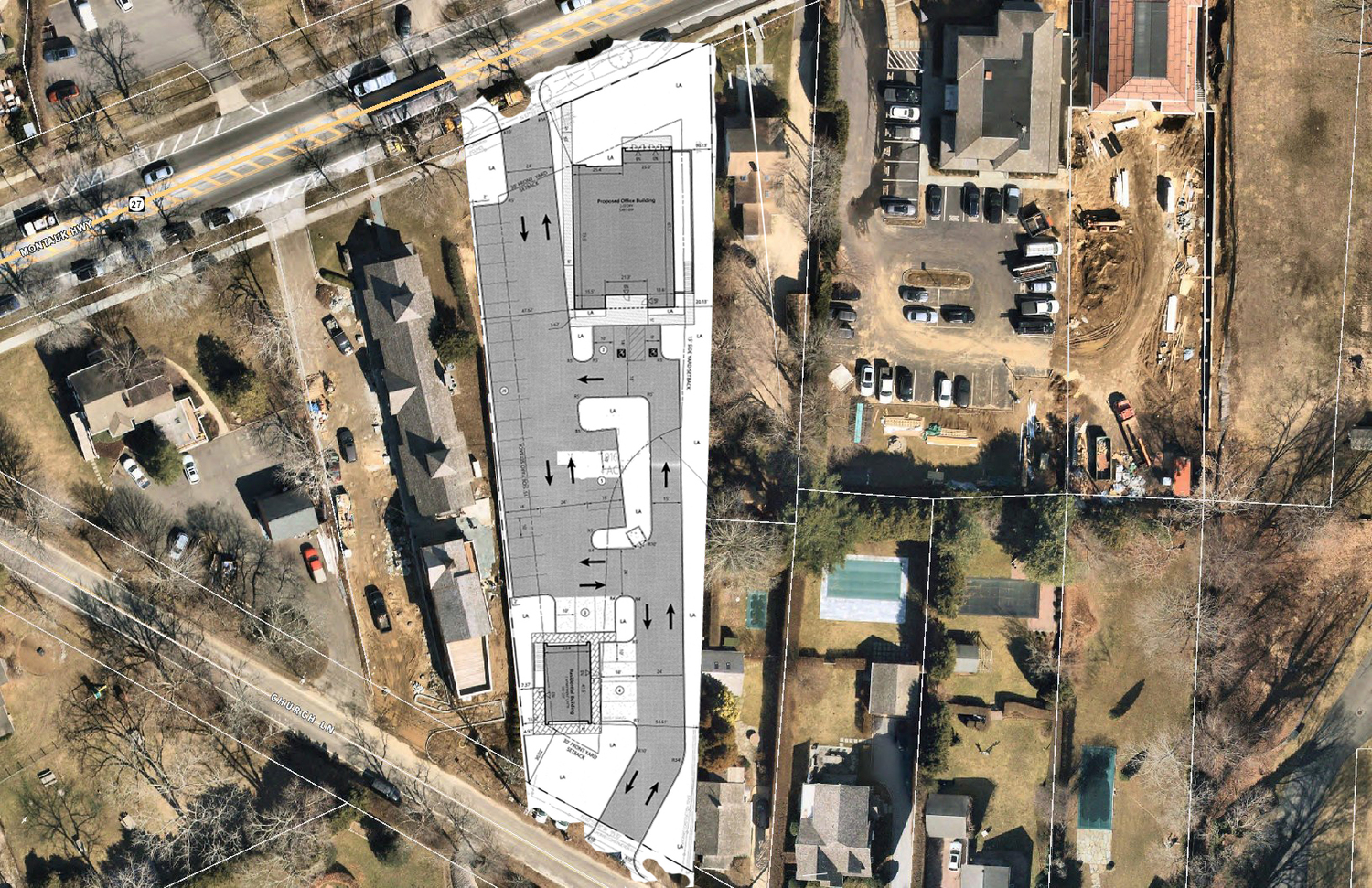
A Farrell Building Company proposal to build a medical facility and two apartments at 2297 Montauk Highway in Bridgehampton is being described by local civic activists as a first test of the hamlet’s newly created Bridgehampton Main Street Historic District — and whether it has any actual teeth in the face of development proposals.
“It should look historic,” said Pamela Harwood, president of the Bridgehampton Civic Association, of developer Joe Farrell’s proposed office building, which she described as a modernist, dark brown building that, as proposed, is out of character with the surrounding community.
Other critics have described the design as being more in line with a standard-issue municipal building, a university building, a firehouse — and even a spaceship.
The developer has requested numerous variances from the Southampton Town Zoning Board of Appeals, including a request to allow for the construction of the 5,491-square-foot building where current zoning allows only for 3,000 square feet on the parcel.
The developer also has asked for a variance to construct a separate residential building featuring two apartments.
As Harwood and others have noted at recent Planning Board and Landmarks & Historic Districts Board meetings, in order to qualify for the special exception to construct a building of greater than 5,000 square feet, the developer would have to include three apartments as part of the building, including a unit designated for a moderate-income family.
Farrell’s presubmission site plan would include separate apartment buildings that would boost the overall square footage of the proposal to more than 6,000 square feet, which is not allowed, Harwood said, even with a special exception.
The Planning Board and Landmarks & Historic Districts Board were both asked to weigh in on the request for variances that would be part of the ZBA’s mandate.
“There is a good deal of relief required,” acknowledged Farrell attorney Carl Benincasa of Water Mill. The site plan application also asks for setback variances to accommodate the office building, which critics said could leave as little as 1 foot of space between the new building and one neighboring property.
As the developer works through the review process, Loopnet.com is featuring advertising of the building design as presubmitted and with a lease availability date set for December 31 of this year.
For its part, the historic district board hasn’t yet received an application for a certificate of appropriateness that would be required were the proposal to move forward in any form. It was asked simply to weigh in on the variance requests for the time being.
“A formal review according to the criteria laid out in the Planning Board response is in the future,” said the board’s chairman, Ed Wesnofske, “when the applicant chooses to make an application.”
At Farrell’s request, the historic districts board received referrals in January from both the ZBA and the Planning Board to address the variance requests. That led to a meeting with Benincasa and the historic districts board, with the board ultimately offering a rebuke to the desired variance relief in the form of a point-by-point email from board member William Heine that was included in the historic district board’s response to the ZBA.
After purchasing the property, the Farrell Development Company demolished a circa 1900 residence on the site in 2022, despite opposition from the Landmarks & Historic Districts Board, which said it might have been landmark-eligible. That demolition occurred even as Bridgehampton residents were advocating for the creation of the Bridgehampton Main Street Historic District. The district was voted into place late last year by the Southampton Town Board.
The parcel is located in a triangle-shaped and largely residential community and borders Montauk Highway and Church Lane.
Following the demolition of the home, the lot was clear-cut of trees and vegetation and graded in anticipation of the new development.
Nearby residents on Church Lane, Hildreth Lane and Halsey Lane have mobilized and hired the law firm Twomey Latham Shea & Kelley to represent their interests. “They are a formidable group of neighbors, and they are deeply committed,” said attorney John Shea.
Those clients include Cary Leitzes, who told the Planning Board recently that the clear-cutting had shifted stormwater flow around her Church Lane cottage, and that she has since endured flooding in her basement, damage to her home’s foundation, and a rat infestation.
Benincasa told the Planning Board that he would meet with Leitzes and discuss a path forward that might include mitigation for the reported damage she said the clear-cutting caused.
“She gave him further details about that problem and is awaiting a response about what he’s going to do,” said Shea. “That’s the past — but what about the future?” he added.
Opponents of the Farrell proposal have offered an alternative footprint via the law firm that would feature a smaller main building and would move it from the proposed Church Lane end of the property to the portion that fronts Montauk Highway. The residential units would then be built on Church Lane and would be more in line with what’s already on the block.
As currently proposed, residents and their representatives have noted that the driveway that would lead off Church Lane into a large parking lot is actually twice as wide as Church Lane itself.
The parking lot would be accessible from Montauk Highway and Church Lane, creating, in effect, a through-street that has not previously existed at the location. That would require a curb cut at Montauk Highway.
Attorney Joan Morgan McGivern from the firm representing the neighbors said the proposal would “radically change this parcel from historical residential use to maximize commercial use.”
The vigorous community response to the Farrell proposal appeared to hold sway with Benincasa and his client.
Planning Board Chairwoman Jacqui Lofaro urged Benincasa on January 24 to convince his client to take a meeting with the Bridgehampton Civic Association. Benincasa said he would “strongly encourage” him to do so.
And a hearing before the ZBA that was to have taken place this week was pushed off for two months to give the developer time to consider input from the community and the relevant review boards, and perhaps adjust his plans accordingly insofar as the sought-after variances and the overall design of the proposed building.
Benincasa told the Planning Board that his client was “actively considering revisions to the plan.”


