


 1 Photo
Farmers on the East End are used to talking about their farms. Since many of them rely on retail sales as the root of their businesses, they do a lot of talking to customers about their land, their produce and their lives.
Last Wednesday, some East End farmers did a lot of talking about their farms with the government.
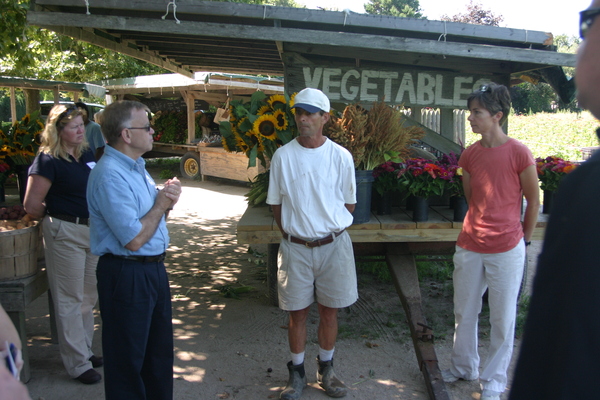
A vanload of officials from the federal Food and Drug Administration were visiting the East End, talking with farmers about some of the details of their business that will help formulate sweeping new nationwide management rules for the handling and distribution of produce. The team of more than a dozen FDA experts visited three farms on the South Fork—Hank Kraszewski’s pumpkin farm and the Halsey family’s Milk Pail farm in Water Mill, and Jim and Jennifer Pike’s farm stand in Sagaponack—spending more than an hour at each, talking with the farmers about everything from deer fencing to retail prices.
“They took a lot of notes and listened very carefully,” said John L. Halsey, owner of the Milk Pail. “They were genuinely interested in what will work for small agriculture.”
The FDA is in the process of drafting a new set of produce safety rules as mandated by the Food Safety Modernization Act adopted by Congress in January. The new rules will govern the care and transport of farmers’ produce throughout the country. In the past, such safety standards were primarily localized and mandated to farmers only by the wholesalers and large retailers who purchased from them.
Formulating rules that will apply across such a sweeping landscape is difficult, as farmers in different regions and states may follow a wide variety of protocols. The FDA team has been on the road for more than a year in an effort to gather the most comprehensive view of farming in America as possible.
“The act requires standards for the whole country, which is hard to do with the different practices in place in various regions,” said Stephanie Yao, one of the FDA officials who visited the South Fork last Wednesday, August 10. “We have to reach out to growers and hear what they are saying.”
Mr. Kraszewksi, whose farm was chosen by the FDA because of its emphasis on tourism and pick-your-own harvesting of its pumpkins in the fall, noted that in his case, and that of other operations like his, the key to food safety will be the education of consumers. “I suggested to them some kind of food safety eduction in the classroom for kids,” he said. “A lot of new families these days are not familiar with the sort of food safety that we all know.”
Ms. Yao said that many farmers were concerned about costs or restrictions the new rules may saddle them with and whether they’d have a say in the final rules, which are still long from being adopted.
Many East End farmers, like the Pikes, who farm 60 acres of crops to supply their Sagaponack Main Street farm stand, could be exempt from the new food handling rules. Ms. Yao said that the criteria will likely be based on gross sales and distances produce is shipped. Mr. Kraszewski said that differentiating between large and small farmers would be an important distinction. “For someone like Jim Pike to have to have a stainless steel washing system would be very expensive, compared to some huge operation like Dole,” he said. “They’re trying to work that kind of thing out.”
The tours by the FDA were arranged for the federal agency by the Long Island Farm Bureau and the Cornell Cooperative Extension in Riverhead.
Mr. Halsey, whose daughter, Jennifer, has been participating in an FDA-run good agricultural practices program, said the open-minded group of FDA officials were an encouraging sign.
“I grew up with the FDA being the strong arm of the law … now they are interested in preserving agriculture and doing it through education,” he said. “These were very intelligent people.”


 27east on Aug 17, 2011