


 1 Photo
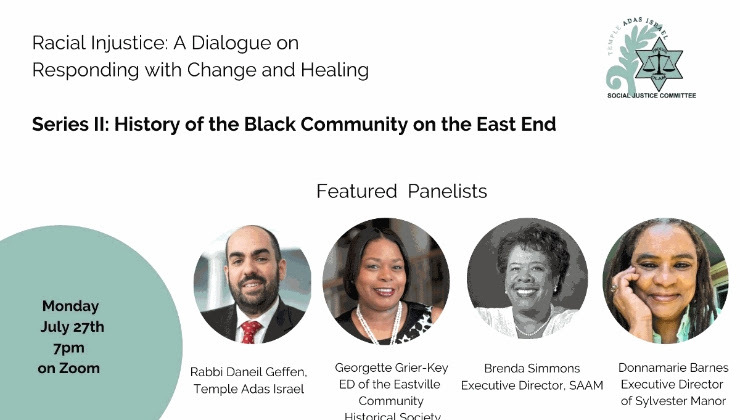
The flier for The History of the Black Community on the East End Zoom Event
Joining the nationwide push for social equality, Temple Adas Israel in Sag Harbor hosted a virtual conversation on the subject of racial injustice, The History of the Black Community on the East End, via Zoom.
On Monday, July 27, the temple hosted the event as a dialogue on responding to racial injustice with change and healing. The event welcomed everyone to come learn.
Co-chairs of the Temple’s Social Justice Committee, Andrea Klausner and Alyssa Peek, came up with the idea. The featured panelists were Dr. Georgette Grier-Key, Ed.D, M.Ed, the inaugural executive director and chief curator of Eastville Community Historical Society of Sag Harbor; Brenda Simmons, the executive director of the Southampton African American Museum; and Donnamarie Barnes, the curator and archivist of Sylvester Manor. It was moderated by Rabbi Daniel Geffen.
The overarching goal of the temple’s Social Justice Committee is “to build community and you do that by working together and helping each other,” Ms. Klausner said. The philosophy of the committee’s learning series events, like this one, is to ask “what do you want us to know so that we can understand better and be there for you? Tell us what we should know and what we should do. It’s not our narrative.”
This event worked toward that goal by inviting speakers who are devoted to sharing the history of the Black community on the East End and are involved with The Eastville Community Historical Society, The Southampton African American Museum, and Sylvester Manor. All three are historical educational sites.
The Eastville Community Historical Society is “a place of American history, consciousness, and culture that we should all be enjoying together and using as a platform of tolerance and understanding,” said Dr. Grier Key.
It is dedicated to preserving historic buildings. The organization also conducts research and collects and spreads information about the history of African Americans, Native Americans and European immigrants.
“The history of African Americans on Long Island and in the country, for that matter, it’s been there. It’s just not documented in the same way,” said Dr. Grier-Key. “And so we want to make sure that it is documented that it is a part of the teaching mechanism.”
Currently the historical society is working to digitize its records to make this history more accessible.
The Southampton African American Museum offers programs that encourage an understanding and appreciation of African American culture. According to its website, members “research and collect local history, produce media events, create exhibits and community celebrations.”
The museum building is actually “the first African American site in the Village of Southampton to be historically designated,” Ms. Simmons said. “The building was originally a juke joint, a barbershop and a beauty parlor back in the ’40s.” It was a place “for African Americans to gather where they had a safe haven to, you know, let the hair down and relax.”
The museum is currently under renovation. However, once opened, the building will educate the public on three things. They are “The Great Migration, the history of barbershops and beauty parlors, as well as the Pyrrhus Concer [a former slave born in Southampton] Project.”
Sylvester Manor was founded in the 1650s by the first European settlers on Shelter Island. It was a sugarcane plantation that used enslaved Africans as the primary workforce. It now serves as an educational site. Organizers are working to uncover as much as possible about those who worked on Sylvester Manor and share their stories.
“This is not black history. This is American history. And what the work that we’re all doing and specifically what we’re doing in the plain sight is to resurrect those people who have been left out of history,” said Ms. Barnes.
Speakers thought the event was a success.
“A lot of people don’t know about the East End African American community,” Ms. Simmons said. “I think it’s just a wonderful thing that people really want to hear and listen now, they are paying attention.”
“I feel people left the event more knowledgeable than they came, and that’s always a good thing,” Dr. Grier Key added.
“They are expanding their knowledge of where they live and what it means to be in this place together, and the only way to really do that is to go back to the beginning and learn the history of the place. That’s the only way to go forward into the future,” Ms. Barnes said.
Despite COVID-19 restrictions, the Eastville Community Historical Society, Sylvester Manor, and the Southampton African American Museum are still operating. At Sylvester Manor, its trails, gardens, farm, and windmill are open. There is also a walking tour app available on the Apple store.
The Eastville Community Historical Society has a walking app, as well. It also welcomes visitors to drive by the exhibition at its cemetery. The Southampton African American Museum is available as a virtual museum.


