
Flesh-Eating Bacteria, Toxic Algae, Oxygen-Starved Waters Were Widespread in 2023, Thanks to Nitrogen and Warmer Waters

icon 6 Photos
Christopher Gobler Ph.D. presented his annual State of the Bays symposium on water quality issues across Long Island earlier this monthy at Stony Brook University-Southampton. MICHAEL WRIGHT
Christopher Gobler Ph.D. presented his annual State of the Bays symposium on water quality issues across Long Island earlier this monthy at Stony Brook University-Southampton. MICHAEL WRIGHT

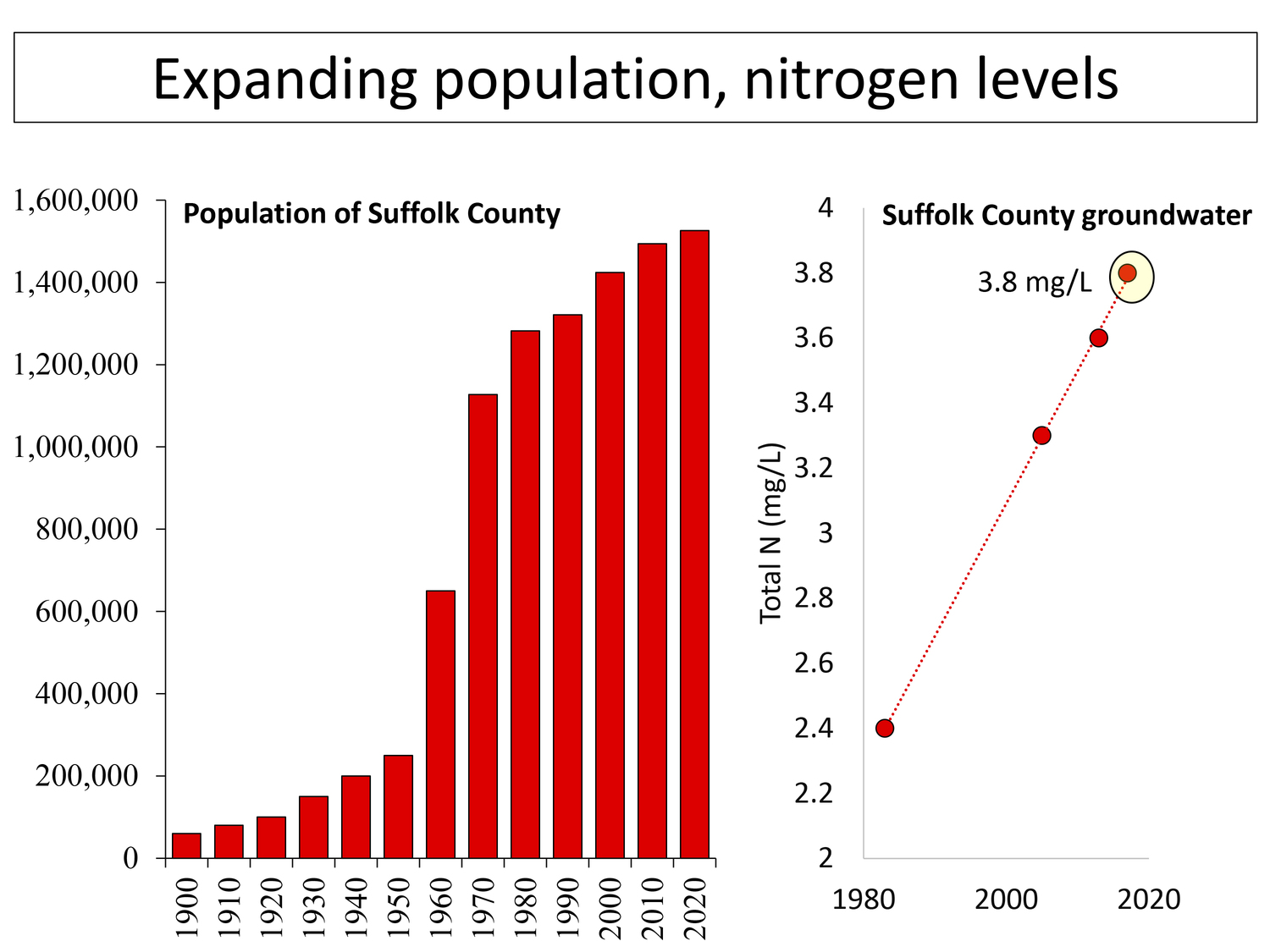
Nitrogen levels in Suffolk County groundwater have soared with population growth, presenting broad environmental and human health concerns, including cancer risks in humans and developmental issues in newborn babies. COURTESY OF THE GOBLER LAB
Nitrogen levels in Suffolk County groundwater have soared with population growth, presenting broad environmental and human health concerns, including cancer risks in humans and developmental issues in newborn babies. COURTESY OF THE GOBLER LAB

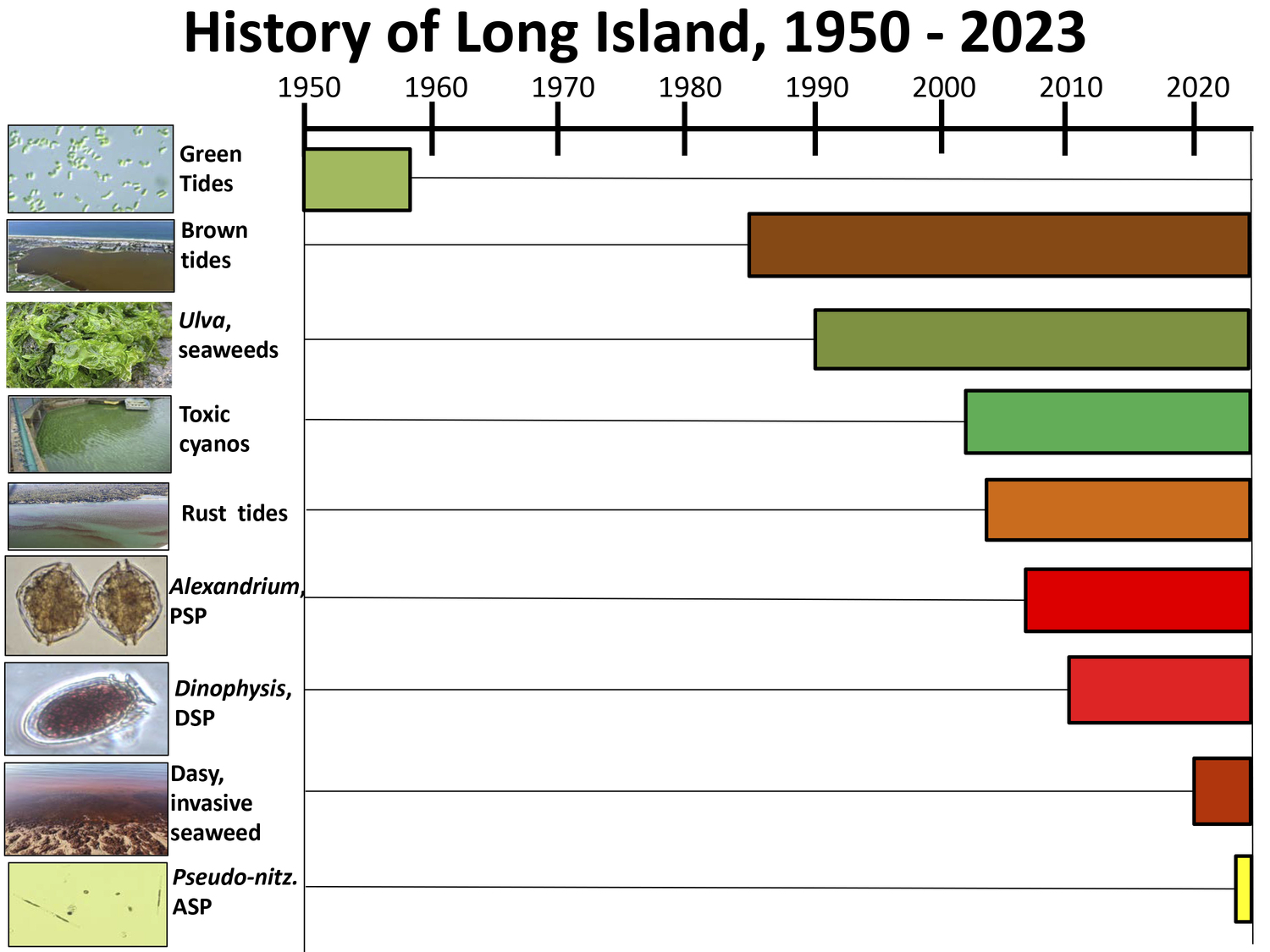
Over the decades, as nitrogen levels have climbed and waters have warmed, the number of different harmful algae species blooming in local bays has grown. COURTESY OF THE GOBLER LAB
Over the decades, as nitrogen levels have climbed and waters have warmed, the number of different harmful algae species blooming in local bays has grown. COURTESY OF THE GOBLER LAB

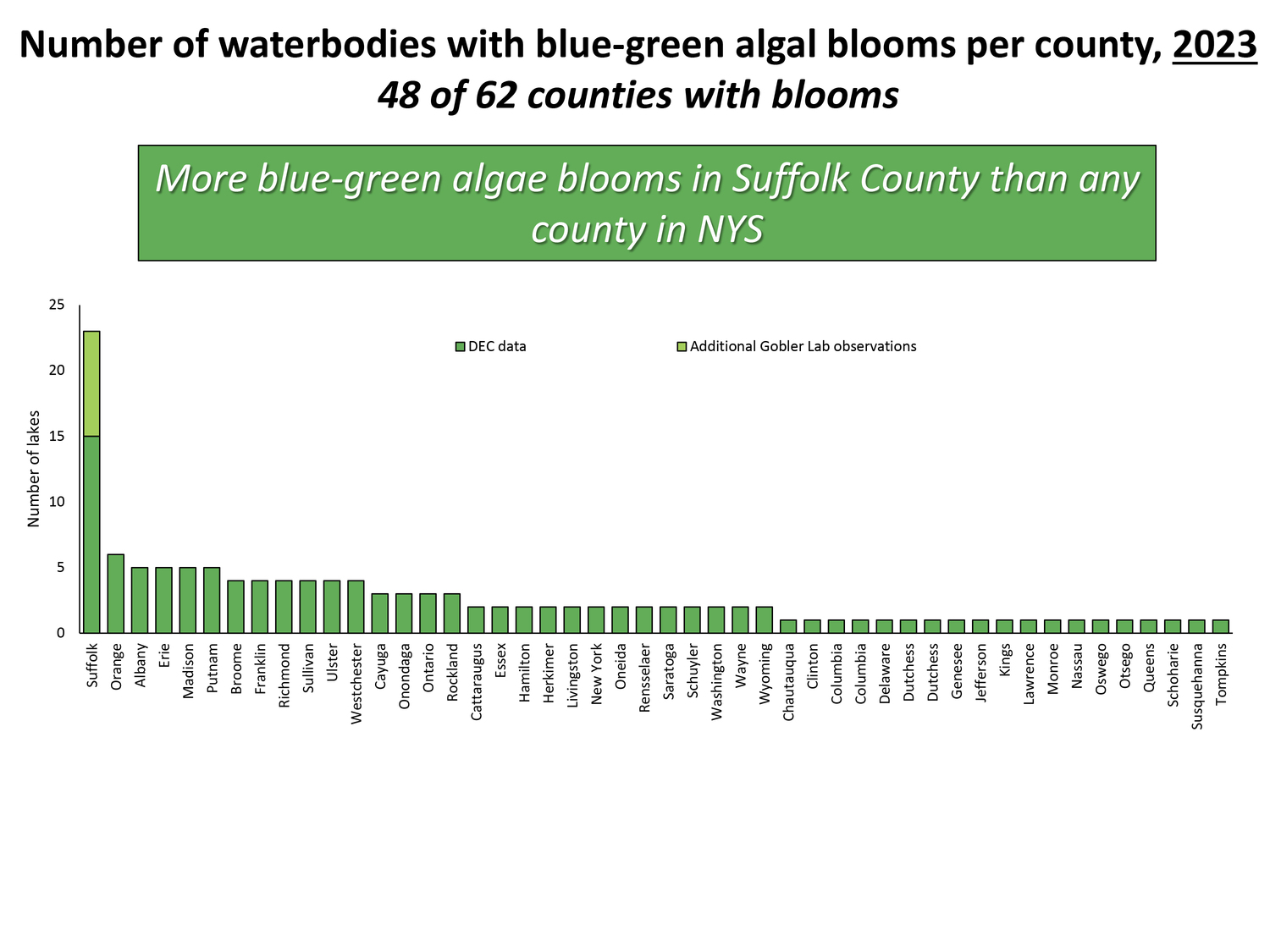
Suffolk County has more than four times as many water bodies that experience toxic blue green algae blooms than any other of the 62 counties in New York State. COURTESY OF THE GOBLER LAB
Suffolk County has more than four times as many water bodies that experience toxic blue green algae blooms than any other of the 62 counties in New York State. COURTESY OF THE GOBLER LAB

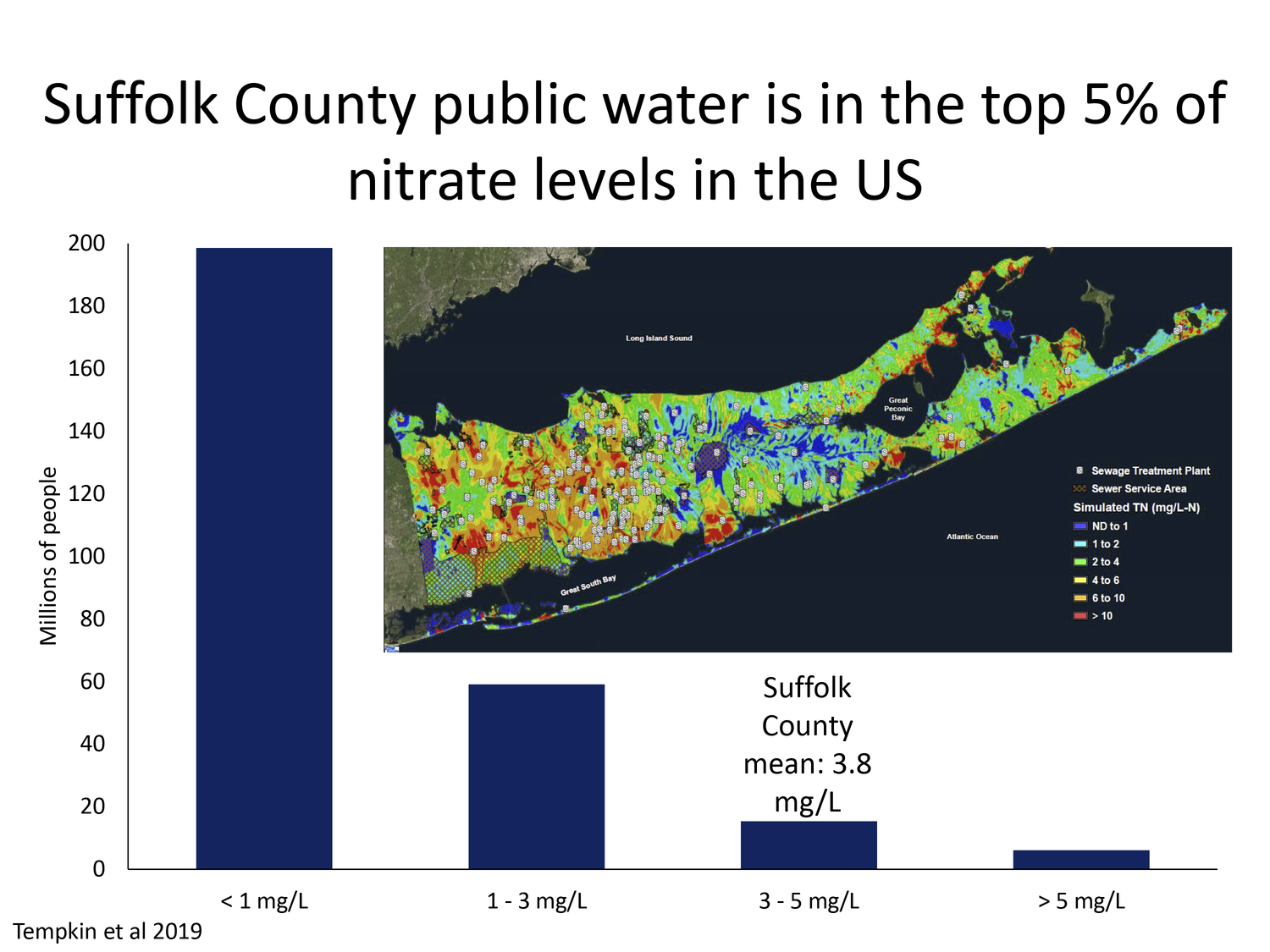
Suffolk County's grounwater has some of the highest levels of nitrates in the entire nation. COURTESY OF THE GOBLER LAB
Suffolk County's grounwater has some of the highest levels of nitrates in the entire nation. COURTESY OF THE GOBLER LAB

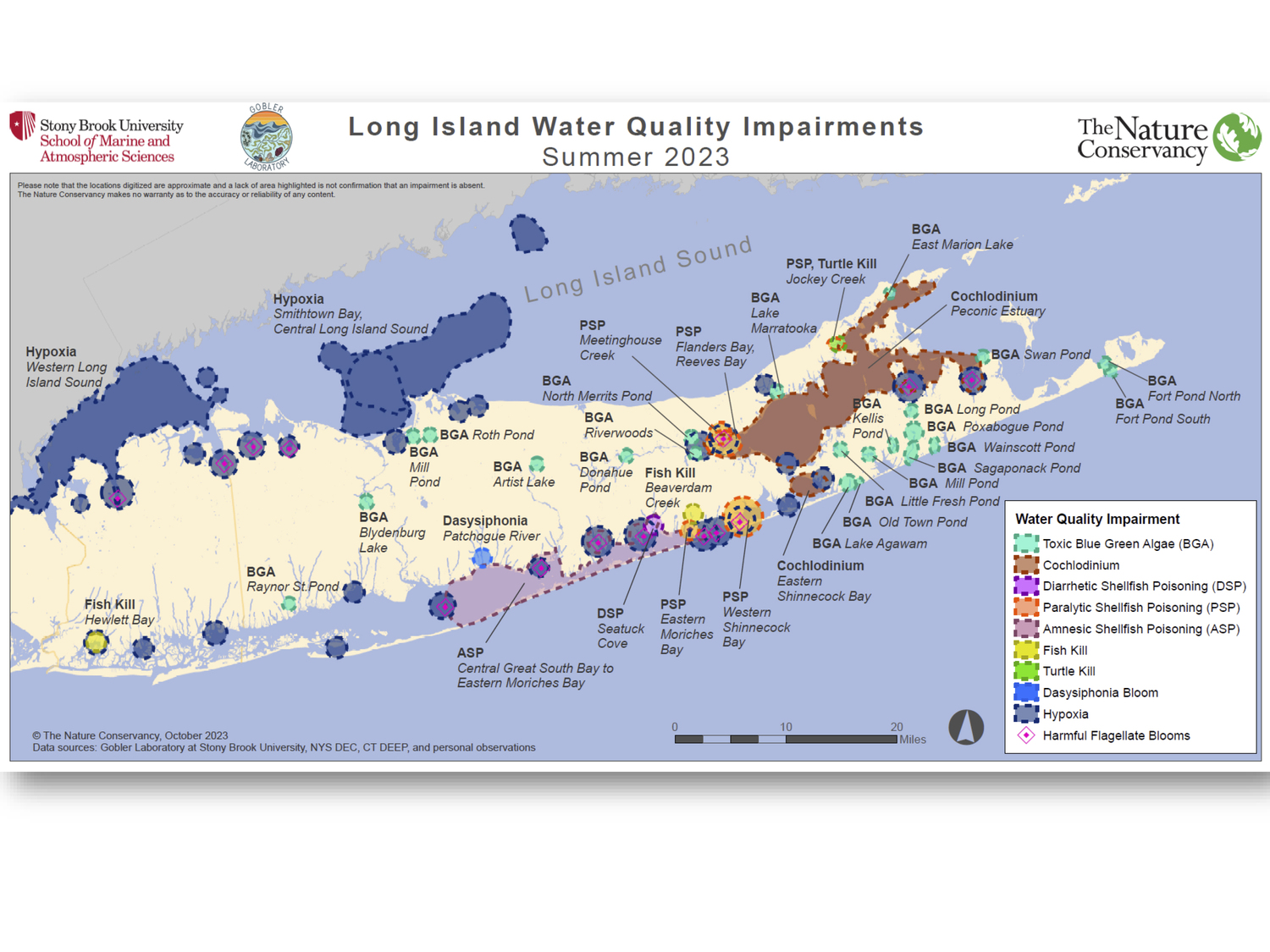
More than two dozen tidal and freshwater bodies on Long Island were stained by harmful algae blooms or starved of oxygen, leading to die-offs of marine species, in 2023.

More than two dozen tidal and freshwater bodies on Long Island were stained by harmful algae blooms or starved of oxygen, leading to die-offs of marine species, in 2023.

authorMichael Wright on Apr 17, 2024

Record-high temperatures globally and in local waters fueled the steadily worsening water quality crisis in Suffolk County’s groundwater, freshwater ponds, and tidal bays and harbors in 2023, Stony Brook University scientists found, according to an annual summary of the impacts seen by researchers.

Stony Brook University professor Dr. Christopher Gobler said his laboratory team tracked toxic algae blooms in more than two dozen individual bodies of water around the region last summer. New species of algae blooms, bringing new threats to human health, are gaining footholds as water temperatures continue to tick upward.

Most of the blooms were seen in eastern Suffolk County, where high levels of nitrogen in groundwater contaminated by human waste are migrating to surface waters in ponds and bays, where they feed, literally, the blooms of algae and the destructive effects they leave in their wake, Gobler said.

Suffolk County had four to five times as many water bodies impacted by blooms of highly toxic blue-green algae in 2023 as any of New York State’s 61 other counties. Blue-green algae blooms are known to be harmful or even fatal to humans.

Other toxic algae blooms that can turn shellfish toxic, kill fish and shellfish in enclosed bays and cause widespread lack of oxygen have grown more intense, more toxic and shifted their life cycles because of the warming water and high nitrogen levels in local waters, Gobler said.

And Long Island last year saw the emergence of a dangerous new flesh-eating bacteria, Vibrio vulnificus, that has been steadily expanding its range northward along the East Coast as waters have warmed. A Suffolk County resident died and two others were hospitalized from Vibrio infections in 2023. Two others died in Connecticut.

“Warming water means that organisms migrate toward the poles to stay in their optimal comfort zone,” Gobler told a packed auditorium on the Stony Brook Southampton campus on April 3, when he presented his annual State of the Bays report. “Vibrio vulnificus has slowly moved up the East Coast, and they had estimated that we’d see it on Long Island in five years — and five months later, we had cases of it here. This is directly related to there being more heavy rainfall and warmer temperatures.”

Gobler repeated warnings issued by health officials last year against swimming or wading in brackish — part saltwater, part freshwater — waters with open cuts, which can lead to Vibrio infections and, in as many as 20 percent of cases, rapid death.

As he has each year for nearly a decade, Gobler ticked off the destructive cycle that has led to the rise and expansion of harmful algal blooms. Explosions of housing development in the 1960s, 1970s and 1980s, with rudimentary waste disposal systems, have left decades of wastewater from tens of thousands of toilets leaching into groundwater that flows directly into ponds and bays.

The level of nitrogen in Suffolk County’s groundwater is among the highest in the nation. Along with being tied to various direct human health effects, like increased rates of cancer and developmental problems with babies and young children, that nitrogen also sparks algae blooms hungry for nutrients. As waters have warmed, more and more new algae have emerged — many likely had been present all along but were spurred to explosive growth by newly ideal environmental conditions — and evolved, bringing with them new concerns.

The region saw the most ever number of waterbodies contaminated with blooms of a particularly toxic “red tide” saltwater algae, Alexandrium, in 2023, forcing widespread closure of local bay bottoms to shellfishing in the early spring. Other areas saw the blooms of other destructive algae many times more dense than had ever been recorded anywhere.

The blooms of algae themselves are not the only problem. As they die, sometimes every night, they suck oxygen from the water and can create oxygen-starved conditions, know as hypoxia. Gobler said that researchers from his lab found hypoxic conditions at nearly every single site in local bays tested at night.

Gobler dedicated his talk this month to Bob Nuzzi, a marine scientist from East Hampton who was one of the first researchers to conduct focused studies of the infamous “brown tide” outbreak of algae blooms in the mid- and late 1980s. And he punctuated it with tidbits of good news — like the end of hypoxic conditions that had plagued Long Island Sound just 20 years ago, thanks to tens of thousands of homes being hooked up to sewage treatment plants that reduce nitrogen released.

And shellfish seeding, oyster farms and kelp growing have been found to suck nitrogen from surface waters — especially when kelp and shellfish are combined in close-quarters at shellfish aquaculture farms.

Suffolk County has set itself on the right course to addressing its massive problem with obsolete septics, thanks to an extensive study conducted by former County Executive Steve Bellone’s administration. Replacing septics with modern systems eventually will reduce the flow of nitrogen fuel, but with more than 300,000 obsolete systems beneath homes, it will be a long battle.

“Nitrogen-reducing septics are starting to help,” Gobler said. “But it’s going to be a long time.”

You May Also Like:

Sag Harbor Village Police Reports for the Week of December 11

SAG HARBOR VILLAGE — An officer responded to a call from a Rysam Street address a little after midnight on Saturday. The caller told the officer that a man wearing a black ski mask had walked onto her porch and banged on the front door then ran off. The woman provided the officer with surveillance video from her Ring camera, which visually confirmed what the woman said had happened. Police described the man as white, “approximately 6 feet tall, wearing a black ski mask, black hoodie with a red logo on the back, and wording on the left chest, a ... 12 Dec 2025 by Staff Writer

Harmony for the Holidays

Let’s be real: As jolly as the holidays can be, they can also be overwhelming. ... by Jessie Kenny

A Little Time, a Big Impact: Pierson's Interact Club Brings Joy to Seniors and Revives Blood Drive

Isabella Carmona DeSousa didn’t know much about Pierson’s Interact Club when she joined two years ... 11 Dec 2025 by Cailin Riley

Dear Neighbor

Congratulations on your new windows. They certainly are big. They certainly are see-through. You must be thrilled with the way they removed even more of that wall and replaced it with glass. It must make it easier to see what is going on in your house even when the internet is down. And security is everything. Which explains the windows. Nothing will make you feel more secure than imagining yourself looking over the rear-yard setback from these massive sheets of structural glass. Staring at the wall has well-known deleterious impact, and windows the size of movie screens are the bold ... by Marilee Foster

I Can Dish It Out

Our basement looks like the final scene in “Raiders of the Lost Ark,” where the (found) ark is crated and wheeled into the middle of a government warehouse with stacked crates going on for miles. In other words, we have a lot of stuff. This tracks. Mr. Hockey and I have been married for 36 (according to my calculator) years. We’ve had four (no calculator needed) pucks. We’ve lived in seven (according to my fingers) different homes in three (no calculator or fingers needed) countries. In 2010, we moved back to East Hampton full time. We brought everything we had ... by Tracy Grathwohl

The Urgency of Real

The Hamptons International Film Festival typically takes up a lot of oxygen in the fall on the South Fork, but it’s worth celebrating a slightly smaller but just as vital event in late autumn: the Hamptons Doc Fest. Running this week for its 18th year, the festival of documentaries was founded by Jacqui Lofaro and has become an essential part of the region’s arts scene every year. It’s a 12-month undertaking for Lofaro and her staff, and the result is always a tantalizing buffet of outstanding filmmaking, not to mention unforgettable stories. The arrival of the era of streaming services ... 10 Dec 2025 by Editorial Board

Hitting Pause

East Hampton’s housing shortage is real; the town can’t afford to ignore any potential long-term solutions. But the recent — and now scrapped — plan for a large employer-run complex on Three Mile Harbor Road raises too many questions that haven’t been fully answered. The proposal, put forward by Kirby Marcantonio and an unnamed partner, would have created 79 units of employer-controlled housing, comparable to a project he has pitched on Pantigo Road. To make it happen, the East Hampton Town Board would have had to allow the project to sidestep the town’s 60-unit limit on affordable developments, and rezone ... by Editorial Board

Proceed With Caution

Overlay districts are a common zoning tool used by many municipalities. Southampton Town has used them to varying degrees of success — the aquifer protection overlay district has been a winner; a downtown overlay district in Hampton Bays less so — in various parts of the town. They essentially look at the existing zoning, then allow those rules governing what can be done on properties to be reconsidered if there’s a newer concern to be addressed. In a bid to clean up the process for creating more affordable housing, the Town Board is looking at a new overlay district that ... by Editorial Board

The Whole Picture

When it comes to evaluating a complex development proposal, splitting up the application into separate parts may seem tempting, especially when environmental uncertainties loom. But in the case of Adam Potter’s plan for 7 and 11 Bridge Street, the Sag Harbor Village Planning Board should resist any temptation to segment the project for review. Potter’s attorney has asked the board to consider the gas ball property at 5 Bridge Street — a site that could provide the 93 parking spaces required for Potter’s 48 residential units and commercial spaces nearby — separate from the main development. The reason is understandable: ... by Editorial Board

New Law Requires Owners of Historic Buildings in Sag Harbor To Document Historic Features Before Renovation Work

The stories are almost commonplace: People seeing dumpsters full of old windows, doors and trim outside historic houses in Sag Harbor that are being renovated. On Tuesday, the Village Board adopted a proposal that it hopes will help put an end to that practice. It will require the owner of a historic house to complete a construction protocol and preservation plan before undertaking any major renovation. That document could be a few sentences or several pages long, depending on the type of work being considered. The amendment requires that the plan outlines “with specificity the detailed preservation, rehabilitation, restoration and/or ... by Stephen J. Kotz