


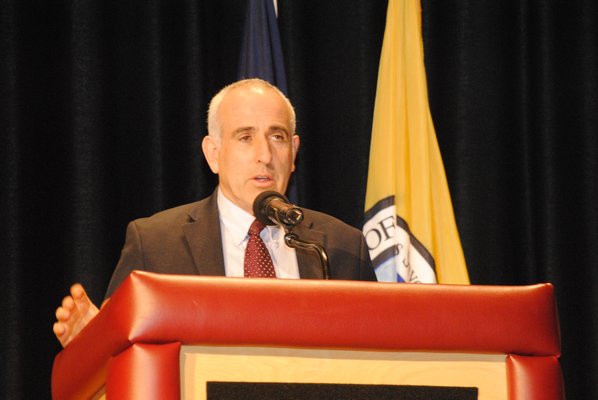
 7 Photos

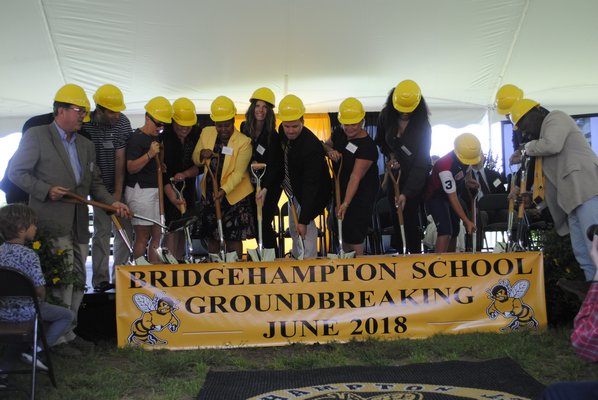
Southampton Superintendent Dr. Scott Farina and Tuckahoe Board of Education President Bob Grisnik talk after the vote to merge the two districts is denied by Southampton voters on Tuesday night. ERIN MCKINLEY BY ERIN MCKINLEY
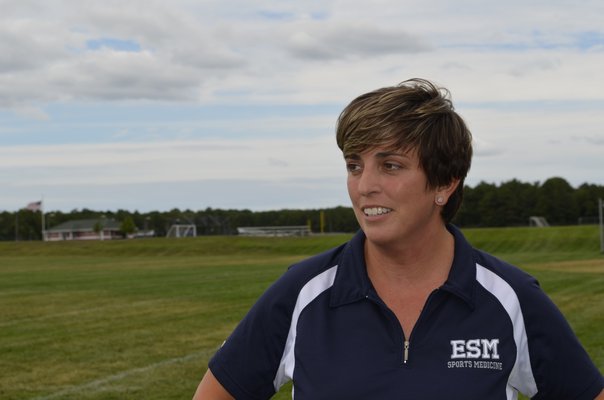
Kathryn Radice, Eastport South Manor Junior Senior High School athletic trainer and health teacher ALEXA GORMAN
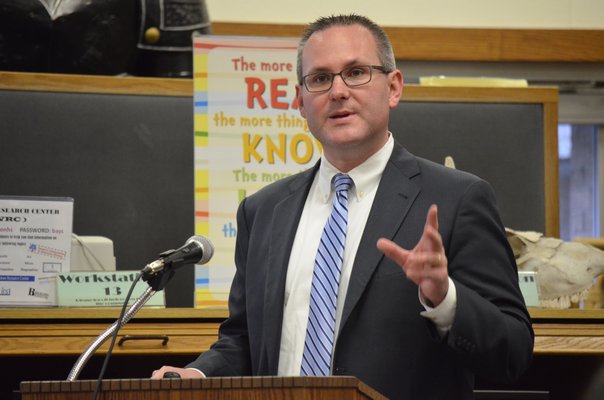
Hampton Bays Superintendent Lars Clemensen presents the district budget on Tuesday night. BY ERIN MCKINLEY


Tuckahoe students made bowls and spoons for an upcoming fundraiser to raise awareness that there are hungry people in the community. BY ERIN MCKINLEY
It was a “medically induced opioid addiction.”
That’s how former Southampton Town Councilman Brad Bender described the circumstances that got him addicted—and ended with him resigning from his post and serving 10 months in federal prison after he pleaded guilty in 2016 to felony charges of illegally distributing the highly addictive painkiller oxycodone in a drug distribution ring.
Mr. Bender shared his story on Wednesday, April 11, standing at a microphone in the Southampton High School auditorium during the public comment portion of the second Southampton Town Opioid Addiction Task Force forum.
The Northampton resident explained that a doctor over-prescribed him painkillers several years earlier when he injured his back, and that he was soon caught in the steely grip of opioid addiction.
He explained that his insurance mandated that his doctor prescribe him about a dozen weeks of a narcotic drug before getting a magnetic resonance imaging, or MRI, to decide if he was to have surgery. He said he was already on the painkillers for a year before the surgery was approved.
“How did I get to the opioid addiction? I don’t know if this is coining a phrase, but I am going to say it: medically induced opioid addiction,” Mr. Bender said at the forum.
In court, before his sentencing, Mr. Bender admitted that he was addicted to the painkillers and began selling the pills to pay his medical bills, all while continuing to also serve in public office.
Mr. Bender—who said last week that he hasn’t used drugs in two and a half years—ultimately spent 10 months in federal prison, four months in a halfway house, and two months in home detention for his involvement in the drug ring.
Mr. Bender talked about his past, noting that drugs were readily available in prison and around the corner from the Brooklyn-based halfway house he attended. He told task force members that they need to get to the root of the addiction problem.
“What is it that causes this addiction or problem?” Mr. Bender asked. “I know what it is for me: I didn’t feel good about myself … Where do I fit in? Why do I have all this pressure? What is going on in my head?
“We need to talk to people and find out what the hell is going on so they can figure out how to get to that next place,” he added.
In Southampton Town alone, there were 19 deaths from opioid addiction last year, according to Town Supervisor Jay Schneiderman, who co-chairs the forums with former News 12 anchor Drew Scott, whose granddaughter died last year of an opioid overdose. The town is a smaller screenshot of a larger regional crisis: Suffolk County reported approximately 400 opioid deaths in 2017.
This year is off to a better start: Town Police Chief Steven Skrynecki shared during last week’s forum that there has been only one fatality related to opioid overdose reported so far in 2018.
The chief gave a presentation during the recent forum, explaining that his department is putting a focus on arresting drug sellers. Police have also started offering to help addicts find treatment—as long as the person consents—when they are called to administer the drug naloxone hydrochloride, commonly known as Narcan, which blocks opioid receptors in the brain and helps an individual who has overdosed to breathe normally again.
Suffolk County District Attorney Timothy Sini agreed that targeting sellers and finding help for people who are overdosing is an appropriate strategy. He said there were more than 800 Narcan saves in Suffolk County last year.
“We’re not going to tolerate drug dealing in our community,” Mr. Sini said at the forum.
Since the task force’s formation last fall, the group has grown to 44 members, including educators, doctors, police, and community members who have direct personal experience with addiction. By the spring, the four subcommittees—education, treatment, recovery and law enforcement—are expected to present recommendations that the local, state and federal governments can do to help defeat the opioid crisis.
To come up with solutions, the subcommittees have been meeting individually to discuss the crisis and come up with a solution. A medical forum and two youth forums have also been held in recent months to help get to the root of the problem.


 Amanda Bernocco on Apr 12, 2018