


 14 Photos
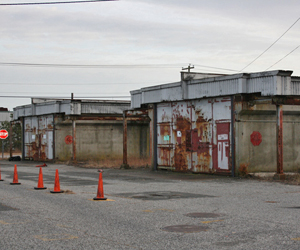
At the beginning of the Cold War, in the late 1950s, an essential component of the federal government’s first line of defense against a possible nuclear attack by the Soviet Union lay hidden in the woods of Westhampton.
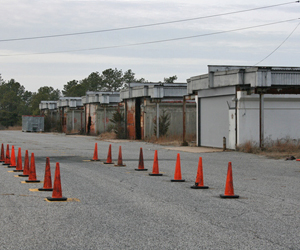
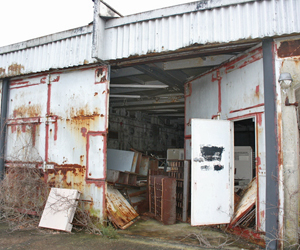
Fifty-six nuclear-tipped missiles were stored in metal garages nestled in the woods just north of Old Country Road. Their potential target: Soviet bombers whose mission was to drop atomic bombs on vital American targets, including New York City, some 75 miles to the west.
“In 1950, the U.S. government was looking into the possibility of shooting a small nuclear device at an attacking airplane,” said Chris Bright, an independent scholar of U.S. nuclear anti-aircraft weapons who lives in Virginia. “At the time, the U.S. thought you needed a nuclear bomb to stop an aircraft.”
The Westhampton missile base, which operated from 1959 until it was decommissioned in 1964, was one of 10 such facilities that defended the East Coast from a potential Soviet air attack. Other missile bases were located as far south as Newport News, Virginia, and as far north as Quebec, Canada, according to Mr. Bright. The sites, known as BOMARC facilities, were named after the developers of the nuclear missiles—Boeing and the Michigan Aerospace Research Center.
The missiles at the Westhampton base have been gone for decades and ownership of the property was later transferred to Suffolk County. Suffolk lawmakers are now looking to cash in on the 186-acre property, though not in the way some might expect.
At the suggestion of Suffolk County Legislator Bill Lindsay, the presiding officer of the government body, crews are expected to clear out tons of scrap metal that have been stored in the former missile shelters, as well as dozens of impounded cars that now litter the property, and recycle it all for cash. The scrap metal initiative is expected to generate as much as $1.2 million in revenue for the county, according to Mr. Lindsay.
He originally estimated that the site contained as much as $3 million worth of scrap metal.
Kara Hahn, Mr. Lindsay’s assistant, said the $1.2 million estimate was offered by an employee of a Long Island scrap metal recycling company who toured the BOMARC property last year. Ms. Hahn declined to identify the company.
“We’re not taking away the history,” Mr. Lindsay said. “Anything we’re throwing away is not historic, except that it’s very old. Some things will go in Dumpsters. Anything that has any value, we’ll try to sell for scrap metal.”
Mr. Lindsay is hopeful the revenue from the scrap sale will go directly into the county’s general fund and help reduce the $117 million budget deficit.
The Westhampton base, which was staffed by 150 U.S. Air Force members during the Cold War, cost the government about $20 million to construct. Each of the 56 nuclear-tipped missiles cost about $3.2 million to assemble, Mr. Bright said. In total, the federal government invested some $179.2 million in building and arming the facility.
Clayton Chun, a professor at the U.S. Army War College in Carlisle, Pennsylvania, said that the Air Force-run BOMARC program was not the military’s only defense against attacking Soviet bombers. The U.S. Army operated another air defense system that utilized nuclear-tipped Nike Hercules missiles. Unlike the rural BOMARC program, the Nike Hercules missiles were placed in major cities.
“There were more of those than BOMARC,” Mr. Chun said, noting that the Nike Hercules missiles had shorter ranges than their counterparts. “They protected urban areas like Washington, D.C., Los Angeles.”
When they were operational, the roofs of the garages housing the four-story missiles would split open, according to Mr. Bright. The BOMARC missiles were designed to streak through the sky at speeds topping 2,000 mph, and could cover distances of up to 200 miles.
Westhampton Beach Mayor Conrad Teller, who was a New York State Trooper on Long Island at the time, said he can still recall when the nuclear-tipped missiles were shipped to the Westhampton base on trailers in the late 1950s. “It wasn’t scary. No one paid attention to them,” said Mr. Teller, a former chief of the Southampton Town and Westhampton Beach police departments. “I never saw the silos open with the missiles coming out of there.”
Mr. Teller’s friend, Jim Doyle, a former Westhampton Beach and Southampton Town Police officer, said he assisted in the transporting of the missiles from what is now Francis S. Gabreski Airport to the BOMARC facility on Old Country Road.
“I used to be on guard when the missiles were brought in,” Mr. Doyle said. “They had patrol cars, one in front and one in back.”
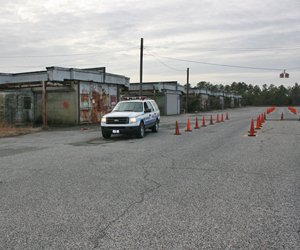
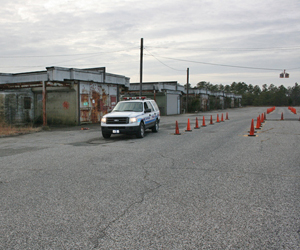
Today, the 186 acres that once housed the missile base, located just east of the Pulte Homes development, a subdivision for senior citizens that was built on the former Westhampton Dragstrip property, are utilized for myriad purposes: more than 3,000 cars involved in serious accidents are stored there by the Suffolk County Police Department, a shooting range used by Federal Bureau of Investigation officials and Suffolk Police officers operates on the northern end of the property and a section of the land is used as a training course for emergency vehicles.
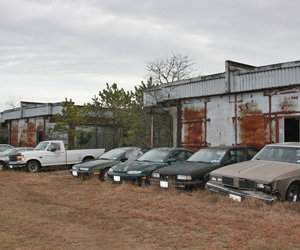
The impounded cars are strewn across the property, though some are lined up in rows in front of the now-defunct missile garages. The vehicles are stored there because most are vital pieces of evidence for court cases involving DWIs, fatal car accidents and suspected arsons, explained Gil Anderson, the commissioner of the Suffolk County Department of Public Works. Mr. Anderson, who is in charge of maintaining the grounds of the former BOMARC base, also oversees a power plant on the site that provides electricity to the entire facility. A county records facility is also located on the property.
Some of the impounded vehicles look as if they were not even involved in accidents. For example, a black Chevrolet Cavalier parked in front of one of the missile garages did not sustain any damage. Those cars will be sold during an annual auction that is hosted by the county. The other vehicles, the ones that have been smashed and mangled in accidents, will be recycled and their metal sold as scrap, according to Mr. Lindsay.
Neon markers have been used by county officials to document each court case, as well as accident or arrest dates, on the corners of some of the vehicles’ windshields. “It’s eerie thinking people could have died in these cars,” said Mr. Anderson while leading a tour of the grounds in the fall.
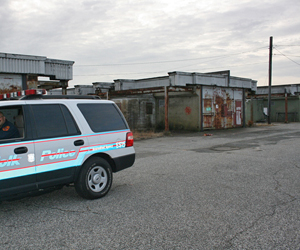
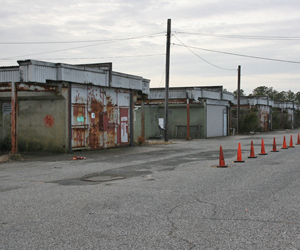
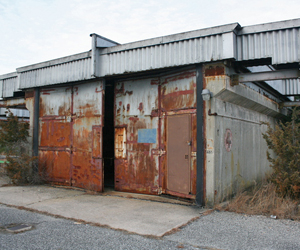
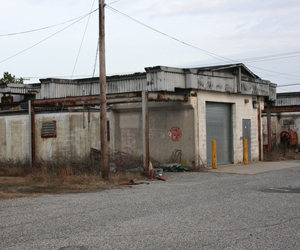
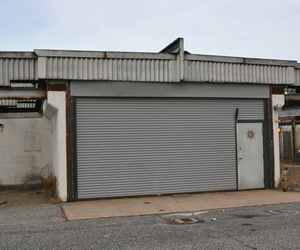
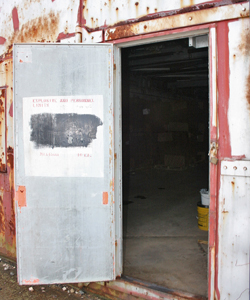
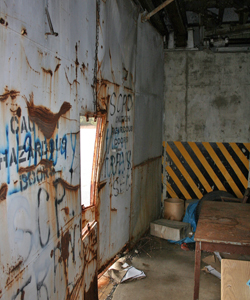
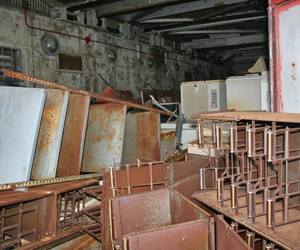
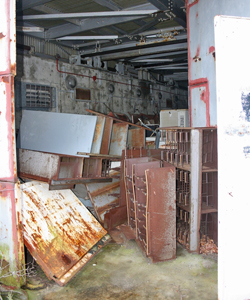
The 56 metal garages that once housed the missiles serve as a backdrop on the property. Some of them have fallen into disrepair following decades of neglect while others have been restored. The severely neglected ones are red with rust and most are brimming with piles of junk that were once pieces of equipment used by various county agencies. Old metal desks are shoved into some of the garages while in others, oversized computers that have not been touched since the 1960s are stacked one on top of another.
Suffolk County officials are hopeful that a number of these metal relics, and some of the impounded cars, can be recycled for cash. Officials said that crews will begin sorting through the items as soon as this spring.
Mr. Lindsay explained that Coram-based PK Metals, which had a previous contract with the county, will be removing the scrap metal and cars with help from prisoners from either of Suffolk County’s two jails, including the facility in Riverside. The contractor will not be paid a fee for the work, according to Mr. Lindsay. Instead, the company will pay the county an unknown amount for every pound of scrap metal that is removed from the site. PK Metals will then sell the scrap metal to a third party and keep the profit.
County officials said they could not say exactly how much they will receive for every pound of scrap metal that is recycled, noting that the price fluctuates almost daily. They also could not offer an estimate regarding the total amount of scrap metal that they hope to recycle later this year.
The half-century-old metal garages that housed the nuclear-tipped missiles will not be recycled, according to Mr. Lindsay. After the scrap metal is removed from them, the garages will most likely continue to be used as storage by county agencies, including the Suffolk Police Department and the Sheriff’s Office.
The metal garages are not typical missile silos, according to Mr. Bright, the scholar from Virginia. He explained that a silo is defined as a structure that covers “a missile that is placed into the ground straight up and down.” The structures at the BOMARC site allow the missiles to be kept above ground. “The roof opened up,” Mr. Bright said, explaining how the facilities work.
Mr. Chun explained that Air Force officials opted to build garages instead of silos because the latter are far more expensive to construct. “A silo is pretty expensive to build,” he said. “You have to build underground. A garage is like a coffin. It would open and the missile would be deployed, fired.”
Though the BOMARC facility is located near the Speonk Solvent Plume, a swath of contaminated groundwater located just west of the former missile base, officials with the New York State Department of Environmental Conservation said the former base is not the source of the contamination. The groundwater was contaminated by an unknown source and the DEC estimates that the plume is about 1.5 miles long and contains several metal degreasers dating back to the end of World War II.
Aphrodite Montalvo, a spokeswoman for the DEC, said the former missile base is not linked to the Speonk plume. “It’s a bit east of the Speonk plume investigation,” she said.
And according to Ms. Montalvo, Brian Jankauskas, the supervisor of the DEC team that is still trying to pinpoint the source of the Speonk plume, has said that the former base is not being investigated.
The 10 BOMARC facilities in the United States and Canada were developed out of the fear of another Pearl Harbor, when Japanese airplanes led a surprise attack on the U.S. Naval base in Hawaii, severely damaging the country’s war fleet and prompting its entrance into World War II. The main difference, Mr. Bright said, was that the BOMARC sites were established to protect America from a possible mainland attack led by the Soviets.
Because planes could fly very high and fast in the 1950s, non-nuclear missiles were not guaranteed to hit an incoming airplane, Mr. Bright said. A nuclear bomb detonated many miles up in the sky, however, would destroy the attacking planes, Mr. Bright explained.
The impact of a nuclear-tipped warhead colliding with a plane carrying another nuclear warhead would not have been as bad as some have speculated, according to Mr. Bright. “It would cause some destruction, but it would not be horrific,” he said.
He explained that because the bombers would be flying so high, the radiation from one of the BOMARC missiles would not have rained down on Long Island. Mr. Bright said that radiation requires some sort of matter, like dirt or buildings, that it can adhere to and cause damage.
Mr. Chun agreed with Mr. Bright’s analysis. However, he added that an atomic explosion would have created an electromagnetic pulse that could have crippled or destroyed electronic devices in the area.
The missiles were never fired and after the base was decommissioned by the Air Force in 1964, technicians removed their nuclear tips and dismantled the weapons. “Some of the missiles they launched for other purposes, or used for targets or tests,” Mr. Bright said. “Some of the insides of the missiles were taken out and put on display.”
The BOMARC facility was decommissioned when the Air Force realized that the Soviets no longer needed bombers to drop atomic bombs on the United States. Rather, advances in technology allowed them to launch nuclear missiles targeting the continental United States from silos located as far away as eastern Europe and the Soviet Union. These advances made the BOMARC sites obsolete.
But before the sites became obsolete, Mr. Bright explained that the missiles would have honed in on their targets utilizing radio signals. “It was a sophisticated tracking system,” he said. If a Soviet bomber approaching the East Coast was picked up on radar, an “elaborate calculation would be made by computers to determine which of the 10 locations BOMARC [missiles] should be launched from,” Mr. Bright said.
Once a site was selected, radio signals from Air Force bases would guide the missile to the attacking bomber, he said. The radio signals controlled the missile’s engine and fins, the latter of which controlled the weapon’s direction.
While the BOMARC base was not a secret, many Westhampton residents were not aware that the missiles featured nuclear tips. Even Mr. Doyle, who guarded the missiles during transport, said he was not fully aware of their power.
“We really knew very little about it,” Mr. Doyle said. “We just knew how dangerous it might have been because it was guarded so well.”


 Joseph Shaw, Executive Editor on Feb 11, 2009